

 5 months ago
198
5 months ago
198
PROTECT YOUR DNA WITH QUANTUM TECHNOLOGY
Orgo-Life the new way to the future Advertising by AdpathwayDisclaimer: This site is not affiliated with the National Hurricane Center, Hurricane Hunters, Storm Prediction Center, or National Weather Service. ALL forecasts herein are the result of my analysis, (to which you will see me at times, insert excerpts from various agencies due to the nature of the importance of the information) and I am solely responsible for the content. As ALWAYS, follow the National Hurricane Center, National Weather Service, and your local Emergency Management officials for emergency decisions. In addition, this is strictly a FORECAST OFFICE. I CANNOT make decisions regarding travel plans, etc. My purpose, is to provide you the information, based solely on information I analyze, and the accuracy of the information at hand of the time of analysis, so you may make informed decisions.
(T. F. “Storm” Walsh)
For those who have donated to my site, your help has been greatly appreciated. If you are not aware, donations to my site help pay for subscriptions to sites I use as well as software updates, which provide all the models and information used in my forecasts. To donate, please click the DONATE button to the right side of the page, or on the graphic of the dog. Any help you provide is immensely appreciated!
DONATIONS ACCEPTED AND APPRECIATED


I will reiterate, my forecasts are based on the available information at the time of analysis, and are only as accurate as the information analyzed and the solutions provided.
Good day everyone!
Since the 2026 Atlantic Hurricane Season begins June 01, and Tropical Weather Outlooks begin being issued by the NHC on May 15, I wanted to go ahead and update my pre-season forecast, based on new global and climate model information. I will continue to monitor for any severe weather risks that may come up.
The following is the list of storm names for the 2026 Atlantic Hurricane Season:
Arthur Bertha Cristobal Dolly Edouard Fay Gonzalo Hanna Isaias
Josephine Kyle Leah Marco Nana Omar Paulette Rene Sally Teddy Vicky
Wilfred
As we go through the season and as storms are named, I will mark them in RED to indicate active, or already named systems.
Based on my analysis of UPDATED forecast information from various global and climate models, it appears at the moment the 2026 Atlantic Hurricane Season SHOULD be a ” below average season”. As always, some forecast conditions could change between now and the start of the season, however this will be my final update. Last season, the climate modeling solutions did not come to fruition as expected, performing not so well in regard to wind shear and dry air in which we had a brief period of an over abundance of both. However, as it stands with the available information, the forecast for below average activity is what I currently expect. I will reiterate once again, when I post my pre-season, and final seasonal forecasts, the totals are based on BONA FIDE storms, not some of the “ham sandwiches” we saw named in previous seasons . I’m speaking of storms that meet the NWS/NHC criteria. First, the system has to start out as a Tropical Disturbance, and as it strengthens, it becomes a depression, storm, and then hurricane:
Tropical Disturbance:
A discrete tropical weather system of apparently organized convection — generally 100 to 300 nmi in diameter — originating in the tropics or subtropics, having a non-frontal migratory character, and maintaining its identity for 24 hours or more. It may or may not be associated with a detectable perturbation of the wind field.
Please note some of the “key” features: apparently organized convection, non-frontal migratory character, and maintaining its identity for 24 hours. In some prior seasons, we saw naked swirls being called depressions, and all of a sudden, if a thunderstorm popped up, or an area of deep convection fired up, mainly on the edge of the center, it got named. This does not meet the criteria of apparently organized deep convection, maintaining its identity for 24 hours. They also named systems that had a frontal system still attached, or decaying front through the center of the system. Keep this in mind if you are following this site and the active storms…look for the criteria.
The following is my FINAL SESONAL outlook forecast for the upcoming 2026 Atlantic Hurricane Season. These totals are based on current climate model information of various parameters.
STORM W PRE-SEASON FORECAST
TOTAL NAMED STORMS: 10 – 13
TOTAL HURRICANES : 4 – 6
MAJOR HURRICANES: 1 – 3
AVERAGE HURRICANE SEASON:
TOTAL NAMED STORMS: 14
TOTAL HURRICANES: 7
MAJOR HURRICANES: 3
CSU (Dr. Phil Klotzbach) SEASONAL FORECAST
TOTAL NAMED STORMS: 13
TOTAL HURRICANES: 6
MAJOR HURRICANES: 2
WEATHERBELL (Chief Forecaster Joe Bastardi)
TOTAL NAMED STORMS: 9 – 13
TOTAL HURRICANES: 3 – 5
MAJOR HURRICANES: 1 – 2
Forecast parameters used in this synopsis include the following:
1.) CLIMATE MODEL ENSO PLUME FORECASTS
2.) SST ANOMALY FORECAST
3.) IOD (Indian Ocean Dipole) FORECAST
4.) WIND SHEAR FORECAST
5.) ONI (Oceanic Nino Index) FORECAST TEMPERATURES AND TRENDS
6.) AVERAGING OF CHOSEN ANALOG YEARS BASED ON CPC ONI HISTORY
7.) Past and current MEI (Multivariate ENSO Index) information
Based on analysis of updated forecast ENSO plumes from global and climate modeling, and updated RONI (Relative Oceanic Nino Index) forecast temperatures and trends, the majority of models seem to indicate the onset of “STRONG to SUPER El Nino” ENSO conditions. As a rule of thumb, the cooler NINO 3.4 becomes, the more favorable conditions become over the Atlantic for storm development, with the opposite effect for a warmer NINO 3.4 region. The SOI or Southern Oscillation Index currently indicates the atmosphere is in a weak”La Nina” ENSO state. When this graph is in “positive” territory, it indicates La Nina conditions in the atmosphere, while “negative territory tends to indicate El Nino conditions in the atmosphere. Typically, the lag time is about 2 months. This means for the atmosphere to be declared in either El Nino or La Nina state, the graph has to be either +7 or -7 for at least 2 months. Here is a little explanation from the BOM:
Sustained positive values of the SOI above +7 typically indicate La Niña, while sustained negative values below −7 typically indicate El Niño. Values between +7 and −7 generally indicate neutral conditions.
SOI CHART 30 DAY RUNNING AVERAGE

The following are the current forecast ENSO or NINO 3.4 forecast plumes for the initial analysis:
CLIMATE NMME MODEL NINO PLUMES FORECAST GRAPHS (CLICK IMAGE FOR MORE MODELS):

CFSv2 (CLICK FOR LARGER IMAGE)

NASA GEOS GMAO (CLICK FOR LARGER IMAGE)

ECMWF

IRI / CPC (LINKED)

The following SST anomalies forecast is from the CFSv2 climate model and NMME model, and currently indicates the onset of a developing “El Nino” pattern by the beginning of the season:
CFSv2 SST ANOMALIES FORECAST JUN – AUG (LINKED)
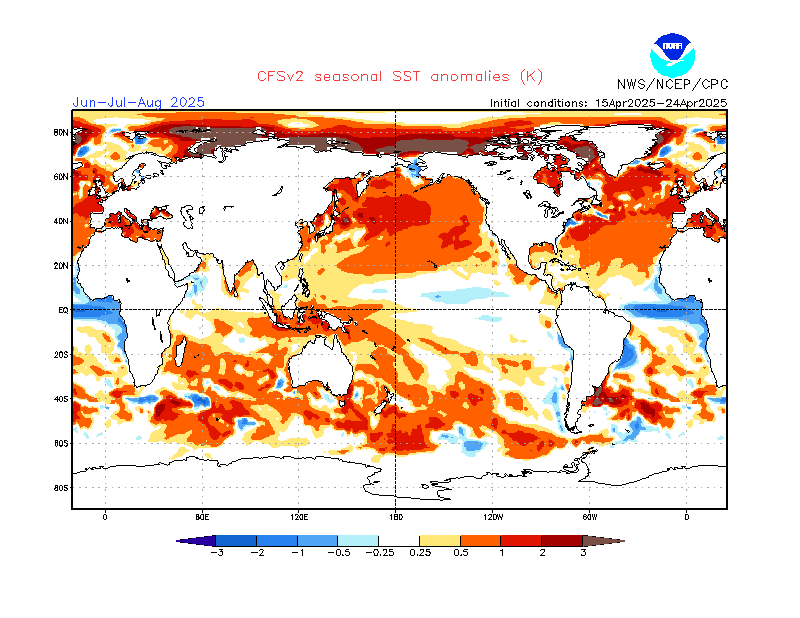
NMME SST ANOMALIES FORECAST (CLICK FOR MORE IMAGES)

ECMWF SEASONAL ANOMALIES FORECAST

CURRENT SST ANOMALIES

Most of the climate modeling indicates the Atlantic is forecast to be warmer over the sub-tropical portion vice the MDR. Most models indicate we may be heading into a colder AMO pattern. This will also have an effect on storm development should it come to fruition. Another condition noted is, models currently have a mixed signal with the Gulf of Guinea and the IOD (Indian Ocean Dipole).
The Gulf of Guinea is the northeastern most part of the tropical Atlantic Ocean from Cape Lopez in Gabon, north and west to Cape Palmas in Liberia.
I am going to forgo going into what the climate models indicate about the Gulf of Guinea forecast temperature anomalies, as they have not panned out over the past few hurricane seasons. I will however state the role played by the Gulf of Guinea. When the Gulf of Guinea is warmer than average/normal (warm anomalies) or a warm neutral, the ITCZ has the tendency to remain further south, (Equatorward) during the season. The heaviest of the SAL outbreaks climatologically occur in the month of July. With the ITCZ further south, it doesn’t extend into the Sahel region of Africa, hence drier conditions and more dust. When the Gulf of Guinea experiences cooler anomalies (colder than normal), it allows for a shift northward in the ITCZ/Monsoon trough, due to the reverse pressure pattern, bringing greater rainfall to the Sahel region, which would aid in a reduction in the SAL.
GULF OF GUINEA
 Another item in the forecast regarding Sea Surface Temperature Anomalies is the IOD (Indian Ocean Dipole). The forecast from climate modeling tends to show the IOD continuing to warm, peaking by, or just before the peak of the season. This would tend to produce a negating factor in hurricane development, as a positive IOD has the opposite effect of a negative IOD phase. During a positive IOD phase, you’ll notice the “Walker” circulation allowing for an increase in convection and rain near east Africa. The rising air causes lower pressure and precipitation at the ocean surface. You’ll see on the eastern side of the circulation, air sinks to the surface, causing higher pressure at the surface and drier conditions. Well, it just so happens, this exact flow happens on the western portion of the circulation. The air rises, and as it reaches the upper portion of the atmosphere, it cools, then begins to sink (higher pressure). As this air in the upper atmosphere sinks, it compresses and heats, drying out the air, hence the “lack” of convection for easterly waves. A negative IOD phase has the opposite effect. As the air “sinks” over the western Indian Ocean, it spreads out over the surface, and across eastern Africa. The pattern then continues with the air “rising” over central Africa, allowing for, or aiding in the formation of convection.
IOD SST ANOMALIES NEGATIVE / POSITIVE

IOD POSITIVE PHASE

IOD NEUTRAL PHASE

IOD NEGATIVE PHASE
 CURRENT IOD FROM BOM, AND NASA GEOS (LINKED)


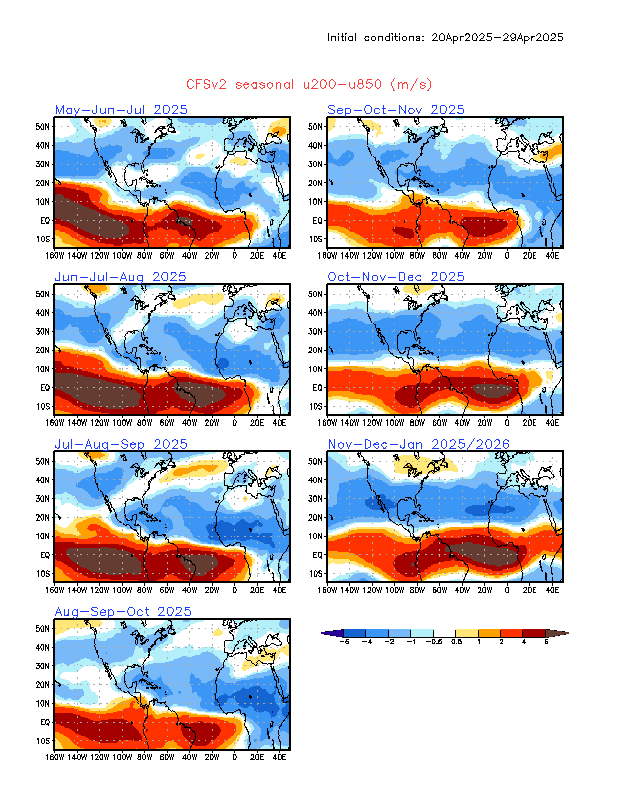
With the forecast of El Nino ENSO conditions, the CFSv2 is showing moderate to strong wind shear over the Atlantic basin (MDR). With the forecast onset of El Nino, wind shear over the MDR should increase, and is another negating factor for the hurricane season.
CFSv2 CURRENT SEASONAL u200 – u850 (WIND SHEAR) FORECAST (LINKED)
Based on analysis of forecast RONI values from the IRI (International Research Institute), which uses 26 different climate models, I came up with the following past hurricane seasons as analog years which have now changed: 1965, 1972, 1982, 1997, 2002, and 2015. This was determined from various Nino forecast plumes and the RONI values and / or value trends based on the average of ALL the climate models, comparing them to the CPC RONI chart, with the years that matched the forecast anomalies, and/or anomaly trends, along with past and current MEI information. The IRI provides an average of the Dynamical models, Statistical models, and an average of ALL 26 models output.
The ONI explained from the site, HDX:
Monthly Oceanic Nino Index (ONI)
The Oceanic Niño Index (ONI) has become the de facto standard that the National Oceanic and Atmospheric Administration (NOAA) uses to identify El Niño (warm) and La Niña (cool) events in the tropical Pacific. It is the three month mean SST anomaly for the El Niño 3.4 region (i.e., 5°N-5°S, 120°-170°W). Events are defined as five consecutive overlapping three month periods at or above the +0.5°C anomaly for warm (El Niño) events and at or below the -0.5 anomaly for cold (La Niña) events. The threshold is further broken down into Weak (with a 0.5 to 0.9 SST anomaly), Moderate (1.0 to 1.4) and Strong (≥ 1.5) events. For an event to be categorized as weak, moderate or strong, it must have equaled or exceeded the threshold for at least three consecutive overlapping three month periods.
HURRICANE PREPAREDNESS GUIDE
https://stormw.wordpress.com/2026/01/13/hurricane-preparedness-information-guide-issued-jan-13-2026-1040-a-m-est/
HURRICANE TUTORIAL ONE: https://stormw.wordpress.com/2026/03/27/hurricane-tutorial-number-one-hurricane-formation-issued-mar-27-2026-1030-a-m-edt/
HURRICANE TUTORIAL TWO: https://stormw.wordpress.com/2026/03/28/hurricane-tutorial-number-two-nhc-informational-videos-issued-mar-28-2026-1040-a-m-edt/
HURRICANE TUTORIAL THREE: https://stormw.wordpress.com/2026/04/20/hurricane-tutorial-three-storm-surge-issued-apr-20-2025-215-p-m-edt/
You may direct any questions this season by contacting me personally, ANYTIME, at: [email protected]
Have a blessed day!
T. F. “STORM” WALSH III
GMCS, USCG (ret)
METEOROLOGIST / HURRICANE SPECIALIST /SEVERE WEATHER SPECIALIST
MEMBER WEST CENTRAL FLORIDA AMS













 English (US) ·
  French (CA) ·