

 3 hours ago
5
PROTECT YOUR DNA WITH QUANTUM TECHNOLOGY
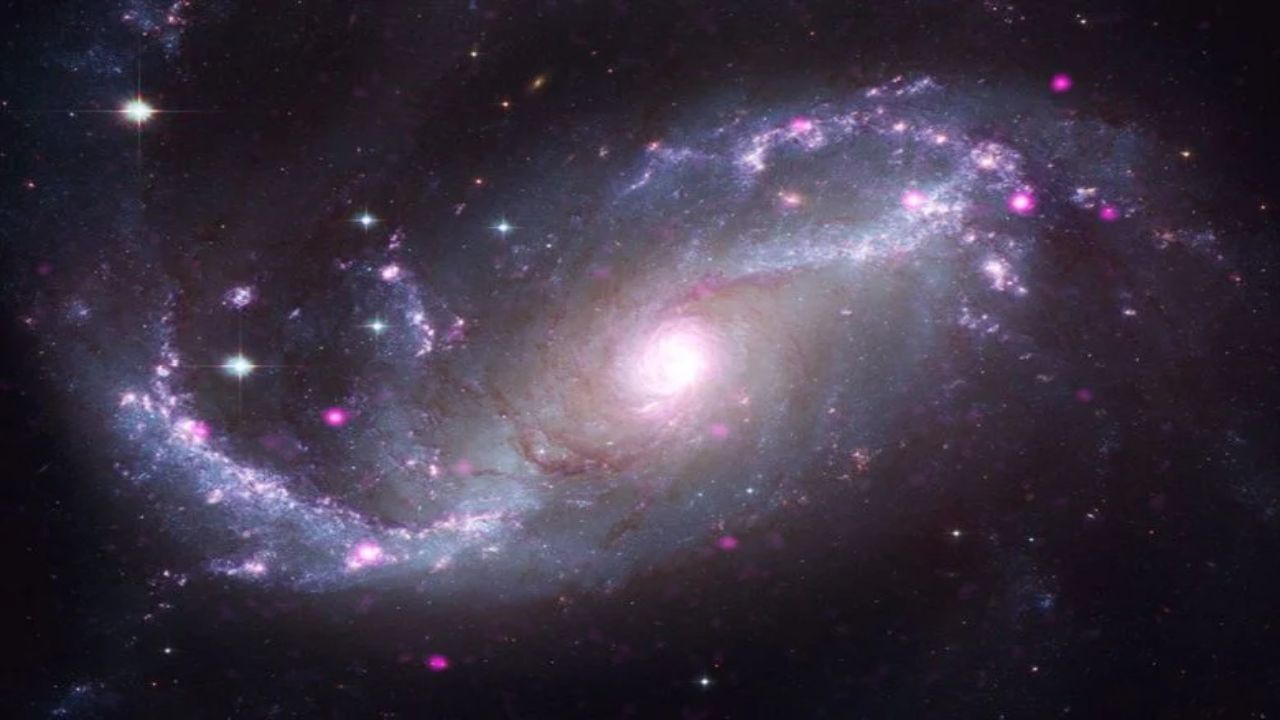
Orgo-Life the new way to the future Advertising by AdpathwayAstronomers studying the galaxy Markarian 501 have found a second, previously unseen jet in its core. They say the jet points to a pair of supermassive black holes orbiting each other roughly every 121 days, close enough that they could merge in as little as 100 years. The finding comes from a team led by Silke Britzen of the Max Planck Institute for Radio Astronomy.
The team first announced the result in April. The study is now listed in the Monthly Notices of the Royal Astronomical Society and has been circulating again this week through ScienceDaily. The second black hole has not been seen directly. Its existence is inferred from the jet's behavior.
If the interpretation holds, it would be extraordinary — a merger on a human timescale. Most supermassive black hole pairs are thought to take millions of years or longer to close in. A collision within one human lifetime would give scientists a rare chance to watch the final stage happen in real time.
A Jet That Kept Moving
Markarian 501, about 464 million light-years away in the constellation Hercules, is a blazar. That means one of its jets points almost straight at Earth, which makes it extremely bright and easy to study, but also hard to look past.
The team analyzed radio observations taken at several frequencies on dozens of days over about 23 years. Hidden in the glare, they found a second jet aimed in a different direction. Over a few weeks, that jet's position shifted. It seemed to emerge from behind the main black hole, sweep counterclockwise around it, and then repeat the motion.
"Evaluating the data felt like being on a ship. The entire jet system is in motion," Britzen said in the institute's announcement. She said the behavior can be explained by two black holes whose orbital plane sways.
A one-day event in June 2022 adds supporting evidence. Radiation from the system appeared to form a ring, which the team interprets as an Einstein ring. That happens when the foreground black hole's gravity bends light from the jet behind it during a brief alignment with Earth.
A Century Instead of Millions of Years
The 23-year record also shows a slower rhythm. Brightness changes repeat roughly every seven years, which the researchers attribute to a wobble of the whole jet system rather than the orbit itself. The faster 121-day cycle is the one they tie to the two black holes circling each other, EarthSky reported.
Each black hole is estimated at 100 million to 1 billion times the mass of the Sun. The team puts the pair about 250 to 540 times the Earth-Sun distance apart, roughly 8 to 18 times Neptune's distance from the Sun.
Theory says pairs like this often get stuck. As two galaxies merge, their central black holes sink together by flinging nearby stars and gas outward. Around a separation of about one parsec, or roughly 3.2 light-years, that process may run out of material, leaving the pair to circle for longer than the age of the universe. This is known as the "final parsec problem."
At no more than about 0.0026 parsecs apart, the proposed Markarian 501 pair would already be past that barrier, ScienceAlert noted. From there, gravitational waves carry away energy fast enough to shrink the orbit quickly. That is why the merger estimate is a century rather than eons. The timeline depends heavily on the black holes' true masses, which are uncertain by a factor of about 10.
Gravitational Waves Could Settle It
A merging pair this large would send out gravitational waves, ripples in spacetime, at extremely low frequencies. Ground-based detectors such as LIGO are built for stellar-mass black holes and cannot hear them. Instead, astronomers use pulsar timing arrays, which track tiny timing shifts in the steady radio pulses of dead stars across the galaxy.
In 2023, the European Pulsar Timing Array and other collaborations reported evidence for a gravitational-wave background. Supermassive black hole pairs are considered the leading explanation for it. Co-author Héctor Olivares said Markarian 501 could be a candidate source. "If gravitational waves are detected, we may even see their frequency steadily rise as the two giants spiral toward collision," he said.
That rising "chirp" would be the clearest confirmation possible. It would also show for the first time how the final stage of a supermassive merger unfolds, a phase current models cannot describe accurately.
The Evidence Check: Promising but Unconfirmed
This is a single team's interpretation of indirect evidence, published in a peer-reviewed journal but not yet independently confirmed. Coverage of the study has described it as not a conclusive detection. The bright blazar makes the core difficult to analyze, and the 121-day period is described as consistent with an orbit, not proof of one.
Other explanations for a jet's wobbling motion exist, including instabilities within a single jet. The team argues that a binary is the most compelling explanation for the full set of observations, but outside groups have not yet tested it with their own data.
No telescope can separate the two black holes directly. Even the Event Horizon Telescope, which imaged the black holes in M87 and the Milky Way, lacks the resolution. Confirmation will depend on continued radio monitoring, a repeat of the lensing signal and, eventually, a gravitational-wave detection.
There is no risk to Earth — none at all. A merger nearly half a billion light-years away would produce waves far too weak to feel. Instruments would register them only as a faint, slow signal.
The bottom line: a hidden jet in Markarian 501 suggests two supermassive black holes may be in a tight, fast orbit that could end in a merger within about a century. It is a prediction built on indirect clues, and pulsar timing arrays and radio follow-up will decide whether it holds.
What Readers Want to Know
What did astronomers find in Markarian 501?
A second radio jet whose repeating motion suggests two supermassive black holes orbiting each other about every 121 days.
When could the black holes merge?
In as little as 100 years, depending on their true masses, which are still uncertain.
Has the second black hole been seen?
No. It is inferred from the second jet's motion and a brief light-bending event in 2022.
Why is a 100-year merger unusual?
Supermassive black hole pairs often stall about a parsec apart for very long periods. This pair appears to be far closer than that, where gravitational waves can shrink the orbit quickly.
How could scientists confirm it?
Pulsar timing arrays could detect its low-frequency gravitational waves, and continued radio monitoring could confirm the orbit.
Is Earth in any danger?
No. The galaxy is about 464 million light-years away.
© 2026 NatureWorldNews.com All rights reserved. Do not reproduce without permission.














 English (US) ·
 French (CA) ·