

 2 months ago
94
2 months ago
94
PROTECT YOUR DNA WITH QUANTUM TECHNOLOGY
Orgo-Life the new way to the future Advertising by AdpathwayThe virus could have appeared in many places on the east coast, but it is a strange coincidence, in the light of later scientific discoveries, that it first became known in the Brisbane suburb of Hendra. The high school is named Aviation High, and the streets are bordered by the international airport and aerospace buildings to the east.
Hendra today is a booming suburb just off the M1 motorway, but for much of the 20th century the neat rows of houses enjoyed pastoral space on the outskirts of the city. When the Eagle Farm Racecourse was built, Hendra became the horse-racing hub of south-east Queensland. It was common to see horse floats parked out the front of the houses, and trainers walking their horses down the streets before daybreak. Over time, the ample paddocks filled with thoroughbreds reared for the tracks. It was in one of these paddocks, in September 1994, that a heavily pregnant bay mare named Drama Series took ill. She was quickly moved to a nursing stable, where she died of a mystery condition.
Within 12 hours, seven more thoroughbred horses in the stable had either expired horrifically or been euthanised.
The animals presented with the same symptoms: fever, facial swelling, respiratory distress, bloodshot eyes, spasms; in some, a bloody froth surged from the nostrils and mouth. The sick horses stumbled around in agony, frantically washing their muzzles in water troughs, or banging their heads on to brick walls. Veterinarians examined the animals and quickly ruled out a list of known exotic diseases in horses, and blood tests precluded any toxins or poisons.
The stable at the centre of the outbreak belonged to a well-known Queensland horse trainer, Vic Rail. As word of the outbreak spread, so did the fear among the racing industry that the illness might jeopardise the entire Australian horse population. Soon, personnel from the state health authorities descended on Hendra hoping to find further clues. They strung up the dead horses and dissected them in the stable’s front yard. Blood ran down the quiet streets of Hendra.
Meanwhile, two people who had treated Drama Series in her final hours had also fallen ill. Rail, the horse’s trainer, died after spending a week in intensive care. His organs had failed, his lungs had filled with fluid and blood, and a later examination determined he had been infected with the same virus as the horses. This was a totally new virus, though it did resemble members of a particular subgroup, the morbilliviruses. It was given the name Hendra virus. Epidemiologists suspected they were looking for a zoonotic disease that had jumped to humans from horses, possibly from a third, unknown species that was the original carrier.
The search for the ‘natural host’
Much less was known at the time about the origins of zoonoses. Unlike today, in the aftermath of the Covid-19 pandemic, bats were not high on the list of potential suspects. Hume Field was one of the scientists who changed that understanding.
When Hendra first hit the news, Field was a lanky ecologist in his mid-30s doing his dissertation in wildlife conservation. He had been catching and tracking feral cats when he was asked by one of his doctoral mentors to join the team working to locate the wildlife origins of the new virus. They were searching for the “natural host”: the organism that carries the pathogen while suffering little or no illness.
Finding these animals can lead virus hunters into mangroves, swamps, woodlands, crop fields, garden sheds, caves, and, as Field was about to find out, horse paddocks. “It really can be a needle-in-a-haystack kind of thing,” he told me when I interviewed him in 2020 about the search for Hendra.
In October 1995 the search took another turn when Mark Preston, a horse owner in Mackay, in North Queensland, died suddenly from an illness with symptoms that matched those seen in Rail. Health authorities learned that two of Preston’s horses had died in August 1994, a month before the first outbreak in Rail’s stables. Blood serum taken from Preston and from the horses were retested. Both contained antibodies to the Hendra virus. So did another sample taken from Preston a year earlier, which had been drawn when he suffered an unexplained episode of seizures. This new case gave researchers more data to work with. The distance between Hendra and Mackay – about 1,000 kilometres – indicated that the virus was carried by a species that could cross vast distances.
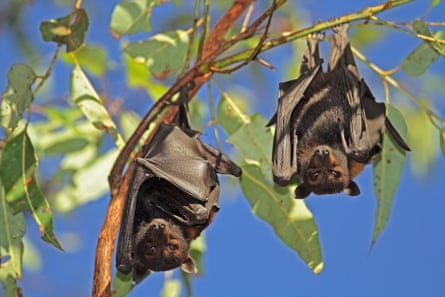
The first antibodies for Hendra were found in black flying foxes in April 1996, and then, within weeks, in three other native Australian flying fox species. Soon after, a Hendra-like virus was taken from the reproductive tract of an apparently healthy, pregnant grey-headed flying fox that had been euthanised after becoming entangled on a wire fence. Armed with these discoveries, researchers tested archival flying fox blood samples from up to a dozen years earlier, and found markers for Hendra. In one of those surveys, nearly half of the flying foxes in eastern Australia were found to be present or former carriers. It indicated that the virus had been circulating in the wild for at least a decade, and probably much longer, before it had spilled over into humans.
Field and I spoke on the phone during Covid-19 lockdown. I called him because I was trying to make sense of our new zoonotic reality and what it might mean for the future. Field’s work on Hendra seemed, in hindsight, like the moment the current coronavirus era began.
Why had the virus only emerged now?
The discovery of Hendra’s origins kickstarted our current understanding of the extraordinary diversity of bat viruses. It was one of the first steps towards learning that some viral groups are widespread in bats without making them sick. With about 1,400 species, bats are the second-largest mammal group behind rodents, and are present on every continent except Antarctica. They live as much as 10 times longer than animals of a similar size, and are also the only mammals that fly, and this is crucial for disease emergence.
Flying foxes are exceptional wanderers. As fruit bats – nectar feeders – they can fly dozens of kilometres each night to feed, and continually move to new feeding grounds through the year. For millennia, these great nomads had chased the seasonal blossoming of the hardwood trees in an unbroken chain of migration that rippled up and down the continent.
But flight, for all bats, radically increases their metabolism and body temperature, up to heights typical of mammalian fever; so if a bat virus spills over to other species, it has been forged in bodies that reach fever temperatures daily, and has thus evolved to withstand one of the primary immune responses of other mammals.
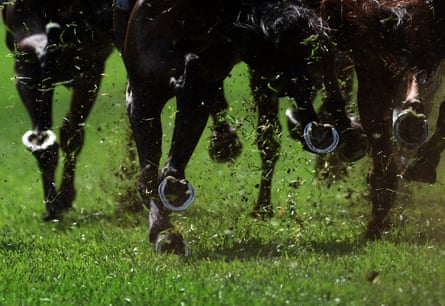
This seemed to be why Hendra was so virulent. After more testing, Field and the other researchers deduced more facts about the disease. So far, no human had caught the virus directly from bats. The horses, scientists reasoned, were acting as an amplifying host – a term for the intermediate link between a natural host of the virus and some other unfortunate animal. In an amplifier host, the virus or other pathogen replicates with extraordinary abundance before it jumps into another creature. This was likely why horse trainers were getting sick, but not wildlife carers who spent years handling flying foxes.
“Disease emergence is all about increased opportunity for contact,” Field said. “It’s all about human impact on the natural system that increases the contact between humans and animals.”
Still, the timing of Hendra’s emergence puzzled those hunting the virus. The ingredients required for Hendra spillover – flying foxes, horses and humans – had coexisted in Australia for centuries, the horses having been the last element to arrive when the English brought them on the First Fleet in 1788. The question for Field, and for others trying to understand Hendra’s leap from bats to humans, was: why had the virus only emerged now?
The answer to those questions could only be found in the eastern forests.
If Hendra ushered in a new understanding of bat viruses, it also revealed their sensitivity to a rapidly changing world. Bats have evolved over millions of years to delicately balance their energy needs within the conditions available to them. This makes them especially vulnerable to environmental change. More than one in five bat species globally are under severe threat from human pressures such as habitat loss and degradation, climate change, overexploitation and disease. Their population numbers and collective health, including the constellation of viruses they carry as a group, respond to these disturbances. Australian flying foxes are no different. The emergence of Hendra virus suggested that something had tipped the ecological balance.
The forest as an inoculation
As more Hendra cases were detected, and public alarm began to grow, it was clear that what had changed drastically were the Brisbane suburbs.
Although it is slightly better known now – especially among disease scientists – Hendra virus didn’t make global news when it emerged.
But in 2011 an unprecedented 18 distinct spillovers more than doubled the number of known incidents to that point. The outbreak demanded an urgent new response.
In a move that was uncommon then – and still is – the government opted to add a bat expert to the health team deployed to Hendra infection sites. This was how, shortly after her 60th birthday, Peggy Eby, a wildlife ecologist at Griffith University who had been studying flying foxes for three decades, began suiting up in protective gear and heading to the scene every time a horse tested positive for Hendra. A typical day might have seen her crawling beneath the fig trees on a small family property searching for bat droppings or half-eaten fruit with tell-tale fang marks, evidence that the bats had been nearby. Over time, Eby noticed that the bat roosts near these sites tended to be newer and smaller than those she was used to seeing in the forests. She sensed this was crucial.
Eby thought the full understanding could only come from widening the search, by looking beyond individual spillover events. It should be possible, she believed, to predict the optimal conditions for Hendra to jump species. If this was understood with enough detail, authorities could warn the public during high-risk periods, or even prevent the virus from making the leap. This was ecological knowledge that could save lives.
Eby cobbled together funding from unusual sources, taking on consulting jobs, such as advising towns whose residents viewed bats as pests. Sometimes she worked for free if there was an opportunity to gather more information. She met like-minded scientists and began to put together a team led by women in the field. Collectively, their data spanned 25 years.
What they found was a story of contrasts. Between 1996 and 2002, there were no Hendra virus outbreaks.
Things started to change rapidly after 2003: the number of urban roosts tripled, and spillovers began to be detected with alarming frequency. To avoid starvation, the bats had adopted a new preference for exotic foods, such as the cultivated non-native plants and weeds found in urban parks and gardens. And more of them now stayed put in these areas year-round.
Eby believed that the virus was being driven out by rapid changes in bat ecology, specifically in the loss of trees that traditionally provided them with food. And there was no shortage of evidence. In the short history of European settlement in Australia, around half the woodlands and forests have been modified or removed for agriculture or urban development. At the turn of the century, the period when things began to change in the researchers’ accumulated data, Australia’s deforestation rate was the sixth highest in the world.
It is no coincidence that, of all places, Hendra virus emerged in Queensland. Nowhere else in the country had seen more of its blossoming native trees removed. For the past 50 years, Queensland has been the land-clearing capital of Australia, and it is presently responsible for some 80% of the trees felled nationally each year – the denuded heart of a global deforestation hotspot. But the decades leading up to the emergence of Hendra were particularly frantic.
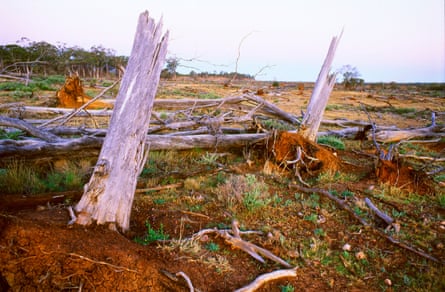
Crucially, for Eby’s research on Hendra, this long history of land clearing has removed the native trees favoured by the bats, and reduced the frequency of the winter blooms that draw them away from humans when other wild food sources are scarce. In some parts of subtropical Australia, more than 95% of their winter foraging area has been destroyed. Only a small fraction of the remainder is protected in conservation reserves. Around Brisbane, native trees had been felled to make way for property development and urban sprawl. But the vast majority of land clearing in Queensland was linked with the beef industry. Seen this way, global commodity markets drive deforestation in Australia, one by-product of which is the spillover of Hendra virus.
At the end of 2022, 10 years after the project began, Eby and her co-authors published a groundbreaking paper in the journal Nature that demonstrated that it is possible to predict the conditions for Hendra virus spillover. They found that the bats responded to the destruction of their habitat and the increasing human footprint by adopting behaviours they would normally use to avoid climate-driven starvation associated with El Niño events. They moved closer to people (and their horses) to survive, but, unlike before 2003, they didn’t return to their large groups in the forest when the food shortage ended. This modified interface between people, horses and bats explain why the disease was being detected with a greater frequency.
What was most exciting about the team’s study was that they found a cause-and effect response that could prevent spillover from happening in the first place.
This discovery came late in their research. In 2019, drought and wildfire decimated the wild food supplies along the bat’s entire range. Eby and her co-authors braced for more infections the following year, but those widespread horse deaths never came. Only one infection was detected.
Getting this so wrong was puzzling – clearly there was something the team had missed. Eby began to wonder about what might be mitigating spillover. In mid-July, she received word that an area around Gympie, a former gold mining town 160 kilometres from Brisbane, had been spared the worst of the weather. About 240,000 flying foxes were roosting in a gully near the town’s hospital. Eby knew immediately that this was significant.
On visiting the camp, the team determined that the bats were drawn to a few nearby patches of forest red gums, a species of eucalyptus that had recently erupted into a massive bloom. With plenty of nectar for the bats to feed on from the fluffy white blossoms, Gympie was spared from the virus.
The findings suggested that planting eucalyptus trees that feed bats in winter, when food elsewhere is scarce, could help prevent spillover by drawing bats from all over the country. When there are rare pulses of flowering in remnant winter habitat, the bats leave the cities and farms, and go back to native habitat. Every time this happened in the 25-year study period, there were no spillover events. A pulse of winter flowers rich enough to draw more than 100,000 flying foxes to an individual roost would substantially reduce the risk of spillover, the researchers concluded. And it is possible that a sufficiently large tract of eucalypts could protect the entire country from the virus.
In this era of hi-tech pharmaceutical solutions, one of the study’s co-authors, Cornell University’s Dr Raina Plowright, believes the approach provides a practical and sustainable solution to preventing spillover at its roots. Restoring winter-flowering trees, she argues, would have a direct benefit to human and wildlife health. The forest itself could act like a broad-scale inoculation.
But convincing studies such as this, requiring long-term dedication and funding, are rare. Studies on the causes of disease emergence far outnumber those that show how spillover can be reversed with ecological solutions. The gap is even more stark outside ecology. After the coronavirus pandemic, efforts to understand the proteins on the surface of the coronavirus – a vital part of vaccine research – have produced tens of thousands of studies. There are far fewer studies on the circulation of the virus among bat populations.
The work is only growing more urgent.
Bats are the most numerous reservoir host on the World Health Organization’s list of pathogens with pandemic potential, which includes Hendra and a related virus named Nipah – a highly deadly pathogen first detected among flying foxes displaced by rapid deforestation in Malaysia, with farmed pigs acting as an intermediary. The work done to identify the environmental origins of Hendra led soon after to the discovery of Nipah, and then to our current understanding of the role of ecological disruption in disease emergence. Cattle ranching – along with soy and palm-oil farming, and logging, mining, and their associated roads – is clearing forests and woodlands worldwide at an unprecedented rate, producing rapid habitat loss and threatening species practically everywhere.
In the meantime, the bats continue chasing floral blooms up and down the Australian coast, along a route they have served with seeds and pollen for thousands of years. They now cross a mosaic of cleared housing plots or bare fields with splintered tree stumps and woodchips mixed with the sodden, churned earth. As they settle into the cities with a rapidly warming climate, they need human help more than ever before.
-
This is an edited extract of Sentinels: When Diseases Spread Between Humans and Animals by Michael Delaney, out on 4 August through Scribe Publications.














 English (US) ·
  French (CA) ·