

 15 hours ago
9
PROTECT YOUR DNA WITH QUANTUM TECHNOLOGY
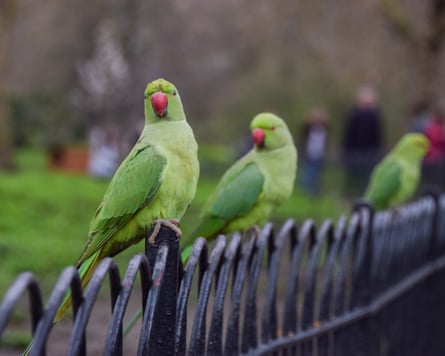
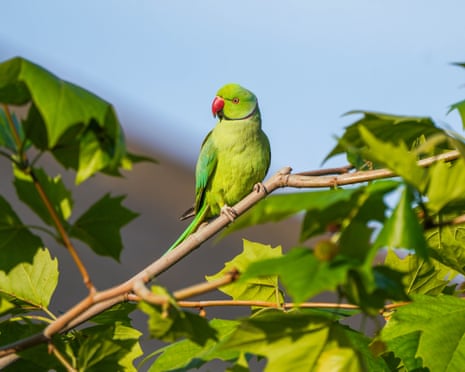
Orgo-Life the new way to the future Advertising by AdpathwayBefore we saw a single parakeet, we heard them: a disembodied static that grew louder as we approached Hither Green cemetery in south-east London. It was an early evening in late June, and we had come to witness an invasion. By the time my friend and I reached the cemetery’s western edge, the clamour was all-encompassing. We hopped the fence and picked our way through the gravestones. Above us now were the birds themselves, their kryptonite-green plumage, scab-red beaks, pearly black collars and trailing tail feathers unmistakable: Psittacula krameri, the ring-necked parakeet.
Hither Green cemetery hosts one of the city’s largest roosts. Every day at dusk, a sizeable chunk of London’s feral parakeet population returns here, to a specific line of poplars. They like to spend the night in the company of their own kind. We watched them come first in ones and twos, and then in larger chirrupping squadrons. Hundreds of them, and then thousands. At maximum capacity, the trees fizzed. Here was a pandemonium, a parakeet concourse. It gave the impression of community, greeting and conversation. “This,” my friend said, “would make a great cheap first date.”
These birds are not from around here. For the past half century or so, the ring-necked parakeet, an arrival from Asia, has been making itself at home in Britain. In that time the population has become genetically distinct from its forebears, an admixture of two subspecies: P k borealis, whose native range spans Pakistan, northern India and Nepal, and east into Bangladesh and Myanmar; and P k manillensis, from southern India and Sri Lanka. Of the two, the boreal is the dominant stock, which might help explain why the birds have taken so well to Britain’s cooler, wetter climate. They are not, as their colour suggests, a tropical species, but creatures of the Himalayan foothills.
Most immediately, they are noisy and they are green. Even after seeing these parakeets all my life, the sheer scale of this gathering in an old, oaky English field still felt like encountering a glitch. Thousands upon thousands of bright-green parrots hanging out in drowsy suburban London, a phenomenon every bit as awesome as a salmon run or a migrating swarm of monarch butterflies. For a metropolitan experience of nonhuman life, it is difficult to think of a more impressive display.
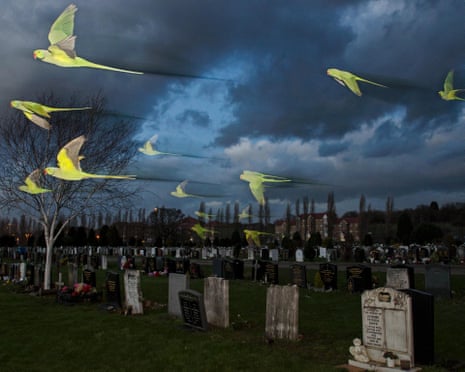
As dusk accelerated, the roost began to quiet, and then, in a single moment decided upon only by the parakeets, it fell silent. The day was flown. Time for bed. My friend and I looked at each other, as if released from a vision. We saw for the first time how the ground had been befouled by their presence. The gravestones, trees and lawn speckled white with uric paste and cottony down.
For all their splendour, the parakeets are a bit of a scandal. Politicians, conservation bodies, land management and the public have all begun to ask: do we want tens of thousands of Himalayan parrots squabbling all over our cities? Across their native range, they are known as a pest. European studies suggest the parakeets have negative impacts on various native bird and bat populations. We know they are a vector for Newcastle disease, a viral ailment that primarily affects poultry, and for Cryptosporidium, a parasite with more general tastes whose characteristic symptom in humans is violent diarrhoea. Though plans for a government cull were allegedly considered in 2021, they were abandoned due to potential expense and general impracticality.
So parakeet numbers keep climbing and their range keeps expanding. An Oxford researcher estimated in 2003 that the Greater London population was growing so rapidly that it would need to be cut by 30% each year just to keep it stable. A 2014 headline in the Northern Echo – “Who’s a chilly boy, then?” – announced their arrival in Scotland. Glasgow is now home to the world’s most northerly wild parrots.
Maybe officialdom doesn’t have the stomach for mandated eradication. Maybe its administrative talents are better suited to finding a workaround. As Hither Green cemetery fell into darkness, central London kept the lights on. Among the corridors and meeting rooms of Whitehall, a change to the law was being discussed. The proposal was a bold one. What if the government didn’t have to kill anything after all? What if we could do it ourselves?
In March, the British government opened a consultation on the quarry list, a catalogue of birds that can be shot in season by anyone with a gun and a landowner’s permission. Most of its proposals would remove or restrict the shooting of declining ducks, geese and waders, but the consultation also invited suggestions for species to add to the quarry list. The British Association for Shooting and Conservation (BASC) duly obliged and put forward 24 birds – the ring-necked parakeet among them.
Legal provisions for the lethal control of parakeets already exist. As an “invasive non-native” species, they can be killed by landowners, provided that the aim is to protect crops or threatened wildlife and that nonlethal methods have proved ineffective or impractical. But quarry status would do away with the need for any such justifications and reorient management away from a defensive posture toward a more general sport-shooting approach. It would allow the public to take matters into its own hands.
How did we get here? How did they get here? How did the ring-necked parakeet become such a common feature of British skies? No one knows. Or not exactly. Origin myths abound: that in 1968 Jimi Hendrix released his pet pair on to Carnaby Street; that in 1951 they escaped from the set of The African Queen; that in the early 16th century they absconded from one of Henry VIII’s royal menageries at Hampton Court. None of these legends stand up to scrutiny: Hendrix’s girlfriend at the time insists the guitarist never owned any parakeets, The African Queen features zero parakeets, and there is no record of parakeets at Hampton Court.
The overwhelming likelihood, according to a 2019 study, is far more mundane. The ring-necked parakeet probably got its start on this island thanks to a steady trickle of runaway pets, deliberate releases and aviary jailbreaks. This is what those who study invasive species call “propagule pressure”: successful invasions tend not to begin with a lone transplant. More often, they are the result of multiple, sustained introductions. In other words, the likelihood that an introduced organism will become established is somewhat determined by how many chances it is given – and we have given parakeets plenty of chances.
Today, parrot keeping is seen as a somewhat niche activity, but this has not always been the case. The British, who during the age of empire rarely denied themselves an acquisitive impulse, shipped literal boatloads of tropical birds back to the imperial nest in the 18th and 19th centuries. By 1895, London had 118 wild-animal shops, which fed a parrot fever (metaphor) that was curtailed only by a parrot fever (real): in 1929 and 1930, an outbreak of a parrot-borne bacterial infection called psittacosis caused widespread alarm. The episode generated Britain’s first parrot-panicked headlines: “Parrot disease”; “Parrot causes man’s death – wife in hospital”; “Don’t kiss ‘Polly’!” The resulting 1930 import ban tanked much of the country’s exotic-bird trade, and one parakeet expert has suggested that fear of the disease might also have caused some to release their birds. Such releases are likely responsible for the parakeets observed in Epping Forest in Essex two years later.
London’s avian founding fathers? Not quite. The Epping parakeets died. So did all the others. Our current abundance actually goes back to Britain’s postwar bird-keeping boom. Between 1947 and 1961, the number of pet birds rose from 600,000 to 11m. By 1971, a self-sustaining population of parakeets had established itself in Croydon. In 1986, Peter Lack’s Atlas of Wintering Birds in Britain and Ireland put the population at about 1,000. The birds soon expanded their range from strongholds in south London and Kent, and estimates in 1997 put the entire UK population at around 3,500 breeding pairs. In the early 2000s, a roost on the grounds of Esher rugby club in Surrey contained about 7,000 individuals, and its collapse (someone felled the trees for reasons no one can quite agree on) is sometimes held responsible for the parakeets’ subsequent dispersal. The most recent official count throughout the UK, in 2016, put their number at 12,000 breeding pairs. Today, 50,000 is commonly cited, including non-breeding individuals, though that may be an underestimate.
This rapid proliferation has prompted more frequent calls for active parakeet management. Leading the charge to bring the parakeet on to the quarry list has been the BASC. The organisation’s opponents have variously accused it of wanting to hunt parakeets for the hell of it, of harbouring a xenophobic animus against these very foreign-looking birds and volunteering too enthusiastically to carry out a private cull. But when we spoke, Conor O’Gorman, the organisation’s head of policy, was keen to emphasise that the proposed change was not about killing for pleasure. What BASC wanted, he said, was to give landowners and farmers a quick legal option when the birds showed up in an orchard or a vineyard. He was careful to insist that this was not about culling the parakeets. “The urban population is here to stay,” he said, and quarry status was insurance against potential rural incursions.
For somebody who has been petitioning the government for more straightforward means to kill parakeets, O’Gorman seemed to like the birds quite a bit. “They’re lovely,” he said, recalling the first time he saw one, at Windsor Castle many years ago. He was even willing to concede that the anti-parakeet brigade might be motivated by prejudice against the exotic. “I can understand the concept,” he said, “that there is this xenophobia underlying the language. That’s something to be conscious of.”
O’Gorman’s candour is disarming, but the solution he advocates would still mean killing thousands of beautiful and increasingly visible birds.
The fix that O’Gorman endorses may sound drastic, but his precautionary principle is shared by invasion biology, the subdiscipline devoted to the study of species transplanted from their native ranges. There is a long history of organisms moved by humans, whether deliberately or inadvertently, wreaking havoc upon their new homes. The brown tree snake, native to Indonesia, northern Australia and Papua New Guinea, was accidentally introduced to Guam by the US military after the second world war and promptly ate its way through 10 of the island’s 12 endemic forest bird species. Nile perch released into Lake Victoria in east Africa by British colonial forces gulped down roughly 200 species of cichlids found nowhere else on Earth. Cane toads in Australia, miconia trees on Hawaii and Tahiti, rats just about everywhere – the list goes on.
If biodiversity loss, however regrettable, seems like an abstraction in the scheme of things, know that human culture frequently suffers direct impoverishment because of invasive species. Chestnut blight, discovered in the US in 1904 after chestnut trees were imported from Japan, effectively deleted the American chestnut tree from the continent; its products were central to the diet and lifestyles of various Indigenous peoples and communities across Appalachia. Phylloxera, an aphid relative, was imported to Europe on American grapevines during the second half of the 19th century. The subsequent infestation resulted in the destruction, by some estimates, of 90% of all European vineyards.
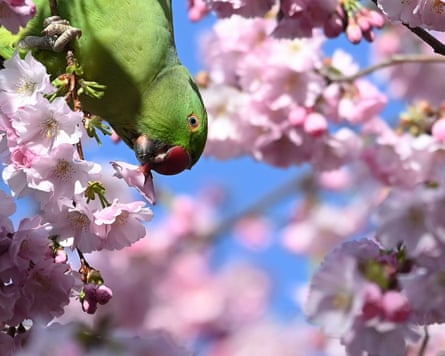
Though the ring-necked parakeet has not yet wreaked comparable devastation, the fear remains that it might one day develop the capacity. Invasion biology uses the term “lag phase” to denote the time between the initial appearance of a non-native species and its maturation into an invasive scourge. Arrivals initially considered harmless may emerge as significant threats when their population reaches a certain size, or as the result of a change in environmental conditions. The Great Britain Non-native Species Secretariat noted in a 2011 risk assessment that parakeets had the potential to be “one of the most destructive bird pests of agriculture”. Their urban concentration has, so far, limited that impact in Britain, but Tim Weston, the director of environment, policy and politics at the National Gamekeepers’ Organisation, told me that they had already become a threat to cherry blossoms in Kent. “We don’t really have another species that eats flowers,” he said. “And, obviously, if a flock of parakeets descends on your orchard and eats all the blossom, well, you don’t get any fruit.”
Then there are the ecological impacts. Evidence from Belgium and Spain suggests that parakeets may outcompete several species, most significantly the Eurasian nuthatch, leading to local declines in areas with large parakeet populations. The concern is that we might, as O’Gorman pointed out, “look back on these things in 20 or 30 years’ time and say: ‘Oh my God, why didn’t we act?’”
From a curiosity to an established presence – one initially thought to be largely benign – the ring-necked parakeet has been recast as a menace, not just responsible for economic damage and ecological disruption but symbolic of our blighted world and symptomatic of our sclerotic inability to arrest its decline. “Parakeets now outnumber native British birds,” warned the Telegraph back in 2008. “Native British birds are so scared of invading parakeets that it’s putting them off their food,” wrote the Daily Mail in 2014. “Invasive parakeets now ‘unstoppable’,” reported ITV News last year.
Despite its invasive status, and for all its supposed crimes, the ring-necked parakeet has found plenty of advocates – and invasion biology its fair share of critics. In the recent Channel 4 documentary Invasion of the Parakeets, the veteran public naturalist Chris Packham argued that much of the case against them was overblown. Packham believes that something simpler is driving the panic: an underlying fear of newcomers stoked by hysterical press coverage. To remove the birds, he concluded, would be ethically dubious, and – now they have established themselves as part of our everyday environment – its own act of eco-cultural vandalism. Should the parakeets one day become a serious threat to agriculture or the environment, their management ought to be humane, and not outsourced to whatever section of the public happens to own suitable firearms.
Flock Together, a bird-watching organisation for people of colour, is even more explicit in linking anti-parakeet sentiment with hostile attitudes toward human arrivals, lamenting in 2021 that the “bitter cocktail of daily microaggressions and institutional insults” suffered by the parakeet would be “a familiar taste to any British citizen with non-white heritage”.
after newsletter promotion
Nick Hunt, the author of the 2019 work of “gonzo ornithology” The Parakeeting of London, refuses these broad positions but nevertheless retains a governing affection for the birds. His book, which grew out of fieldwork conducted from 2015 to 2017, is not even a decade old, but its framing already seems archaic, with Hunt and the photographer Tim Mitchell going on a quest to “track down” the birds. In many cities, tracking them down today requires merely walking up to the nearest tree and tilting your head back.
Since the book’s release, the ring-necked parakeet has become to many something akin to a civic mascot. Parakeets have been the subject of street murals, featured in fiction (such as JB Smith’s story Parakeets of London), and been documented in countless social media posts. One north London pub is even named The Parakeet. “Everything is about diminishment and decline, but the parakeets are thriving, and they’re doing it in style. It’s a joyous thing to witness,” says Hunt. “We shouldn’t only be talking about ‘aliens’ and ‘eradication.’ It’s depressing.” His more profound objection is to the underlying rigidity that governs these terms: “Accepting borders and current ranges as the natural way of things, that they can never change, that they must always be fixed in place – well, it seems, paradoxically, to go against the natural order of things.”
During much of the past three centuries, the introduction of non-native species was not considered a public ill. Domestic rabbits were brought to Australia from England with the first fleet of British settlers in 1788, as pets and food, although the problems didn’t begin in earnest until 1859, when rangier, cannier wild rabbits were introduced as game. By 1879, they had multiplied to such biblical proportions that farmers were abandoning their properties, the grazing stripped to the last shoot. In an attempt to control the plague, cats, ferrets and mongooses were introduced. As noted by Daniel Simberloff, a professor of environmental science at the University of Tennessee, none of these predators successfully reduced rabbit numbers, and several went on to further devastate the native biota.
Alongside imperial follies, the prime offenders when it came to disastrous introductions of non-native species were groups known as “acclimatisation societies”. These were initially a French phenomenon: the Société zoologique d’acclimatation was founded in 1854, and versions modelled upon it soon sprang up in the US, Russia, Germany, England and Australia. These institutions carried out hundreds of introductions, often with some vague pretension to “improve” the local environment – to correct a perceived lack of proper produce or control some insect. Some initiatives were even more dunderheaded. America, for example, may owe its 200m-plus starlings to the New York pharmacist Eugene Schieffelin, who as chair of the American Acclimatization Society released a few dozen of them into Central Park in 1890 and 1891, supposedly as part of an attempt to introduce every species mentioned in the works of Shakespeare. By the early 20th century, most of the acclimatisation societies petered out – or, sometimes, transformed into more modern environmental organisations. Australia’s Acclimatisation Society of Victoria became, for example, Zoos Victoria, which has had notable conservation successes with endangered bandicoots and frogs.
Invasion biology has long made use of a troubled vocabulary – terms such as “exotic”, “kill on sight” and “biological pollution” – and wrestled with the ideology that categories such as alien, native and pristine would seem to confer. Although its origins go back far earlier, invasion biology did not properly coalesce until the early 1980s. The discipline has been debating its own ambiguities ever since. Movement of species is a nebulous concept, given that species have, obviously, always moved around. What’s the baseline? Can a species such as the Australian dingo, introduced by an unknown, ancient maritime people about 5,000 years ago, achieve nativeness? And, to return to Hunt’s point, what does it mean to describe nonhuman species with language akin to that used by some of our most hateful politicians for human migrants?
In 2011, long-simmering arguments within the discipline went mainstream (sort of) when the Macalester College professor of biology Mark Davis, along with 18 signatories, published a paper in the journal Nature titled: “Don’t judge species on their origins”. Davis wrote that the “practical value of the native-versus-alien species dichotomy in conservation is declining, and even becoming counterproductive”. Nativeness, in his view, is a flawed concept. He pointed out that many introduced species brought substantial benefits and that “the insect currently suspected to be killing more trees than any other in North America is the native mountain pine beetle”. Davis called for an interrogation of the field’s conspicuously militant mindset and concluded that it was “time for conservationists to focus much more on the functions of species, and much less on where they originated”.
Simberloff, the University of Tennessee professor, quickly marshalled a rebuttal against what he saw as a dangerous revisionist position. He and his 141 signatories accused Davis of attacking two straw men: first, most invasion biologists did not “oppose non-native species per se”, only those identified as threats by the Convention on Biological Diversity. Second, they had not ignored the potential benefits of non-native species; they recognised that many introductions curtailed erosion, provided food and contributed other useful ecological services. “Nobody tries to eradicate wheat,” he pointed out.
Simberloff also accused Davis and his allies of downplaying the severe impact of non-native species. The public, he said, should remain “vigilant of introductions and continue to support the many successful management efforts”. The battle lines were drawn, and drawn they remain. Today, public, governmental and institutional approaches tend to side with Simberloff. But a cohort of writers, academics, conservationists and activists has remained critical of invasion biology’s core doctrines.
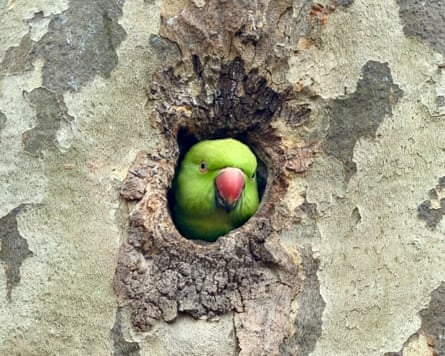
The botanist Ken Thompson is one such dissident. His popular-science book Where Do Camels Belong? argues that demonising any species that comes from “somewhere else” is a waste of resources, and that nativeness is a concept fraught with contradiction. In his view, invasion biology has left little room for nuance. Take the zebra mussel, which arrived in North America via ballast water sometime in the 1980s and proceeded to attach itself to any hard surface it could find, clogging pipes, threatening local bivalves and by one estimate costing the public more than $1bn a year. That sounds bad, but Thompson also points to the US Army Corps of Engineers’ Zebra Mussel Research Program, which has reported increases in water clarity, aquatic plant abundance and provision of food for birds and fish, all courtesy of the mussel. Thompson is all for sensible precautions. But, he told me, the official invasion biologists’ position was ideological, not scientific. “It’s not about facts. It’s about their beliefs that aliens are, by their nature, bad.”
Are the parakeets “bad”? It depends on whom you ask. To fruit farmers, they are a growing pest. To nuthatches, they are a potential nest thief. But to many members of the public, they are a welcome addition to otherwise grey cityscapes and a reminder – more benign than, say, tick-borne steak allergies – of our changing world.
That they readily occupy this ambiguous position is in some way a testament to the weaknesses inherent in invasion biology’s categorical thinking. Its traditionalists have doubled down on blanket labels such as “native” and “invader”, unable to admit more apt designations such as “harmful to human interests”. Despite the destruction caused by some invasive species, and despite the real need to mitigate their impacts, the notion of a pristine past, free of human influence and its degradations, is an attitude that places us firmly – and ahistorically – outside the nature that invasion biology seeks to preserve. As Thompson notes, an incomplete list of culinary plants introduced to Britain by the Romans would include (deep breath): lentil, medlar, pear, almond, peach, garlic, onion, shallot, leek, cabbage, cucumber, lettuce, turnip, radish, asparagus, rosemary, thyme, basil, walnut, sweet chestnut, grapes, mulberry and apples that (unlike the native crabapple) are actually nice to eat. Most of these your average subject of the crown would defend as traditionally British. Leeks, for example, are the national symbol of Wales.
In August, I met up again with the friend who had accompanied me to Hither Green cemetery. This time, we took a walk through Kensington Gardens, its grass bleached yellow by the summer’s relentless heatwaves. Here, on the western bank of the lake, stands a bronze statue of Peter Pan, in the vicinity of which the parakeets are tamer than elsewhere. If you bring an apple, or some nuts, they will even eat from your hand.
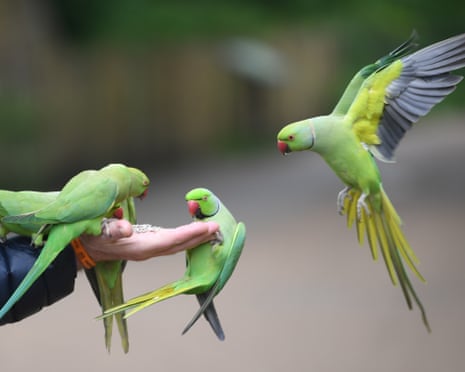
“So did you work out if we should kill them all or not?” my friend asked. The parakeets hopped from branch to branch in the surrounding trees, squawking and cocking their heads to see what we had brought them.
I said I thought a better question might be: “What do we want?” It might not be any easier to answer, but it was a way to gesture at the inevitability of human intervention and the responsibility it entails.
“You’ve become a parakeet centrist,” he replied. Maybe so. Maybe parakeets, with their chirpy evasion of worldly prejudice, are poor candidates for either condemnation or absolution. It is people, not the birds, who must be accountable for their environment. “It’s funny,” my friend said. “I believe all that stuff you just said, but I never really think about them. They’re here now. I can’t really imagine life without them.”
I was reminded of something Hunt told me: when he last visited the Peter Pan statue, he saw a woman watching the parakeets. Eventually, he approached her and learned she was a tourist from the Gulf states. “They’re lovely,” she remarked. “It’s so nice to come here and see them in their natural habitat.”
A longer version of this article original appeared in the Baffler magazine.












 English (US) ·
 French (CA) ·