

 2 months ago
89
2 months ago
89
PROTECT YOUR DNA WITH QUANTUM TECHNOLOGY
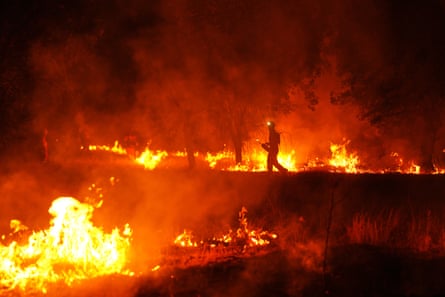
Orgo-Life the new way to the future Advertising by AdpathwayNearly 4,000 people have been evacuated from tourist sites on France’s Atlantic coast as the return of winds and extreme heat jeopardises firefighters’ battles to contain wildfires raging in France and Spain.
The precautionary evacuation order in France, which covers campsites, holiday villages and other tourist accommodation around the resort of Lacanau to the west of Bordeaux, exacerbated a wildfire emergency described by the French president, Emmanuel Macron, as the “toughest” situation the country had dealt with since the second world war.
On a visit to a crisis centre in Bordeaux on Tuesday, Macron warned that “the coming weeks will be tough and we have to hold out”.

In Spain, meanwhile, a woman who had been injured in a wildfire in the southern province of Almería this month died in hospital, bringing the death toll from that blaze to 14.
The woman, who was not named, died at Seville’s Virgen del Rocío university hospital where she had been treated since suffering severe injuries in the wildfire, a hospital spokeswoman told AFP, without giving further details.
In France,Rémi Lassoureille, a fire commander in the Gironde department, was quoted by Le Monde as saying that the blaze there, which has destroyed 42,000 hectares (104,000 acres) of forest, was “relatively under control”, although firefighters feared a “potential flare-up of the fire on its north-west flank towards Lacanau”.
“That is why we decided to evacuate the campsites,” he said.
Other large fires have been contained in the nearby Landes, where thousands of evacuees were allowed to return home, and the Écrins massif in the French Alps, although one in the Gros Bessillon massif in the Var area of south-east France has not yet been fully brought under control.
Wildfires in France, Spain and Italy have forced the evacuation of about 330,000 people over the past week, with Spain entering Europe’s fourth intense heatwave of the summer attempting to contain some of the worst forest fires in the country’s history.
The Spanish prime minister, Pedro Sánchez, said the country faced “difficult hours, complex hours” before the new heatwave, which is forecast to begin on Wednesday. He later said authorities were beginning to “see light at the end of the tunnel in the fight against wildfires”, while warning about the urgency of responding to the climate emergency.
A fire in the hilly terrain of Ávila, west of Madrid, has become Spain’s largest on record, burning 50,000 hectares.
A firefighter, Javier García, told Associated Press he had never faced anything like it in his two decades protecting woodlands and rural communities.
“This doesn’t have a precedent,” he said, adding that the ferocity of the wildfire was forcing firefighters to fundamentally change their tactics by prioritising evacuations and property protection because of the danger from fast-moving walls of flames and blazes too powerful to attack directly.
“The evolution is alarming,” García said.
An EU spokesperson Anna-Kaisa Itkonen said a number of firefighting planes and helicopters from member countries had been deployed to France and Spain.
She said it was “important to clarify that no country can maintain alone all the resources that are needed to tackle every possible natural or other disaster and crisis”.
EU officials have said wildfires could still be burning until early November in what threatens to be a record-breaking year of burnt land area.
after newsletter promotion
Wildfire weather across the bloc has been more severe this year than ever before, according to data up to 22 July from the European Forest Fire Information System. In France, which had broken its full-year record for burnt area by then, and in Spain, the cumulative numbers of fires in 2026 have also set new records.
European wildfires have struck at the same time as ferocious North American ones, with hundreds of blazes continuing to devastate the western US and swathes of Canada. Meanwhile, torrential rains have flooded countries across Asia.
“The climate alarm is blaring, from every direction,” Simon Stiell, the executive secretary of UN Climate Change, said on Tuesday. With Europe now facing another heatwave, he said the human and economic costs of the climate crisis were reaching “national emergency” levels.
“These spiralling disasters are now the lived reality for billions in a world getting rapidly hotter, as humanity moves too slowly from fossil fuels to clean energy and to protect forests,” he said.
Western Europe had a wet winter and also, in some parts, a wet spring, which encouraged heavy plant growth. It has been followed by a dangerously hot and dry summer, with back-to-back heatwaves forcing moisture from plants and leaving behind a surplus of fuel that has fed the flames.
The climatic drivers have been made worse by the long-running abandonment of farmland that used to fragment the landscape, preventing small fires from growing into blazing infernos.
“If the issue of fuel load isn’t addressed, I think we’re going to have to get used to [fires too strong to put out],” said Dr Jesús Notario del Pino, a soil scientist at the University of La Laguna in Tenerife. “As many forestry specialists and engineers often say: what we don’t manage, the fire will.”
Dr Thomas Smith, a wildfire scientist at the London School of Economics, said: “If I was holidaying on the coast of Spain or the south of France, I would make sure I have any fire alerts or fire weather apps installed on my phone and familiarise myself with the evacuation plans for the hotel or residence. It’s very important to understand that timely evacuation saves lives.”
The June heatwave would have been “virtually impossible” without the added heat from more than a century of carbon pollution, a rapid analysis found last month, while the level of soil dryness in western Europe was made five times more likely by climate breakdown, according to a separate study from the same international research network last week.
Estimates of the death toll from the heatwaves, from national public health agencies and independent scientists, suggest they have claimed at least 10,000 lives.
Stiell said: “The science on the cause is unequivocal: global heating, driven by humanity burning colossal amounts of coal, oil and gas, is making protracted heatwaves, severe floods and violent mega-storms more frequent, more intense and more costly.
“What needs to be done is equally clear: leave coal, oil and gas behind faster, scale up renewables, and protect people where the impacts are already hitting hardest.”















 English (US) ·
  French (CA) ·