

 3 months ago
102
3 months ago
102
PROTECT YOUR DNA WITH QUANTUM TECHNOLOGY
Orgo-Life the new way to the future Advertising by AdpathwayLiedson Carneiro, Southwestern Oklahoma State University, discusses his article: Structural differences in individual pollinator networks across bee species reveal the importance of population-level processes in the assembly of species interactions
Plant–pollinator interactions are often described as networks; plant species are connected to pollinator species through their visits to flowers. This approach has advanced our understanding of ecological communities and helped reveal the underlying blueprint of species interactions. It has also shown that many plant–pollinator communities are highly generalised: many pollinators visit multiple plant species, and many plants receive visits from multiple pollinators.
Although these networks are often represented as “species interaction networks”, they usually aggregate information from interactions involving many individual insects and plants. As a result, species-level networks may hide important information about individual foraging decisions, the drivers of those decisions, and how they may shape the assembly and organisation of entire communities. To address this, our study asked what happens when we zoom in and describe plant–pollinator interactions not only at the species level, but also at the level of individuals.
To explore this question, we studied a diverse serpentine seep plant community at McLaughlin Natural Reserve in northern California. These communities are rich in co-flowering plants and flower-visiting insects during a short flowering season. Instead of relying on observed visits, we used pollen carried on insect bodies as a record of plant–pollinator interactions. We sampled over 500 individual insects, and each one carried a small history of its recent foraging activity.
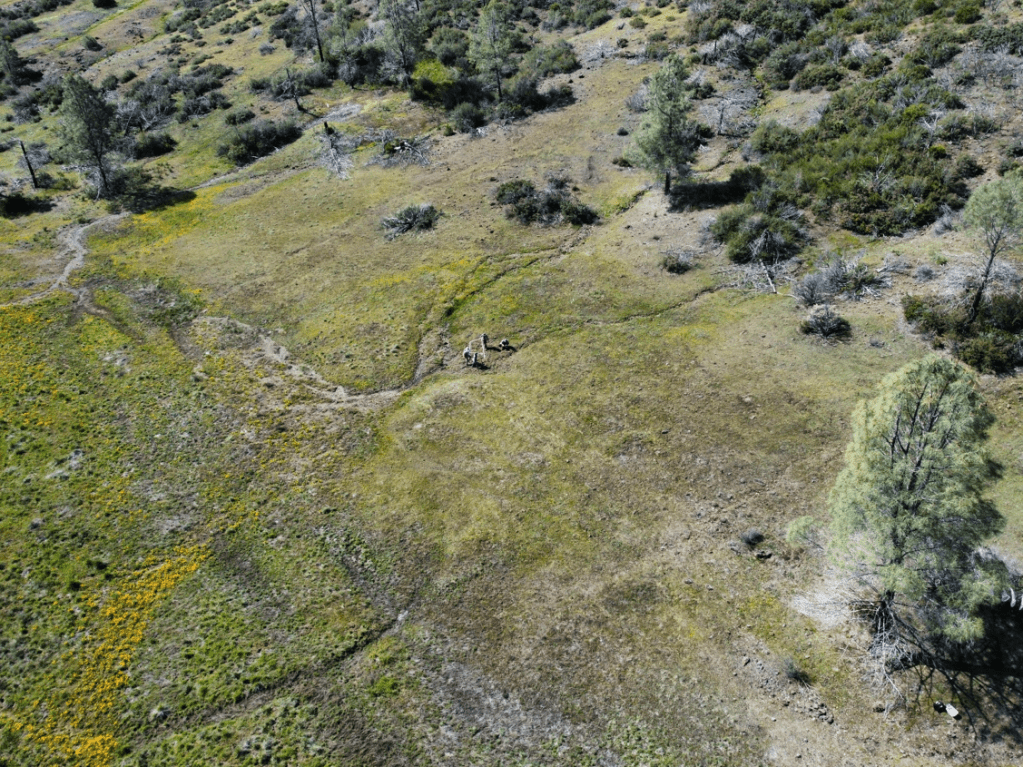 Aerial image of the serpentine seep community at McLaughlin Natural Reserve, northern California, United States. Our research group can be seen working on the seeps in the centre of the picture. Photo by Daniel Barker.
At the individual level, a striking pattern emerged: individual pollinators were much more specialised than if they were simply random samplers of their species’ overall diet. In other words, a pollinator species may appear generalised when all individuals are pooled together, but each individual may forage on a much smaller subset of the flowers used by the species as a whole.
This helps clarify an apparent paradox in pollination ecology. Plant–pollinator communities are often described as generalised, yet many individual pollinators can show strong preferences for, or repeatedly use, particular floral resources. Our results suggest that both views can be true at the same time. Generalisation and specialisation can occur at different levels of biological organisation.
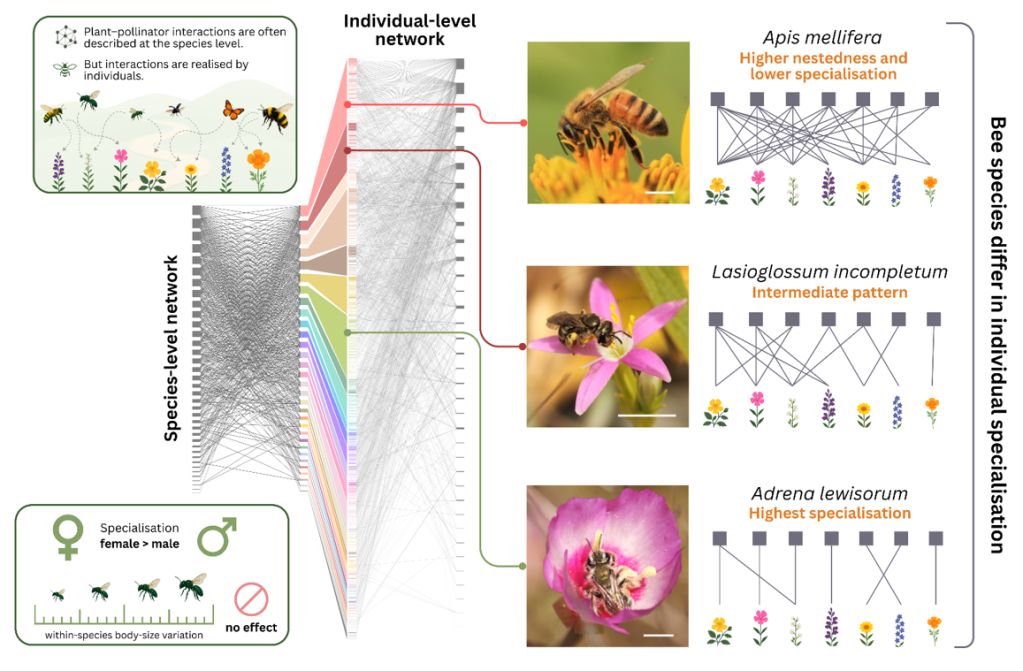 Graphical abstract showing the overall idea and findings of our study. Photos by Laura Russo.
We also found that not all pollinator species produced the same individual-level pattern. Honey bees showed a more nested and less specialised structure, suggesting greater overlap among individuals in the flowers they used. In contrast, mining bees showed the highest level of individual specialisation, with individuals forming stronger associations with fewer plant species. Sweat bees showed an intermediate pattern, reinforcing the idea that different population-level processes, such as niche redundancy and niche divergence, contribute to the structure of species-level plant-pollinator interactions.
These differences matter because they may influence how effectively pollen is transferred. If individuals repeatedly visit a narrow set of plant species, they may transfer more conspecific pollen and reduce pollen loss or heterospecific pollen interference. If individuals overlap strongly in their floral resource use, this may contribute to network robustness, but could also increase pollen mixing among plant species.
Finally, we found that female bees were more specialised than males, providing evidence that sex-specific behaviour can shape ecological interactions. This may be specifically important in bees since males and females often use flowers differently.
By looking more closely at individuals, we can better understand how ecological networks are assembled. The next challenge is to connect these individual-level interaction patterns with ecological function: not only who interacts with whom, but how these interactions affect plant reproduction and the resilience of diverse communities.













 English (US) ·
  French (CA) ·