

PROTECT YOUR DNA WITH QUANTUM TECHNOLOGY
Orgo-Life the new way to the future Advertising by AdpathwayBlack birds with yellow beaks are some of the most striking and easily recognizable birds in the world. The dramatic contrast between glossy dark feathers and a bright, often golden beak makes these species stand out in forests, wetlands, cities, and coastlines alike. Beyond their appearance, these birds are fascinating for their intelligence, adaptability, vocal abilities, and important roles in ecosystems. From the familiar blackbird in European gardens to tropical species found only on remote islands, black birds with yellow beaks capture human attention across cultures and continents.
Why the color contrast matters
Coloration in birds is never random. Black feathers can serve several purposes: they may help with camouflage in shaded environments, absorb heat efficiently in cooler climates, or signal dominance and health to potential mates. Yellow beaks, on the other hand, are often linked to diet and fitness. In many species, a brighter yellow beak indicates good nutrition and strong immune health, making the bird more attractive during mating season.
This bold color contrast also helps birds recognize one another. In dense foliage or crowded colonies, a bright beak can act as a visual signal during courtship displays, feeding interactions, or territorial disputes. For humans, it makes these birds especially easy to identify, even from a distance.
Black birds with yellow beaks
Common Blackbird

The Common Blackbird is the quintessential “black bird,” but its simplicity is its most striking feature. The adult male is draped in solid, coal-black plumage that carries a subtle, velvety sheen, making it look as though it has been carved out of obsidian. This dark canvas serves as the perfect backdrop for its most famous accessory: a vivid, bright yellow-to-orange bill.
To complete the high-contrast look, the bird also features a matching yellow eye-ring, which gives it a bright, alert expression against its dark feathers. Interestingly, this iconic look is reserved specifically for the males; females and juveniles are a more camouflaged, streaky brown, lacking the “sunshine-on-shadow” contrast that makes the male Common Blackbird so easy to spot in a garden or forest.
Common Hill Myna
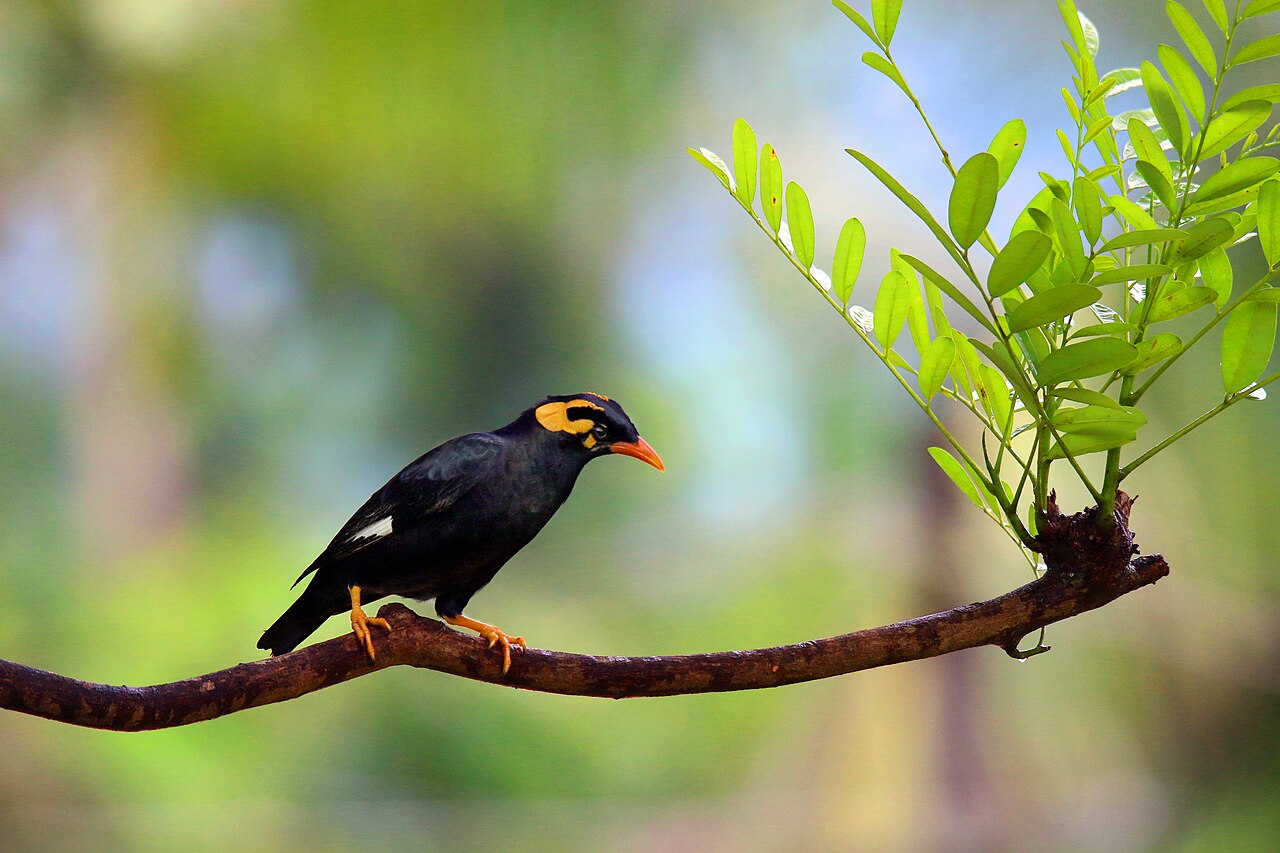
The Common Hill Myna takes the “black and yellow” aesthetic and gives it a glossy, high-fashion upgrade. Its plumage is not just black, but a deeply iridescent, oily purple and green that shimmers like polished metal when it catches the light. This dark, lustrous body is set off by a bright orange-yellow bill that is heavy and slightly curved, designed for plucking fruit.
However, its most flamboyant feature is the bright yellow wattles—strips of bare, fleshy skin that wrap around the back of its head like a pair of golden ribbons. These wattles, combined with the yellow bill, create a bold “splashed” effect against the dark head, making the Hill Myna look far more ornate than the understated Common Blackbird.
Yellow-billed Chough

The Yellow-billed Chough (also known as the Alpine Chough) is the high-altitude specialist of the “black-and-yellow” group, carrying this color palette to the literal roof of the world. Its plumage is a dense, uniform jet-black with a metallic greenish sheen that helps it absorb heat in the thin, cold mountain air. Against this dark silhouette, its short, bright lemon-yellow bill is a sharp, vibrant contrast.
Unlike the Common Blackbird or the Hill Myna, the Chough adds a third color to the mix: vivid red legs, which provide a surprising splash of heat against the snow and gray rock of its alpine home. This bird is a master of the air, and seeing that yellow bill lead the way as it performs high-speed acrobatics above the tree line is one of the most iconic sights of the Himalayas and the Alps.
European Starling

The European Starling puts a complex, “maximalist” spin on the black-and-yellow theme. While it appears as a solid black bird with a bright lemon-yellow bill during the spring breeding season, a closer look reveals a kaleidoscope of color. Its feathers are not merely black but are drenched in an intense iridescence, shimmering with oily purples, greens, and bronzes that shift as the bird moves.
This metallic sheen is often punctuated by tiny white or cream-colored “stars”—the tips of its feathers—which give the bird its name. The yellow bill is a key signal of the breeding season; as summer fades, the bill actually changes color, turning a dark, sober black for the winter months.
Regent Bowerbird
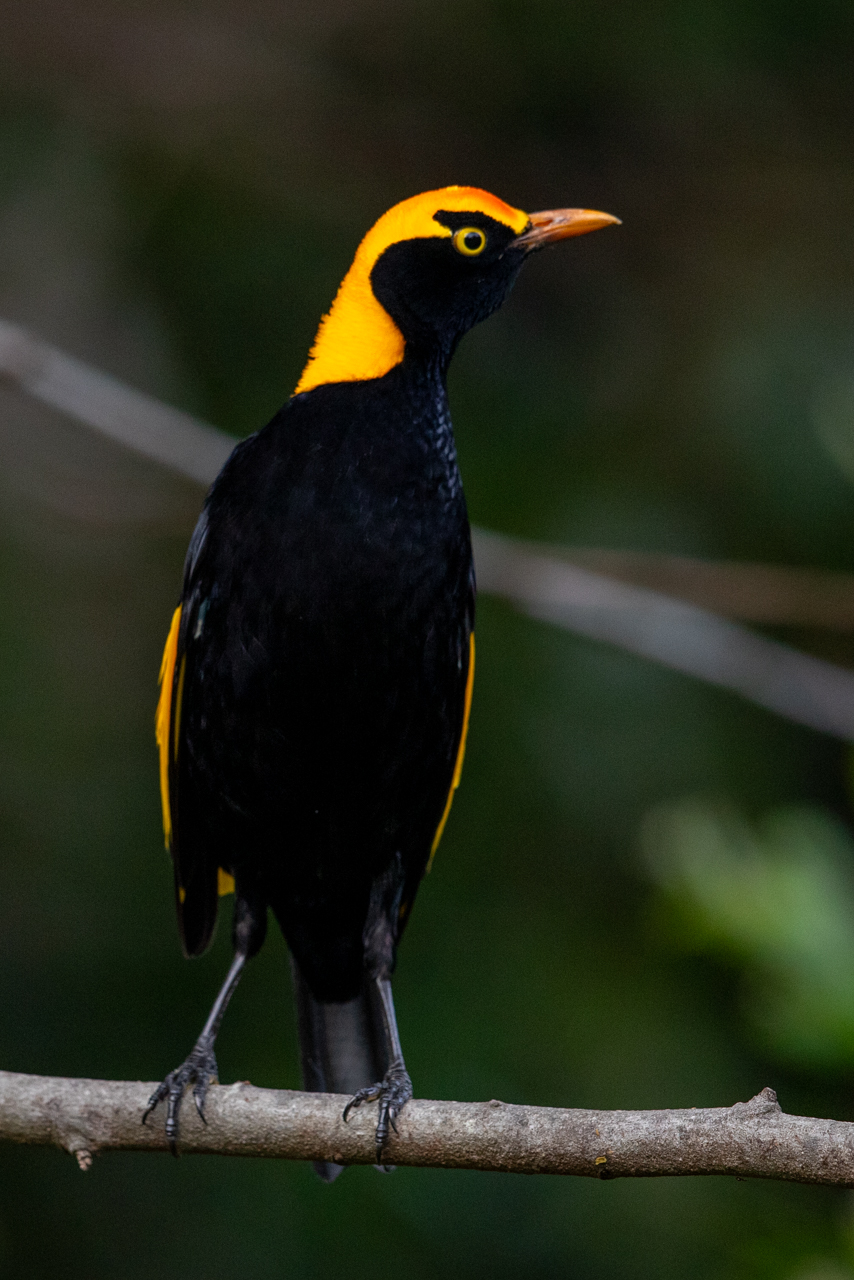
The Regent Bowerbird is arguably the most spectacular member of the “black and yellow” club, looking less like a backyard bird and more like a piece of molten gold dropped onto a shadow. The male’s plumage is a masterclass in high-fashion contrast: his back and wings are a blindingly bright, velvety yellow, while his head, throat, and tail are a deep, shimmery jet-black.
This isn’t just a simple bill-and-feather combo; the yellow on his wings is so saturated it can appear almost orange in deep forest light. To finish the look, he sports a piercing yellow eye and a yellowish-horn bill, making him one of the most visually arresting birds in the Australian rainforest.
Behavior and intelligence
Many black birds with yellow beaks belong to bird families known for intelligence and complex behavior. Blackbirds, mynas, and choughs all show problem-solving skills, social learning, and adaptability. They can learn new feeding strategies, recognize individual humans, and adjust quickly to changes in their environment.
Vocal communication is another standout trait. While not all of these birds mimic sounds, many have rich and varied calls. Songs may be used to attract mates, warn rivals, or coordinate group behavior. In urban environments, some species have even altered the pitch and timing of their songs to compete with traffic noise.
Diet and ecological role
Most black birds with yellow beaks are omnivorous. Their diet may include insects, worms, fruit, seeds, small reptiles, or scraps of human food. This flexibility helps explain their success in both wild and urban habitats. By feeding on insects, they help control pest populations. By eating fruit and dispersing seeds, they contribute to plant regeneration and ecosystem health.
In coastal and marine environments, seabirds with yellow beaks play a role in nutrient cycling. Their droppings, known as guano, are rich in nitrogen and phosphorus and help fertilize island ecosystems.

Cultural significance
These birds have long appeared in folklore, poetry, and symbolism. In European literature, the blackbird is often associated with dawn, song, and quiet reflection. Its presence in gardens has made it a symbol of everyday beauty and resilience. In parts of Asia, mynas are admired for their intelligence and speech, sometimes regarded as clever tricksters.
At the same time, some species have complicated relationships with humans. Invasive populations of mynas can outcompete native birds, leading to ecological imbalance. This dual role—as admired companion and ecological challenge—highlights how powerful and adaptable these birds can be.
Conservation and challenges
While some black birds with yellow beaks are abundant, others face serious threats. Habitat loss, climate change, pollution, and illegal wildlife trade have all taken a toll. Species like the hill myna have seen population declines due to trapping and deforestation. Conservation efforts now focus on habitat protection, legal enforcement, and public education to reduce demand for wild-caught birds.
Urban-friendly species such as the common blackbird show that coexistence with humans is possible, but even they are affected by pesticide use, window collisions, and loss of green spaces. Protecting these birds often means protecting entire ecosystems, which benefits many other species as well.

Final Thoughts
Black birds with yellow beaks are more than just visually striking animals. They are singers, survivors, mimics, and key players in the environments they inhabit. Their bold appearance reflects equally bold personalities—intelligent, adaptable, and often surprisingly social. Whether seen hopping across a garden lawn, calling from a forest canopy, or soaring above ocean waves, these birds remind us how color, behavior, and ecology come together in the natural world. By appreciating and protecting them, we preserve not only their beauty but also the balance of the ecosystems they help sustain.
















 English (US) ·
  French (CA) ·