

PROTECT YOUR DNA WITH QUANTUM TECHNOLOGY
Orgo-Life the new way to the future Advertising by AdpathwayBug of the Week is written by "The Bug Guy," Michael J. Raupp, Professor of Entomology at the University of Maryland.
June 22, 2026
Last week while tidying up a basement walkout, a colleague discovered a gorgeous and very pregnant black widow spider attempting to escape her broom. Fortunately, my colleague did not freak out and punish the spider. After glamming for the camera for a while, the widow casually strolled into a capture jar held by the dauntless homeowner. This beauty, named Lola, enjoyed a photo shoot and will soon be joining her cousins as a full-fledged member of the Insect Petting Zoo at the University of Maryland. Another name for these creepily beautiful arachnids is ‘hourglass spiders’ due to the bright red hourglass-shaped mark on the underside of the abdomen of some species.
What a surprise! A gorgeous female black widow spider making a basement walkout her home. After glamming for the camera for a few moments, she readily investigated a capture jar held in the steady hands of stout-hearted Dr. Shrewsbury. This beautiful spider, now christened Lola, will join more than a hundred of her arthropod kin in the insect petting zoo at the University of Maryland, College Park.
The black widow is arguably one of the most interesting characters in Marvel Comics pantheon of heroes and one of the most dangerous groups of spiders in the United States. The widow’s venom contains a very potent neurotoxin, alpha-latrotoxin. A measure of the toxicity of alpha-latrotoxin, an LD50 of 20 – 40 micrograms per kilogram of body weight, puts it right up with some very deadly snakes. Fortunately, widows do not always inject venom when they bite and even if they do, the quantity is exceedingly tiny. There are five species of widows in the United States, three native species and two non-native species, and they are found in every state except Alaska, but mostly in southern and western states. Widows spin loose webs in protected places such as under logs, stones, or boards, and in angles of windows and shutters. They are commonly found in dumps and in rural areas such as farms and plant nurseries where they frequent barns, sheds, outhouses, and equipment storage areas.
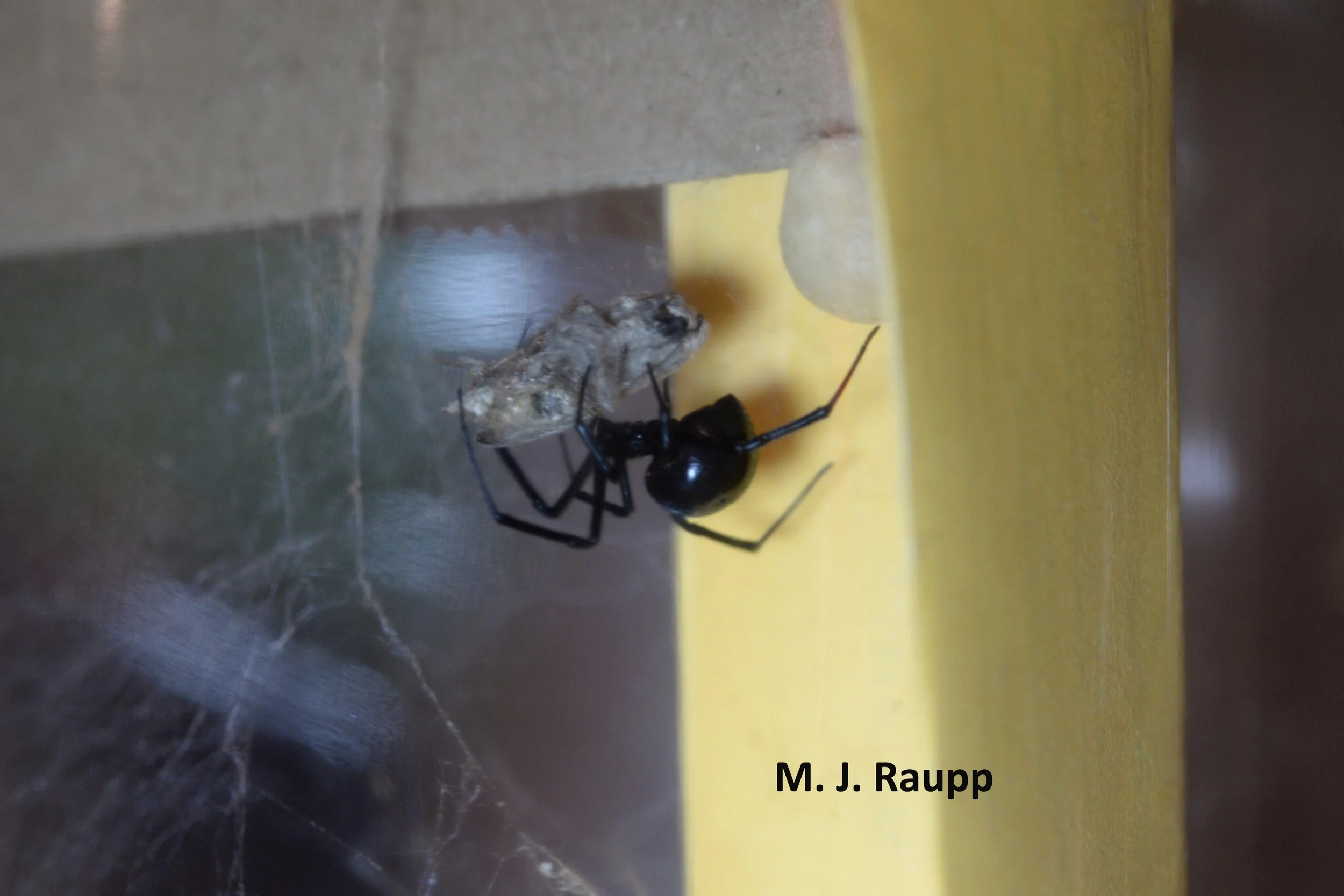
Having paralyzed a hapless moth with venom and wrapped her victim in silk, the black widow will feed at her leisure.
Like most spiders, the fangs of the black widow are used to capture prey and the venom injected through the fangs helps subdue the victim. Also like most spiders, black widows are not aggressive and bite humans only when harassed or accidentally pinched or grabbed. The bite of the widow is usually painless or felt as a pinprick. The more serious symptoms of the bite first appear within 30 minutes to two hours after the bite. These include back pain and muscle cramps that can be severe, rigid muscles in the abdomen, nausea, vomiting, sweating, restlessness and, in some cases, elevated blood pressure. These symptoms are most severe after 3 hours but may persist for many days.
A previous member of the Insect Petting Zoo at the University of Maryland, a gorgeous black widow named Scarlett, glides back to protect her unhatched brood in the egg case after carefully inspecting her gossamer web.
Black widows do not discriminate among their human victims, and envenomation can occur in people of any age. In the U.S., between 2,000 and 2,500 bites are reported each year with the greatest number of bites in children. Lethal bites are exceedingly rare and only three deaths have been reported worldwide in medical literature. Complications associated with black widow bites are greatest for the very young, the very old, and people with cardiovascular disease. The death rate from documented bites occurs in far less than 1% of reported cases. Rapid treatment with antivenin and other medications can greatly reduce the severity and duration of symptoms associated with a black widow bite. Unlike other spider bites, such as those from the brown recluse, there is no terrifying necrotic skin lesion at the site of the bite.
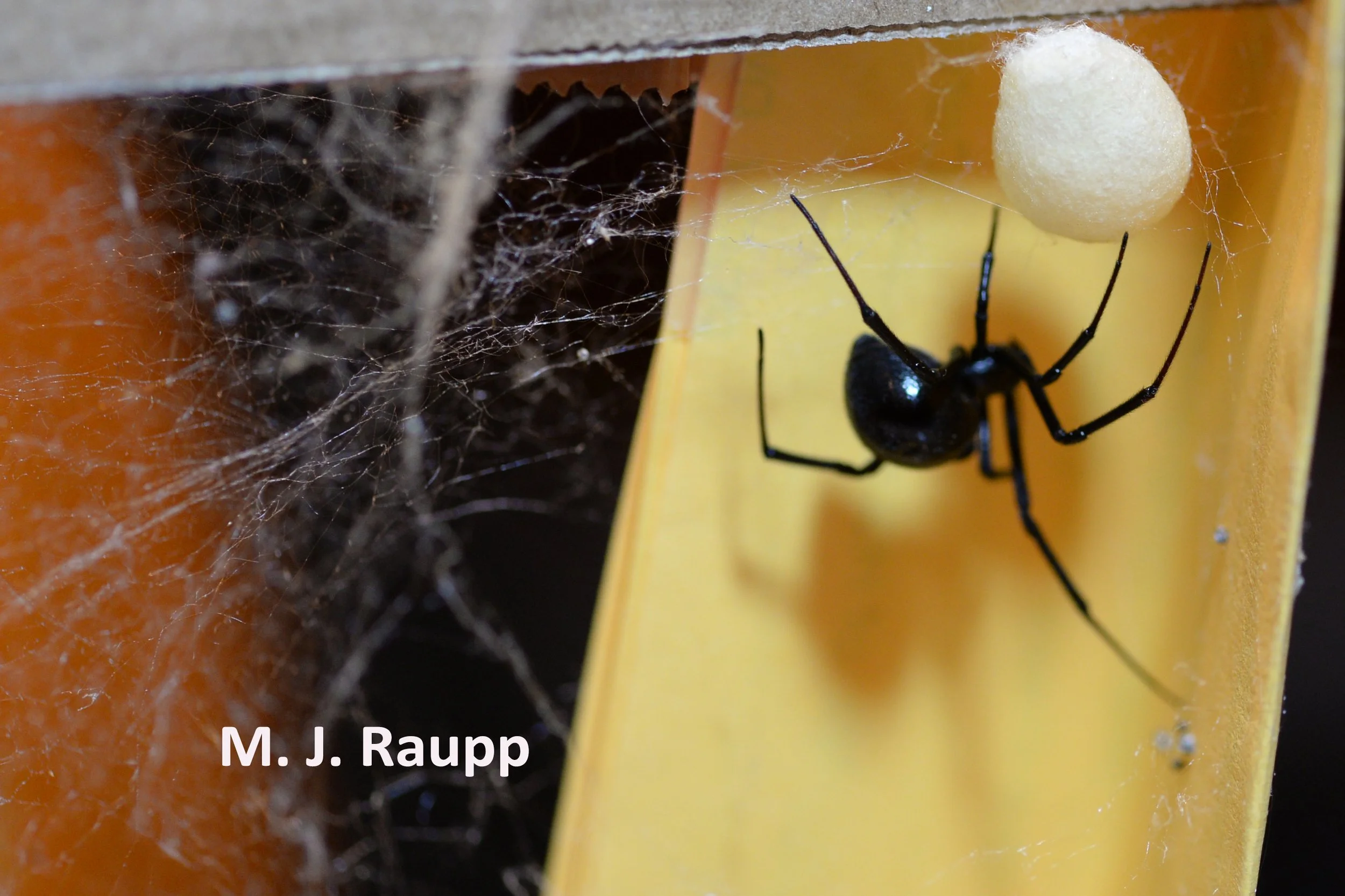
Hundreds of spiderlings hatch from a single egg sac of the black widow and each female can lay several egg sacs annually.
To avoid bites of black widows and other spiders, wear gloves and long-sleeved shirts when you work in areas that might house spiders. Try to reduce clutter such as brush piles, vegetation, trash, and rubbish where spiders might hide outdoors. Do the same for furniture, sports equipment, and clothes indoors. Carefully inspect these items before moving them and store them in containers or sealed bags whenever possible. If you are bitten by a spider, try to collect the spider whether alive and intact or dead and pulverized. This will help a trained arachnologist identify the offending arthropod and help direct the course of therapy. If you or your child is bitten by a black widow spider, seek medical attention immediately. Finally, despite its name, the black widow does not always eat her mate. In fact, in some species of widows the male brings food to his mate. What a guy!
References
Special thanks to courageous Dr. Shrewsbury who discovered and captured Lola, the gorgeous black widow spider featured in this episode. The great spider books ‘Biology of Spiders’ by Rainer Foelix, “Black widow spider” by Steve Jacobs, and the fact filled article “The Treatment of Black Widow Spider Envenomation with Antivenin Latrodectus mactans: A Case Series” by Steven R. Offerman, G. Patrick Daubert, and Richard F. Clark served as references for this episode.











 English (US) ·
  French (CA) ·