

 1 month ago
27
1 month ago
27
PROTECT YOUR DNA WITH QUANTUM TECHNOLOGY
Orgo-Life the new way to the future Advertising by AdpathwayZapping the brain’s motor cortex with mild electrical current has become one of the most popular tools in human neuroscience, promising sharper learning, faster reactions, and better performance in everything from rehabilitation clinics to elite sports labs. But a new study suggests that this technique, at least for certain kinds of complex tasks, may not live up to its reputation. Researchers at Indiana University have found that anodal transcranial direct current stimulation (a-tDCS) applied over the primary motor cortex did nothing to enhance learning of a dexterous, timing-based videogame task compared with a sham condition, even though every participant improved substantially with practice. The findings, published in Physiological Reports, add fuel to a growing debate over when and why brain stimulation actually works.
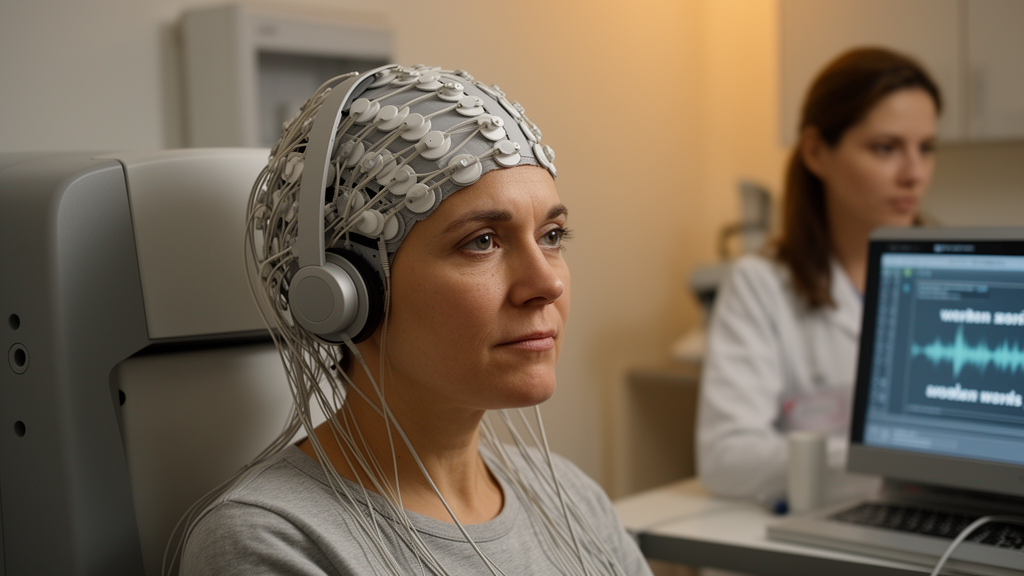
The idea behind a-tDCS is elegantly simple. A weak electrical current, in this case just one milliampere, is passed through an electrode placed over the scalp, gently shifting the resting membrane potential of neurons beneath it. When delivered over the primary motor cortex (M1), the brain region that directly controls voluntary movement, anodal stimulation is thought to depolarize neuronal membranes and make the region more excitable. Since decades of research have shown that repeated activation of task-specific cortical neurons during practice drives synaptic strengthening and cortical reorganization, the theoretical logic follows that boosting M1 excitability during practice should amplify the circuits being trained, leading to faster learning and better retention. Indeed, previous studies pairing a-tDCS with physical training have reported larger motor-evoked potentials, faster reaction times, and fewer errors than training alone.
The Indiana University team, however, has accumulated a mixed track record with the technique. In their own laboratory, M1 stimulation failed to accelerate learning of a simple choice reaction time task or dart throwing at randomly selected targets, yet it did enhance performance on a tweezer dexterity task and on a rhythm-timing videogame that required pressing a single key with precise timing. Those inconsistencies raised an important question: what specific combination of task demands makes M1 stimulation effective? To find out, the researchers designed a new experiment using a Guitar Hero-style rhythm game, a task superficially similar to their earlier successful paradigm but with a few crucial differences that, as it turned out, may have made all the difference.
Forty healthy adults, averaging about 22 years of age and with widely varying levels of gaming experience, were recruited for the study. Crucially, participants were excluded if they had ever played a stringed instrument or used a guitar-shaped game controller, ensuring that everyone started from a comparable baseline of ignorance. The task used an open-source rhythm game called Clone Hero, played with a wireless guitar controller. Colored notes scrolled up a virtual fretboard, and participants had to hold down the correct fret buttons with the index through pinky fingers of their left hand while strumming with their right thumb at exactly the right moment. Some passages required two fret buttons to be pressed simultaneously, and the continuous scrolling rhythm demanded moment-to-moment timing precision.
Each participant visited the laboratory twice, at the same time of day. On the first visit, they completed a familiarization trial, a three-song pre-test block, a 20-minute practice block during which stimulation was delivered, and a three-song post-test immediately afterward. They returned 24 hours later for a retention test. Half the participants received real a-tDCS: a 35-square-centimeter electrode over the motor cortical hotspot corresponding to their non-dominant hand, with a return electrode over the ipsilateral supraorbital region, delivering one milliampere for the full 20-minute practice period. The other half received sham stimulation, which included identical 30-second ramps of current at the beginning and end to mimic the tingling sensation, but no current in between. The study was single-blind, meaning participants did not know which group they were in. The researchers also used finite-element modeling software to estimate the current density reaching the gray matter beneath the electrode, confirming values comparable to those used in their previous studies.
Performance was quantified with three game metrics: accuracy, the percentage of notes hit correctly; best continuous streak, the longest unbroken run of successful notes; and overstrums, a count of erroneous strum attempts. The results on these measures told a clear story about practice and an equally clear story about stimulation. Across all participants, accuracy improved dramatically from pre-test through practice, post-test, and the 24-hour follow-up, with the statistical analysis showing an enormous effect of time on accuracy. Best streaks lengthened and overstrums declined in parallel, and gains were not merely maintained but in some cases continued to grow at the retention session, a classic signature of offline consolidation. But when the a-tDCS and sham groups were compared, there were no differences on any measure at any time point, and no time-by-group interactions emerged. Even Bayesian analyses, which quantify the evidence for or against group differences, returned values hovering near one, indicating no meaningful evidence in either direction.
The null result is particularly striking because the study was powered to detect a moderate-to-large effect. An a priori power analysis indicated that 15 to 18 participants per group would suffice to detect a group-by-time interaction of the anticipated size, and the researchers collected 20 per group to buffer against unexpected variability. Yet the observed data showed the two groups nowhere near being statistically different, and, complicating the interpretation, also too variable to be declared statistically equivalent. Two one-sided tests for equivalence produced confidence intervals far wider than the predefined equivalence bounds, reflecting the noisy, trial-to-trial fluctuations inherent in the task. In rhythm games, a single lapse in attention can derail an entire long sequence of notes, even in otherwise skilled performers, and that volatility swamped any signal the stimulation might have produced.
So why did stimulation fail here when it worked on a superficially similar task before? The researchers point to the specific computational demands of the Guitar Hero-style game. Unlike the earlier rhythm task, which required pressing a single arrow key in time with the beat, this game is bimanual: one hand strums while the other, the one whose cortical representation was targeted, presses frets. It also demands simultaneous double-note presses and continuous integration of visual input, finger selection, and strum timing. These features likely shift the burden of learning away from M1-dependent, use-dependent plasticity and toward the cerebellum and fronto-striatal circuits, which handle error-based prediction and trial-by-trial correction. In other words, boosting the excitability of M1 may have been stimulating the wrong node of a distributed learning network. Early performance gains in timing-heavy tasks are often cerebellar in origin, and no amount of cortical excitation in the motor strip can substitute for that.
The study also highlights practical limitations that plague the broader tDCS literature. While one milliampere reliably increases M1 excitability, recent guidelines emphasize that current flow patterns depend on electrode montage, that baseline excitability varies between individuals, and that neuroanatomical variability moderates behavioral outcomes. The heterogeneous sample, which included participants ranging from non-gamers to heavy gamers and was not stratified by other fine-motor experience such as keyboard typing, may have introduced response variability that masked group-level effects. There is also the possibility that 20 minutes of practice was simply too short to engage the slower consolidation processes where M1 excitability changes exert their strongest influence, though the preserved gains at 24 hours show that consolidation did occur in both groups equally. And because the task is bimanual, stimulating only the fret-hand hemisphere ignores the strumming hand entirely; a bilateral montage might behave differently.
For a field that has been criticized for inconsistent replication, the study is a valuable datapoint. It demonstrates, with careful methodological controls, adequate statistical power, and a well-characterized stimulation protocol, that enhancing M1 excitability alone is insufficient to modify learning of a complex, dexterous, timing-based task. The message is not that brain stimulation is useless, but that its effects are contingent: on the stimulation site, on the neural systems the task actually engages, and on the type of learning being measured. Future work, the authors suggest, should target other nodes of the motor learning network, such as the cerebellum or prefrontal regions, or combine stimulation sites across hemispheres. In the meantime, aspiring Guitar Hero champions would be better off logging practice hours than strapping an electrode to their heads. The brain, it turns out, learns what it practices, and it cannot easily be hacked from the outside.
Subject of Research: Effects of anodal transcranial direct current stimulation over primary motor cortex on motor skill acquisition and retention of a dexterous, timing-based videogame task in adults
Article Title: M1 a-tDCS does not acutely enhance motor skill acquisition of a dexterous, timing-based videogame task in adults
Article References: Blake, B. O., Burton, W. P., Duchow, E. E., McCallion, Q., Poston, B., & Riley, Z. A. (2026). M1 a‐ tDCS does not acutely enhance motor skill acquisition of a dexterous, timing‐based videogame task in adults. Physiological Reports, 14(12), Article e70978. https://doi.org/10.14814/phy2.70978
Image Credits: AI Generated
DOI: 10.14814/phy2.70978
Keywords: transcranial direct current stimulation, primary motor cortex, motor skill acquisition, videogame task, rhythm timing, dexterity, motor learning, retention, sham stimulation, cerebellum, neuromodulation
Cite Scienmag News
APA MLA Chicago
Cassandra Pierce. (September 4, 2026). Brain stimulation fails to boost timing-based videogame skill learning in adults. Scienmag. https://scienmag.com/brain-stimulation-fails-to-boost-timing-based-videogame-skill-learning-in-adults/
Copy citation Download RIS
Tags: a-tDCSadult cognitive enhancementbrain stimulationcomplex task learningelectrophysiological modulationMotor Cortexmotor skill acquisitionneuroscience researchneurostimulation effectivenessprimary motor cortextiming-based videogame skill learningtranscranial direct current stimulation













 English (US) ·
  French (CA) ·