

PROTECT YOUR DNA WITH QUANTUM TECHNOLOGY
Orgo-Life the new way to the future Advertising by Adpathway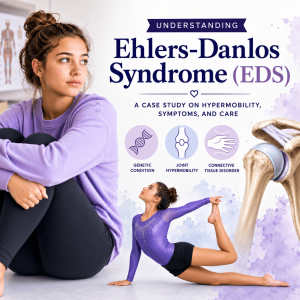
One of the best ways to help students understand anatomy is to connect body systems to real people. This Ehlers-Danlos Syndrome (EDS) Case Study introduces students to a teenage girl whose unusual flexibility turns out to be more than a talent. EDS is the result of a connective tissue disorder that affects the entire body.
Many students have heard the term “double-jointed,” but few understand what joint hypermobility actually means. In this activity, students follow Maya’s journey from unexplained joint pain and repeated shoulder and knee injuries to a diagnosis of hypermobile Ehlers-Danlos syndrome (hEDS). Along the way, they learn how collagen provides strength to connective tissues and why defects in collagen can lead to unstable joints, chronic pain, and other symptoms.
Many students have heard the term “double-jointed,” but few understand what joint hypermobility actually means. In this activity, students follow Maya’s journey from unexplained joint pain and repeated shoulder and knee injuries to a diagnosis of hypermobile Ehlers-Danlos syndrome (hEDS). Along the way, they learn how collagen provides strength to connective tissues and why defects in collagen can lead to unstable joints, chronic pain, and other symptoms.
The case study reinforces anatomy vocabulary such as the joints, ligaments, tendons, cartilage, and connective tissue. Students also examine how connective tissue supports the musculoskeletal system and why weakened collagen affects tissues throughout the body.
The lesson also introduces students to the genetics of EDS, explaining why hypermobile EDS runs in families and how inherited changes affecting collagen can produce lifelong symptoms.

Clinical Assessment: Beighton Score
A unique feature of this resource is its focus on the Beighton Score, the clinical assessment used to evaluate generalized joint hypermobility. Students learn how physicians examine flexibility of the fingers, thumbs, elbows, knees, and spine while discovering that diagnosis involves much more than simply being flexible.
Students perform their own test to determine their score on hypermobility. The test involves examining the way the knees and elbows bend, and whether you can place both hands on the floor with legs straight. A score of 5 or more indicates hypermobility. Though, for clinical diagnosis, a doctor will take other factors into account.
The case includes questions for reading comprehension and anatomical knowledge. Students analyze Maya’s symptoms, interpret the Beighton Score, and explain how connective tissue functions. They evaluate why strengthening muscles can improve joint stability even though defective collagen cannot be repaired.
A Claim-Evidence-Reasoning (CER) writing prompt provide opportunities for higher-level thinking and scientific argumentation.
This case study fits well into units on connective tissue, the integumentary system, skeletal system, and muscular system, . It also serves as an excellent introduction to how anatomy and physiology are used in medicine to diagnose and manage chronic disorders. Because EDS affects multiple body systems, students gain a broader appreciation for how structure and function are connected throughout the human body.
Related Resources
Chapter Resources Tissues – Lecture slides, students notes, and handouts to support learning
Connective Tissue Matrix Coloring – focusing on the types of fibers and supporting cells
Case Study: Prader Willi Syndrome – follows a girl with a genetic disorder affecting her appetite
Giant Microbes Chromosome Plush – One of my favorite models to use with lessons related to chromosomes














 English (US) ·
  French (CA) ·