

 3 months ago
114
3 months ago
114
PROTECT YOUR DNA WITH QUANTUM TECHNOLOGY
Orgo-Life the new way to the future Advertising by AdpathwayExperts say that despite recent increased investment in drones to monitor for sharks in states like New York, the machines have limited usefulness as a public safety tool and there does not appear to be evidence that the threat to swimmers from sharks has increased.
There have, however, been more reports of sharks around local beaches.
Observers caution that the increase might simply be because more machines are now hovering over the water looking for sharks and that there aren’t necessarily more sharks swimming close to shore. That perceived increase could then incite irrational reactions from government officials and beachgoers, experts say, especially since shark attacks remain very rare.
The ultimate result could be a spiral: governments receive more reports of shark sightings, so they purchase more drones, which then spot more sharks.
“The truth of the matter is, the number of sharks may not have increased, but certainly the fear factor can go up,” said Greg Skomal, senior fisheries scientist with the Massachusetts division of marine fisheries.
The odds of being bitten by a shark are one in 4.3 million, according to the Woods Hole Oceanographic Institution. In 2025, there were 65 unprovoked shark bites worldwide, less than the most recent 10-year average of 72, the Florida Museum of Natural History reported.
Though sharks do not appear to pose a greater threat, New York state keeps spending more money to monitor them. In 2022, Governor Kathy Hochul announced that the state would increase lifeguard staffing by 25% through overtime and purchase additional drones to watch the ocean. The next year, on Shark Awareness Day, she announced that the state would spend $1m to purchase drones and train staff to use them. The state then deployed 60 drones.
This year, the state spent $322,000 to purchase 16 more drones to monitor for sharks, according to the New York state office of parks, recreation and historic preservation. (A spokesperson did not respond on whether this was in addition to the previous $1m commitment or part of it.)
“We’re going to be harnessing the power of technology [and] the human capital of our lifeguards and making sure we’re doing everything we can to literally take the bite out of any future shark encounters,” Hochul said in 2023.
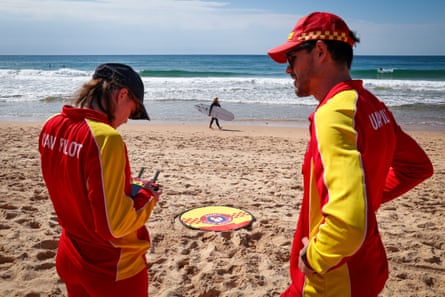
In Australia, the New South Wales government also recently announced a $34m initiative to expand its shark monitoring.
Drones are effective at spotting sharks on the surface and are cheap, easy to use and can cover lots of space, says Chris Lowe, director of the Shark Lab at California State University, Long Beach.
“The problem is, if visibility is bad, a shark can literally be 5ft below the surface, and you can’t see them,” Lowe said, noting that alongside the drones, his lab staff has tagged sharks and installed acoustic receivers along the beaches.
“When a tagged shark gets within about 300 or 400 yards of one of those underwater receivers, the receiver will log the time, the date, and the ID of the shark,” Lowe said.
The lab shares that information with local authorities.
“We always tell lifeguards, this is not an early warning system, this is a science tool,” Lowe explained. “If the goal is to just put up surveillance and then pull people out of the water, you can do that, but it may be unnecessary, and it could have other consequences, like economic consequences” if people decided not to visit a beach because of shark reports.
Lowe emphasized that his team had not “in thousands of flights, seen any footage of a shark acting aggressively towards a person.”
Around Wellfleet, Massachusetts, more great white sharks have recently emerged because of a rebound in the population of seals, which they eat. In 2018, a man died after being attacked by a shark near Wellfleet. Afterwards, the town got receivers to detect tagged sharks and purchased a pair of drones for $6,000.
The drones only work well “if the water is crystal clear, which is not the usual thing”, said Suzanne Grout Thomas, Wellfleet’s retired director of community services. She also does not think sharks necessarily pose a greater threat. They are intelligent and “don’t want to eat people; they really want seals, and they are learning to distinguish between those”.
Notably, since drones can’t spot all sharks, they can also provide the public a false sense of security, Skomal said, adding: “I think that is why many municipalities don’t invest in drones.”
If any staff at New York state beaches spots a shark with a drone, lifeguards always clear the water, said George Gorman, regional director at the state parks office. The state does not use tags and receivers to detect sharks.
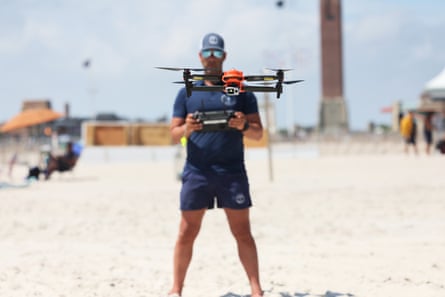
“If they see anything of a concern, meaning if there is a large school of [baitfish] or bunker fish, that is a red flag for us,” because sharks like those fish, Gorman said. “They then watch over that area more intensely.”
The state had not cleared the water at its parks this year until someone’s foot was bitten on 3 July at Jones Beach. That person was taken to the hospital with non-life-threatening injuries. Gorman pointed out that it was only a suspected shark bite and that the swimmer did not see the animal.
At New York City beaches, which the state does not manage, the police deploy two-man teams at four beaches to perform drone flights looking for “distressed swimmers, sharks and any other unusual occurrences”, according to a spokesperson.
“If one of our pilots identifies a shark or dangerous marine life, we notify the parks department and New York City emergency management. The parks department will make a final decision on closing beaches,” the spokesperson stated in an email.
If aerial surveillance confirms a shark sighting, the department closes the beach for one mile in each direction for at least one hour or until sharks are confirmed not to be present, a parks department spokesperson stated.
This year, shark sightings have caused the department to close beaches at the Rockaways, located in Queens, 23 times since late May, the Gothamist reported this week.
At that point last year, there had only been 11 closures. And in 2024, there were just 11 all year.
When determining whether to close a beach, officials must do so judiciously, Lowe said. “Otherwise, you have a situation where people are afraid to go in the water.”
















 English (US) ·
  French (CA) ·