

 2 months ago
123
2 months ago
123
PROTECT YOUR DNA WITH QUANTUM TECHNOLOGY
Orgo-Life the new way to the future Advertising by AdpathwayAstronomers have found a Jupiter-mass world orbiting a brown dwarf that orbits a star.
Astronomers have discovered a planetary-mass object orbiting a brown dwarf that is itself part of a binary system with an ordinary star. This strange hierarchy is proving hard to classify, with the team behind the discovery tentatively calling the new object an exosatellite — or possibly even the first exomoon.
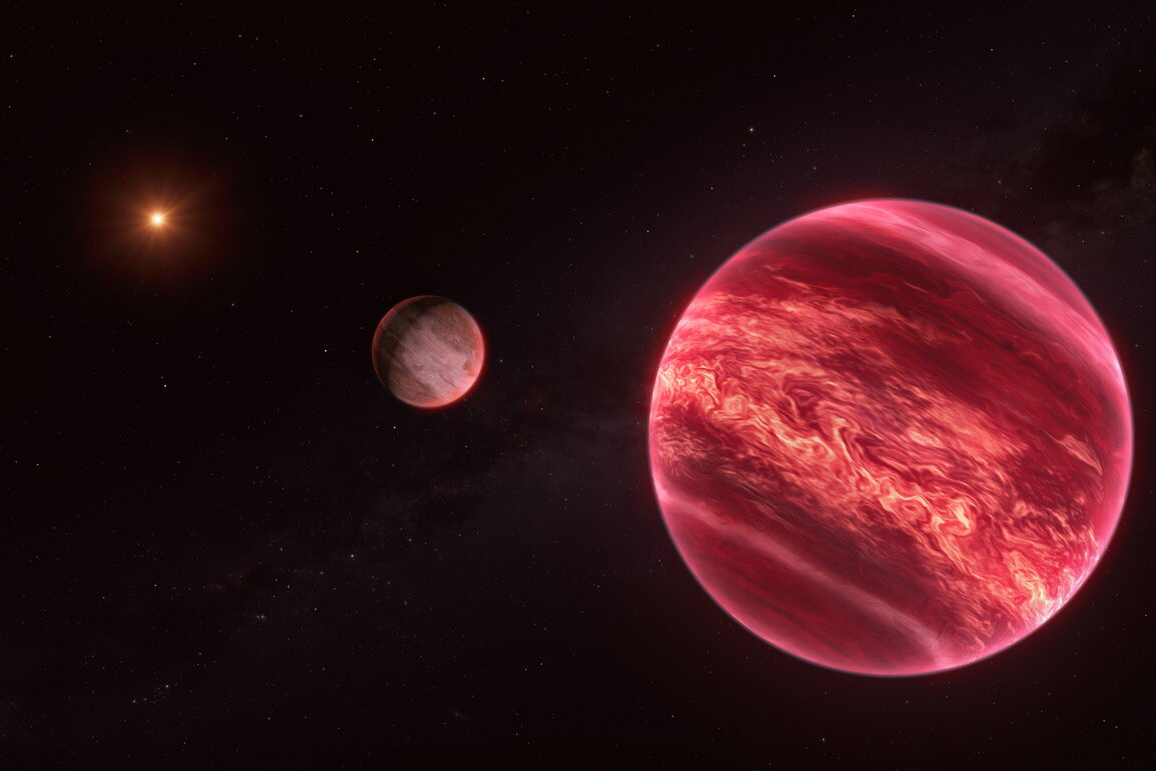 This artist's illustration shows the CD-35 2722 star system, which contains a red dwarf star (point source at left) and a brown dwarf (reddish-brown object at far right). The brown dwarf is, in turn, orbited by a newly discovered object about as massive as Jupiter, seen at center. Since the brown dwarf is a "failed star" -- too massive to be a planet, but not massive enough to sustain nuclear fusion in its core as stars do -- scientists disagree about what the new planet-mass object should be called. Is it an exosatellite, an exoplanet, or something in between?
 ESO / M. Kornmesser
The action takes place around CD-35 2722 A, an M-class red dwarf star some 72 light-years from Earth. Astronomers already knew that this star belongs to a binary system alongside a brown dwarf — an object considered too massive to be a planet, but not massive enough to sustain hydrogen fusion in its core and be a star.
Now, a team led by Kevin Hoy (Diego Portales University, Chile) has used the Very Large Telescope to measure tiny changes in the brown dwarf's velocity caused by the gravitational tug of something smaller orbiting it. The results are published in Nature.
Hoy’s team spent two years taking measurements, spread over 23 different nights. The relatively large angular separation between star and brown dwarf — some 2.8 arcseconds — helped significantly by enabling the researchers to study the brown dwarf’s spectrum with minimal light contamination from the companion star. As a result, the measurements are up to 100 times more precise than previous attempts in similar systems.
Two different scenarios fit the data. The first is a single, roughly Jupiter-mass object spinning around the brown dwarf on a fairly eccentric orbit. The second sees a similar object on a much more circular orbit, coupled with an additional world in a tighter orbit and in resonance with the first.
Hoy’s team then ran computer simulations to see which of these two configurations is more stable. They found that a two-object system would likely fling itself apart after just a few hundred years, making the single Jupiter-mass object the more plausible explanation.
If confirmed, the discovery would be the first time this technique has produced evidence of a satellite around a brown dwarf in a binary system. Similar searches have targeted directly imaged brown dwarfs and giant planets looking for satellites, but found nothing. Another candidate around the brown dwarf in the binary system HD 206893 remains unconfirmed.
Astronomers are particularly interested in such worlds because — if they occupy a close enough orbit — they could be warmed not by starlight but by tidal heating created by the brown dwarf gravitationally kneading their interiors. For smaller, rockier worlds than this one, that potentially allows them to stay habitable far from any star's traditional habitable zone.
But accurately labeling these objects is proving tricky. “This system is somewhat hard to define using solar system–based words like ‘planet’ and ‘moon,’” says Hoy. After all, CD-35 2722 Bb orbits neither a star nor a planet. "Being the third wheel in this system makes us want to call it a moon, even if it is nothing like the small, rocky moons we have in our system,” Hoy says.
However, not everyone is convinced by the “exosatellite” label. “I strongly believe the newly found object is the failed core of a star, and to me the entire system is only a system of three substellar bodies,” says Nader Haghighipour (University of Hawai‘i, Manoa), who was not involved in the research. “The Jupiter-mass body is not a satellite,” he says.
Roman Rafikov (University of Cambridge, UK), who was also not involved in the discovery, agrees. “I would definitely not call it an exomoon or exosatellite,” he says. “I don't think there is any ambiguity here. I call the star–brown dwarf system a ‘binary,’ and the new object a ‘planet’ around one of the binary components.”
This arrangement isn’t novel, he adds. Astronomers already have a name for exoplanets orbiting one member of a multi-star system: S-type planets. He points to Gamma Cephei – a system where a Jupiter-mass planet orbits one star in a binary — as a precedent. Observers have found hundreds of S-type worlds.
Perhaps part of the problem is that, according to the official International Astronomical Union definition, planets only orbit the Sun, and there is currently no IAU definition of a moon. As the universe continues to churn out weird and wonderful worlds, astronomers may need to look again at their vocabulary.
















 English (US) ·
  French (CA) ·