

 10 months ago
259
10 months ago
259
PROTECT YOUR DNA WITH QUANTUM TECHNOLOGY
Orgo-Life the new way to the future Advertising by AdpathwayDisclaimer: This site is not affiliated with the National Hurricane Center, Hurricane Hunters, Storm Prediction Center, or National Weather Service. ALL forecasts herein are the result of my analysis, (to which you will see me at times, insert excerpts from various agencies due to the nature of the importance of the information) and I am solely responsible for the content. As ALWAYS, follow the National Hurricane Center, National Weather Service, and your local Emergency Management officials for emergency decisions. In addition, this is strictly a FORECAST OFFICE. I CANNOT make decisions regarding travel plans, etc. My purpose, is to provide you the information, based solely on information I analyze, and the accuracy of the information at hand of the time of analysis, so you may make informed decisions.
(T. F. “Storm” Walsh)
For those who have donated to my site, your help has been greatly appreciated. If you are not aware, donations to my site help pay for subscriptions to sites I use as well as software updates, which provide all the models and information used in my forecasts. To donate, please click the DONATE button to the right side of the page, or on the graphic of the dog. Any help you provide is immensely appreciated!
DONATIONS ACCEPTED AND APPRECIATED


I will reiterate, my forecasts are based on the available information at the time of analysis, and are only as accurate as the information analyzed and the solutions provided.
Good day everyone!
This summary will attempt to explain the conditions that caused a lull in the 2025 Hurricane Season from JUL 07 – AUG 03 and AUG 27 – SEP 17. It will also attempt to explain why we encountered so much dry air most of the season with subsidence causing a lack of instability, periods of increased wind shear, and extended period of African Dust (SAL).
While the season came in just under the average, we were short 1 storm for attaining the storm average, 2 short for the hurricane average, but 1 over for the major hurricane average, for a season producing 13 storms, 5 hurricanes, and 4 major hurricanes. We had a total of 12 tropical systems and 1 sub-tropical system.
2025 HURRICANE SEASON MAP (CLICK FOR LARGER IMAGE)
The following were my seasonal predictions, average hurricane season totals, Dr. Phil Klotzbach’s seasonal predictions, and actual season totals.
STORM W 2025 SEASON FORECAST
TOTAL NAMED STORMS: 15 – 17
TOTAL HURRICANES: 7 – 8
MAJOR HURRICANES: 2 – 3
AVERAGE HURRICANE SEASON:
TOTAL NAMED STORMS: 14
TOTAL HURRICANES: 7
MAJOR HURRICANES: 3
CSU (Dr. Phil Klotzbach) UPDATED SEASONAL FORECAST
TOTAL NAMED STORMS: 16
TOTAL HURRICANES: 8
MAJOR HURRICANES: 3
2025 HURRICANE SEASON TOTALS
TOTAL NAMED STORMS: 13*
TOTAL HURRICANES: 5
MAJOR HURRICANES: 4
* (12 TROPICAL…1 SUBTROPICAL)
The following is the list of storm names for the 2025 Atlantic Hurricane Season:
Andrea Barry Chantal Dexter Erin Fernand Gabrielle Humberto Imelda Jerry
Karen Lorenzo Melissa Nestor Olga Pablo Rebekah Sebastien Tanya Van Wendy
As I began research earlier in Nov., I was able to find various information from numerous meteorological colleagues regarding factors for the slightly lower predicted totals. I will be posting their articles for credit to them. Several factors were discovered which included drier air over the subtropical and tropical Atlantic, increases in wind shear, and an extended period of dealing with the SAL (Saharan Air Layer). Bear in mind, the factors did not occur all at once, however some presented a combination at times. Before we cover the dry air, there is another factor that affected the lack of vertical instability…warmer tropopause temperatures.
1.) WEAK LAPSE RATES: Warmer tropopause temperatures were noted by a meteorologist who posts on Reddit. These warmer temperatures in the upper atmosphere (200 mb and above) allow for a disruption in the ELR (Environmental Lapse Rate) by slowing the lapse rate. As we go higher in the atmosphere, the surrounding temperatures involving a rising column of warm air are supposed to get colder, allowing for convective and thunderstorm development. The steeper the lapse rate, the more severe and stronger the thunderstorms. A low lapse rate, or even an inversion does not allow for the warm air column to rise, hence no thunderstorm activity to initiate tropical development. The following was the 200 mb temperature anomalies (near the tropopause) recorded from AUG. 01 – SEP. 16, 2025
The following is the link for the full article:
https://www.reddit.com/r/hurricane/comments/1nkwueb/whats_up_with_the_hurricane_season/
2.) DRY AIR:
Drier air was almost constantly noted in water vapor images during daily analysis. This was another factor that kept vertical instability below “climatology” for a good majority of the season.
VERTICAL INSTABILITY GRAPH
During a good portion of the season, we had warmer SST anomalies over the sub-tropical Atlantic, and cooler anomalies over the MDR. This temperature distortion creates a more stable environment over the MDR, as maximum net lift is focused more over the subtropics. In order to achieve maximum lift over the MDR, we look for a favorable setup of the Atlantic Tripole of warm, over cold, over warm as in the following graphic. Air rises over the warmer anomalies, while sinking air comes from above over the cooler anomalies. This cause the atmosphere to dry out over that particular region. This setup below allows for max. instability over the MDR:
Two other factors which aided in drier air intrusion were the Azores Bermuda high being stronger than average and the persistent TUTT (Tropical Upper Troposheric Trough) that was present in the western Atlantic, centered just off the U.S. east coast. It was noted in my daily analyses that the A/B high was at around 1028 – 1033 mb. The “average” for the high is 1024 mb. The stronger northward flow on the east side of the high brought in drier air from the north. As far as the TUTT, because of it’s flow and strength, allowed dry air to come south. The graphic are MSLP anomalies during the AUG. lull:
The following graphic shows MSLP over the MDR was quite a bit above climatology most of the season:
The following graphic shows the TUTT over the U.S. east coast (since it is not located over the tropics, it would be just a deep layer trough) which was present for a good portion of the season which allowed for dry air to come south, and an increase in shear over the western Atlantic:
3.) WIND SHEAR:
Wind shear causes tropical systems to become not aligned vertically, which spreads out the heat energy and moisture, not allowing it focus in a “column”. When this occurs, development is usually not likely to occur. In order for a tropical system to develop, wind shear must be 20 kts or under. In addition to the stronger subtropical ridge, and TUTT bringing higher shear values, it was noted in most of my daily analyses that the EASJ (East Asian Subtropical Jetstream) was fairly strong during a good portion of the season, closer toward the peak months of AUG. – SEP. I know you’re probably thinking, what does something over in east Asia have to to with the Atlantic hurricane season. Well, this jet can affect development in that as it travels eastward. As the jet becomes stronger, it can carry with it what is known as a Rossby Wave. These Rossby waves can enter the Atlantic and “break”. The following links explain this process and the effect on NATL hurricane development:
EAST ASIAN SUBTROPICAL JETSTREAM:
https://oceannews.com/news/science-technology/link-between-atlantic-hurricanes-and-east-asia-weather-system/
ROSSBY WAVES:
https://oceanservice.noaa.gov/facts/rossby-wave.html
ROSSBY WAVE BREAKING
https://journals.ametsoc.org/view/journals/clim/32/13/jcli-d-18-0299.1.xml
4.) AFRICAN DUST / SAL
African dust, otherwise known as the SAL (Saharan Air Layer) also allowed for drier air over the MDR. The SAL is usually located around the 700 – 600 mb level associated with dust picked up from the AEJ (African Easterly Jet). Because this “dust” is extremely warm and dry, it creates what is known as an “inversion”, due to warmer air being located aloft not only choking off moisture needed for development, but pretty much reversing the ELR, which ceases convection and cloud growth. This phenomenon is usually the strongest during the month of July, and as a general rule, usually subsides and weakens at the beginning of August, and no later than the second week of August. The 2025 hurricane season saw this dust last well into September. A feature known as the Saharan Heat Low became positioned over various portions of the Sahel region, allowing for the stir up of dust which transported to the AEJ. The lack of rainfall over the Sahel region for the season was responsible for such dry conditions and high amount of dust. The following link is an article on the Saharan Heat Low and its role in transporting dust.
SAHARAN HEAT LOW:
https://www.sciencedirect.com/science/article/abs/pii/S1875963717300253
Finally I know you’ve seen in my forecasts, discussions on the forecast for the MJO (Madden Julian Oscillation). In daily analyses, most of the time the MJO models indicated this entity to be forecast in favorable phases with a moderate to strong signal, especially during the last half of the season. At first, the models projected strong, slow moving signals within the favorable phases, which would indicate an increase in activity. However, by the peak of the season, the signals became weaker, and moved much quicker than had originally been forecast. This led to no real increase in tropical activity. In order for the MJO to produce the favorable conditions needed to enhance activity, the signal needs to be moderate to strong, and slow moving, as to not create detrimental wind shear, and allow for the upward motion pulse to create lowering MSLP at the ocean surface and produce the necessary moisture needed for development. So, long story short on this aspect is, the models did a lousy job for the season in forecasting the MJO. Usually, both models that I use for the MJO forecast are very accurate in their predictions.
The following link is for an article from Dr. Klotzbach regarding the lull in activity we experienced:
https://tropical.colostate.edu/Forecast/2025_0909_seasondiscussion.pdf
One last item…when pre-season forecasts are posted, these conditions I have just gone over are not in the forecast information analyzed for making the pre-season forecasts. The forecast parameters that are available and used are as follows:
1.) CLIMATE MODEL ENSO PLUME FORECASTS
2.) SST ANOMALY FORECAST
3.) IOD (Indian Ocean Dipole) FORECAST
4.) WIND SHEAR FORECAST
5.) ONI (Oceanic Nino Index) FORECAST TEMPERATURES AND TRENDS
6.) AVERAGING OF CHOSEN ANALOG YEARS BASED ON CPC ONI HISTORY
7.) Past and current MEI (Multivariate ENSO Index) information
I hope this provides some idea of what occurred this past season, and I look forward to forecasting for you come the 2026 hurricane season.
The following NWS Watch / Warning map will provide local NWS information for your area. Click the image, then once it refreshes, click on your area of interest to view any special weather statements, hazards or advisories for your area.
NWS WATCH / WARNING DISPLAY (LINKED…CLICK MAP, THEN YOUR AREA)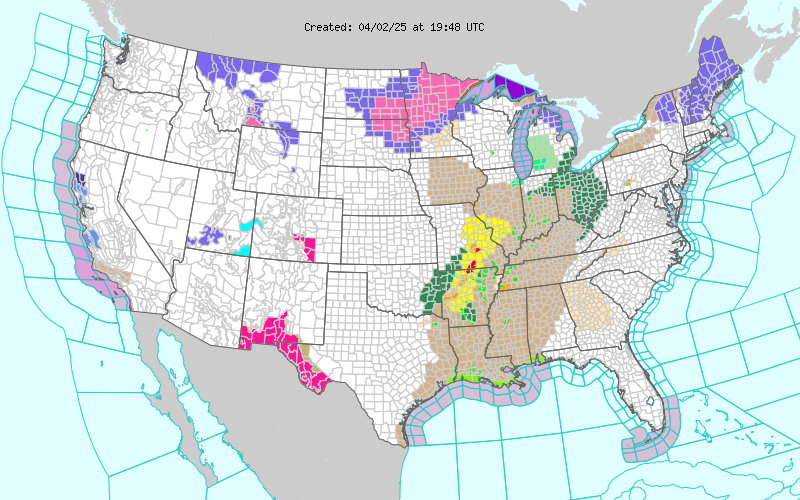
NWS DOPPLER RADAR LOOP (LINKED, CLICK RADAR MAP)
RAP RADAR (CLICK IMAGE THEN GO TO LOOP DURATION AND PICK LENGTH OF LOOP, THEN CLICK RADAR SITE)
CARIBBEAN RADAR (CLICK IMAGE TO ACCESS ANIMATION) You may direct any questions by contacting me personally, ANYTIME, at: [email protected]
Have a blessed evening!
T. F. “STORM” WALSH III GMCS, USCG (ret)
METEOROLOGIST / HURRICANE SPECIALIST /SEVERE WEATHER SPECIALIST
MEMBER WEST CENTRAL FLORIDA AMS













 English (US) ·
  French (CA) ·