

 2 months ago
70
2 months ago
70
PROTECT YOUR DNA WITH QUANTUM TECHNOLOGY
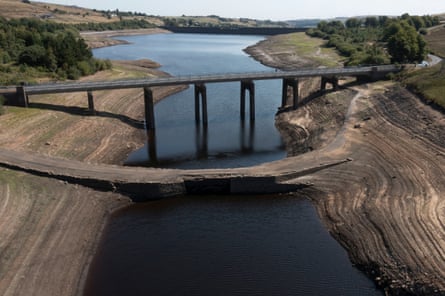
Orgo-Life the new way to the future Advertising by AdpathwayFive key reservoirs across England and Wales are “exceptionally low” as drought and extreme heat piles pressure on public water supply that is likely to continue into the autumn.
Most of Europe has endured back-to-back climate crisis-driven heatwaves this summer. The extreme heat, coupled with strikingly little rainfall, means almost three-quarters of England and the whole of Wales is now in drought.
Environment Agency data from 11 August shows five key reservoirs are now “exceptionally low”.
Wimbleball reservoir, operated by South West Water, is less than half full, at 46%. The other four that are “exceptionally low” are Clatworthy in Somerset (48%), Hanningfield in Essex (56%), Clywedog in Powys (56%), and the Dove group in Derbyshire (69%).
Across England, total reservoir levels have fallen to 66%, down from 69% last week and nearly 14 percentage points lower than expected for this time of year. Of the 32 reservoirs the Environment Agency classifies as strategically important or geographically representative, just four are classed as at normal levels.
These are Draycote Water in Warwickshire, Bewl in Kent, Roadford in Devon and Vyrnwy in Powys.
Reservoirs are essential for the security of water supply, providing drinking water to millions of people.
In its latest summary published on Thursday, the National Hydrological Monitoring Programme said aridity in July had been “unprecedented” and that “widespread below-normal to exceptionally low” water flows were likely to persist well into the autumn, with “further deterioration” likely.
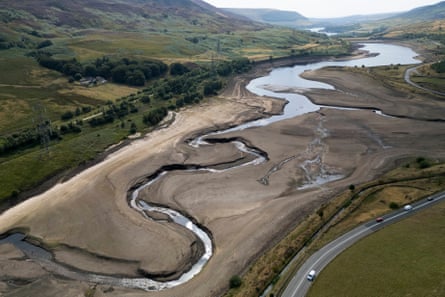
Alastair Chisholm, the lead for water policy, regulation and governance at the consultancy firm Arup, said with three droughts recorded in the past five years, the country was in “new territory”.
During last year’s drought, reservoir levels also fell to extremely low levels. By this time last year, the Pennines group and Yorkshire group reservoirs were less than 39% full, and experts say this cumulative impact is of particular concern.
England and Wales rely on on reservoirs filling up over the winter – and this year’s particularly wet winter has meant the situation this summer is not as bad as it could have been. “If we do get a dry winter this time round, then that will be very concerning for the government,” Chisholm said.
Prof Liz Bentley, the chief executive of the Royal Meteorological Society, said the key concern now was how long the dry weather would continue.
“There is very little rain forecast over the next couple of weeks and that is more the concern. If we go through autumn and winter and have low rainfall, we could have real trouble,” she said.
Mark Smith, the chair of the Chartered Institution of Water and Environmental Management’s water resources specialist panel, said that while winter rain helped, “ultimately you can only store so much”.
The heatwave of 1976 was the last time households in the UK had their water supplies cut off. That this has not happened again is largely due to investment in infrastructure to transfer water, which has baked in resilience in the overall system.
Although investment has been made to improve water company infrastructure, no new reservoir has been built in the UK since 1992 and research by Greenpeace UK has found that 2.87bn litres a day is wasted by water companies through leaky pipes in England and Wales – a fifth of all water pumped through the network and enough to fill 1,150 Olympic-size swimming pools.
With droughts and heatwaves becoming more frequent and more extreme due to the escalating climate crisis, the Environment Agency has estimated England’s public water supply could be short by 5bn litres a day by 2055 without urgent action.
Last year, the government ordered the building of two major reservoirs, in East Anglia and Lincolnshire, but they will not be ready until 2036 and 2040 respectively.
Another seven large reservoirs are planned to be built by 2050 – in Oxfordshire, Suffolk, Kent, East Sussex, the West Midlands and two in Somerset – and work is already under way at a further site in Hampshire.
However, these will account for only 30-40% of the overall projected demand.
In the absence of this additional storage, water companies are having to use increasingly extreme measures to deal with water shortages. For example, Southern Water has applied to the Environment Agency to abstract more water from the River Test, a protected chalk stream that supports a highly sensitive ecological system.
The campaign group WildFish has said over-abstraction of this river could have drastic effects on wildlife and the long-term ecology of the river.
Chisholm said a society-wide approach was needed, including a move to regenerative agriculture to improve the soil’s ability to store water, developing “sponge cities” that use nature-based solutions to absorb, store and filter rainwater, and using captured rainwater instead of drinking water for water-intensive infrastructure, such as datacentres and flushing toilets.
















 English (US) ·
  French (CA) ·