

 2 months ago
93
2 months ago
93
PROTECT YOUR DNA WITH QUANTUM TECHNOLOGY
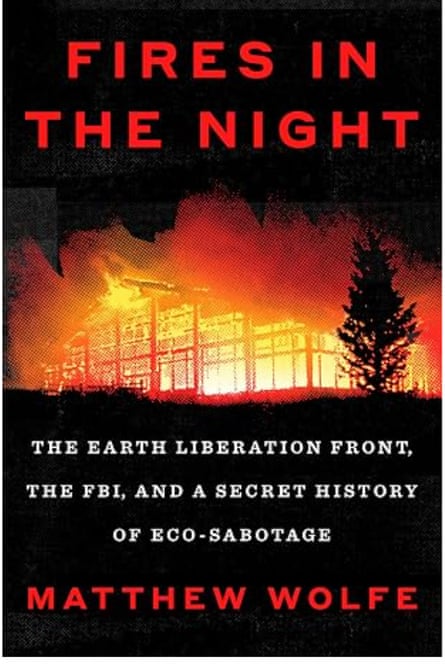
Orgo-Life the new way to the future Advertising by AdpathwayAre echoes of 1990s radical environmentalism returning louder or fading away? It’s a question posed by Fires in the Night, a new book on the history of the Earth Liberation Front (Elf), a loosely grouped band of US Pacific north-west activists that used economic sabotage and arson to protest environmental destruction.
The members called themselves “the Family” and were known to the outside world as Elves, owed to the acronym for the group Elf. Unlike rightwing extremists of the era, they practiced non-violence toward life, though not property. They were labelled domestic terrorists and practiced “leaderless resistance”.
They have left a long political trail, with direct-action descendants including the Sunrise Movement, Extinction Rebellion and Just Stop Oil that share the same broad goals around opposition to fossil fuels, ecological damage and authoritarianism.
Between 1995 and 2001, Elf members targeted fur breeders, timber warehouses, meatpacking plants, a horse corral run by the Bureau of Land Management, SUV dealerships, toppling electric power transmission towers – and most famously, in 1998, a ski resort in Vail, Colorado, causing damage in excess of $12m. The group said the Vail attack was on behalf of endangered lynx.
Fires in the Night asks if Elf were a warning sentinel for the accelerating ecological damage. At the time, the advised response to the climate crisis was to take shorter showers and turn off the light when you leave the room. The group’s response was try and sabotage – or “monkey wrench” the profits out of businesses that profit from ecological destruction.
After a May 2001 attack on an Oregon tree farm, Elf arsonists left a message on a remaining structure: “YOU CANNOT CONTROL WHAT IS WILD!”, it said alongside the acronym for the group.
The Elf, says author Matthew Wolfe, “seemed to be taking the threat seriously and responding in a way that was commensurate with the danger we were facing”. A quarter of a century later, with gigantic and deadly forest fires raging in Canada and Europe, Elf’s point that society wasn’t doing enough to prevent climate-related damage, seems prescient.
The group was a radical out-growth of eco-anarchists Earth First!, an environmental movement founded a decade earlier in response to the compromises made by mainstream conservation groups. Elf, alongside a partner group Animal Liberation Front (Alf), was focused in Eugene, Oregon, where Earth First! had headquarters.
“It was an old logging town where counter-cultural resistance and radical politics came crashing into capitalism,” says Wolfe. “A lot of people came there for the trees, and a lot of people came to cut down the trees.”
Eugene became a hotbed for radical environmentalism. “You had anarchists, animal rights activists, hardcore tree-hugging environmentalists,” he says. That mixture of influences, alongside what he calls the “prankish, theatrical qualities” of Earth First!, were not serious enough.
“They felt they needed to adopt a serious tactic – and that was arson,” Wolfe says. The bitter irony, of course, is that the Elves were using fire to protest against environmental circumstances that are now organically produced by a planet in distress.
“You can consider it an irony or a remark on what kind of violence we as a society are concerned with and what kind of violence we’re more likely to try to stem,” Wolfe says. “Without endorsing what they we’re doing, and they were deeply unsuccessful, the result of their small fires failing was that much larger fires were in the offing.”
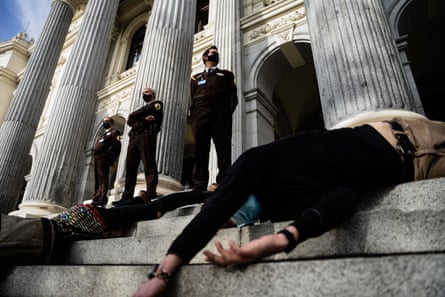
Climate activists may again be flirting with radical ideas, including street protests and civil disobedience campaigns. In 2013, the typically legislative- and legal-focused Sierra Club officially endorsed and participated in protests. The Sunrise Movement now organizes around opposition to authoritarianism to get to climate legislation.
The movement still takes on arguably quixotic undertakings: the protests against Tesla dealerships last year, nominally to protest owner Elon Musk’s involvement in Trump administration efforts to reduce the size of the federal government, ended up setting fire to vehicles that are supposed to reduce fossil fuel emissions.
“It’s one of the essential questions of political movements,” says Wolfe. “How do you create a spectacle without turning people off?”
For some Elf members prosecution and incarceration for acts that led to $45m in damages, according to the government, led to a re-appraisal. In a statement before being sentenced to 13 years in prison for a string of arsons, including the Vail fire, Stanislas Meyerhoff, an Elf member and co-author of an incendiary bomb-making guide, said he “was ignorant of history and economy and acted from a faulty and narrow vision as an ordinary bigot”.
Others said they felt the message was worthwhile despite the great personal cost. Another member, Joseph Dibee, who was picked up on an Interpol red notice in Cuba in 2018, later said that Elf hadn’t really existed, a claim that runs parallel to current debates about “antifa” that the Trump administration has designated a terrorist organization.
“The reality is I’m an environmentalist, and somebody decided to say that I’m part of some organization that doesn’t exist,” Dibee told Oregon Public Broadcasting. “It’s more, as I understand it, the philosophy that binds people. And that’s quite different than what the government is claiming.”
The project to set fires to save a burning planet attracted odd characters. There was a drifter with a criminal past, Jake Ferguson, who Wolfe describes as “a kind of post-apocalyptic pirate, a rope-muscled man dressed in raggedy black clothing and carrying his long, dark hair in a nest of dreadlocks”. Ferguson is believed to have testified against other members in exchange for immunity.
At least one of the Elves, Josephine Overaker, is still at large. Authorities believe Overaker, described as having a Mother Earth persona, a large predatory bird with its wings spread tattooed between her shoulder blades, is probably out of the US and may have sought employment as a firefighter, a midwife, a sheep tender or a masseuse.
For a time Elf held public and law enforcement attention. In 2004, the FBI deputy director John Lewis testified that more than 34 FBI field offices had 190 investigations into Alf and Elf activities. Lewis said there was “little, if any, known hierarchal structure to such entities” and “exhibit remarkable levels of security awareness when engaged in criminal activity”.
It was only when Elf sought to expand following the Vail attack that whatever discipline it had mustered began to fray. They put out a recruitment video, Igniting the Revolution, with a soundtrack of Godspeed You! Black Emperor.
In 1999, an incendiary was placed close to a gas line during an attack on a meat-processing company. A year later, Elf attacked a police substation and a family-owned lumber company in Superior Lumber in Glendale, Oregon. Neither bore much resemblance to the original project mission.
“The 1990s were a funny decade of deep pessimism and optimism,” says Wolfe. “A lot of people were feeling frustrated about structural forces, whether it was immigration, environmental destruction, capitalism or globalization. There was awareness they were affecting people’s lives, but they were still optimistic enough to take them on.”
The failure of the Elf may be only that unlike other radical groups, they failed to act in concert with more mainstream pressure groups. Through their disconnection, their attacks acted only as sensational fringe events. But many of the same qualities of frustration about the political process that existed then, exist now, except that the fires are burning brighter.
“They’d protested and tried to make a change through traditional politics and were not getting the results they wanted. It came out of a place of real frustration and desperation – and a sense they need to do something different,” Wolfe said.
-
Fires in the Night, published by Viking, is out now
















 English (US) ·
  French (CA) ·