

 6 months ago
182
6 months ago
182
PROTECT YOUR DNA WITH QUANTUM TECHNOLOGY
Orgo-Life the new way to the future Advertising by AdpathwayStriking images from Hubble, Webb, and the Very Large Telescope dive into Saturn’s atmosphere, capture the Crab Nebula’s expansion, and reveal a newborn planet.
Diving Into Saturn
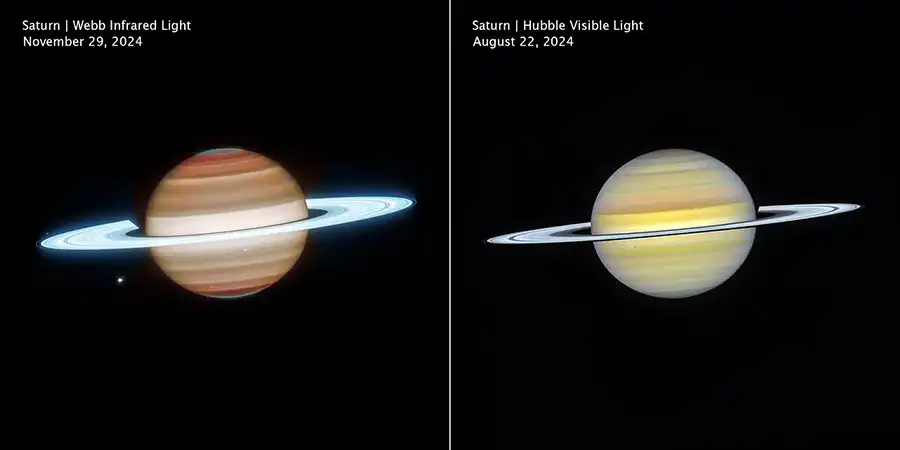 The James Webb and Hubble space telescopes reveal Saturn in infrared (left) and visible (right) light, respectively. Hubble highlights subtle cloud banding and color variations, while Webb’s infrared vision probes different atmospheric layers, bringing out detail in the planet's storms, waves, and glowing ring structures.
NASA / ESA / CSA / STScI / A. Simon (NASA-GSFC) / M. Wong (University of California); Image processing: J. DePasquale (STScI)
The two best telescopes at our disposal have captured Saturn in these images taken in 2024 and released last week. The Hubble Space Telescope took this image as part of the Outer Planet Atmospheres Legacy (OPAL) program, and the James Webb Space Telescope took its image a few months later. The images show the planet as its southern half is transitioning toward spring, with more sunlight falling on the southern hemisphere.
While Hubble has been tracking the outer planets for more than a decade, Webb has only recently joined in. Its image reveals new details in atmospheric waves and storms. A long-lived jet stream known as the ribbon wave meanders across the northern mid-latitudes, shaped by atmospheric waves. Just below that is a small remnant of the Great White Spot that was most visible in 2011 and 2012. Several other storms dot the planet's southern hemisphere. The green at Saturn's poles represents light at 4.3 microns and could come from hydrocarbon molecules suspended high in the atmosphere, or perhaps from aurora.
Read more (and see wider views with moons labeled) in NASA's press release.
The Crab Nebula's Slow-motion Explosion
In 1054 AD, Chinese astronomers noted a "new star" in Taurus that remained visible even in daytime. Now we know that that bright spot of light actually marked the end of a star 6,500 light-years away. Hubble got its first close look at the remnant of this supernova, which we now call the Crab Nebula, in 1999. Now, 25 years later, the Hubble team has released another look at this expanding remnant.
We've been watching the Crab explode for decades before Hubble imaged the remnant. But the expansion appears slow to our cameras. The gases are still blasting through space at 1,500 kilometers per second (more than 3 million mph), but because the nebula is more than 11 light-years across, even a detonation going at 0.5% the speed of light appears to move slowly from our perspective.
The newest Hubble image, taken in 2024, shows the filaments move outward over time, pushed by the particle-and-radiation wind emanating from the neutron star at the nebula's heart. The high-resolution images also help astronomers understand the Crab's 3D shape from the shadows cast by nearside filaments on the bright central haze; farside filaments cast no shadow. Colors encode the gases' temperature, density, and chemical composition.
Read more in NASA's press release and in the Astrophysical Journal.
Also, see the Webb's view of the Crab, also taken in 2024.
Newborn planet: WISPIT 2C
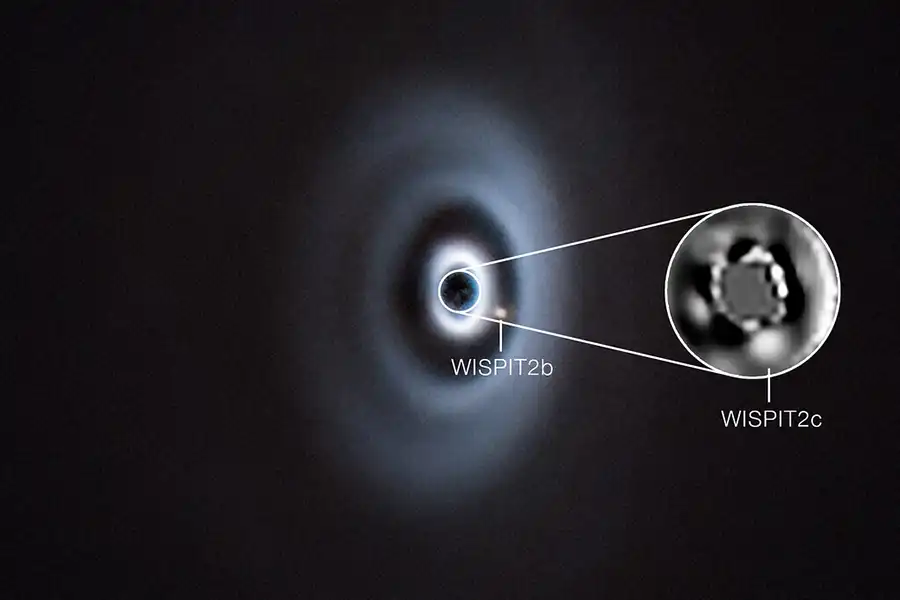 This image, taken with the Very Large Telescope shows a planetary system being born around the young star WISPIT 2. In 2025 astronomers detected a young planet, called WISPIT 2b, carving out a gap in the gas-and-dust disk that surrounds the star. Now the same team confirmed the presence of a second planet, WISPIT 2c, orbiting even closer to the star (inset).
 ESO / C. Lawlor / R. F. van Capelleveen et al.
Astronomers have photographed a second planet forming around a star known as WISPIT 2, 440 light-years away in the constellation Aquila, the Eagle.
The first planet to be imaged around this star, WISPIT 2b, was discovered in 2025 as part of the Wide Separation Planets In Time survey. That planet, about five times more massive than Jupiter, is farther from its parent star than Pluto is from the Sun, all the way out at 54-57 astronomical units (au).
Now, using the European Southern Observatory's Very Large Telescope in Chile, the same team of astronomers, this time led by Chloe Lawlor (University of Galway, Ireland), has discovered a second, closer-in planet. More massive than its sibling, WISPIT 2c is a gas giant 10 times Jupiter's mass. With an orbit of about 14 au, it's a little farther out from its star than Saturn is from the Sun. A spectrum, taken by the GRAVITY+ instrument at the Very Large Telescope Interferometer, found a clear signature of carbon monoxide, a molecule common to giant planets (including all four in the solar system).
This is only the second system in which astronomers have imaged two forming planets, the first being PDS 70. Both systems are about 5 million years old and actively forming planets in disks of dust and gas that surround the star. WISPIT 2 has a more extensive disk, though, with additional gaps that might also host planets awaiting detection.
Read more in the European Southern Observatory's press release and in the paper to appear in the Astrophysical Journal Letters.
















 English (US) ·
  French (CA) ·