

 3 months ago
94
3 months ago
94
PROTECT YOUR DNA WITH QUANTUM TECHNOLOGY
Orgo-Life the new way to the future Advertising by AdpathwayA rare black-crowned night heron has been spotted on an estate in the south-west of England where an innovative river “reset” is transforming the area into an oasis for birdlife.
The heron was caught on camera in a jungly corner of the Holnicote Estate, where conservation experts have been restoring the landscape by allowing a river to return to its natural course.
As well as the heron, charismatic birds including white-tailed eagles, white storks and cranes have been seen at the National Trust estate.
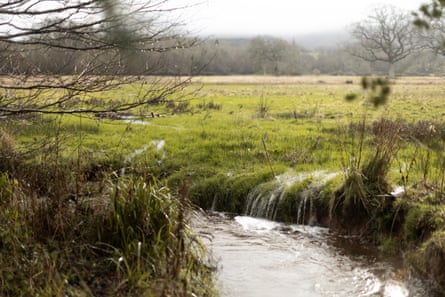
Ben Eardley, restore nature project manager for Somerset coast and countryside, said it had been incredible to see the heron. “It’s rare to see this wetland species in the UK and so exciting that we observed one on our estate cameras on three consecutive days,” he said.
Eardley believes that more birds were congregating because so much of southern England is dry, while parts of Holnicote remain wet and lush.
“Everywhere else is parched, so we’re seeing lots of wildlife utilise it and lots of interesting bird species arrive. It’s proving a real refuge.”
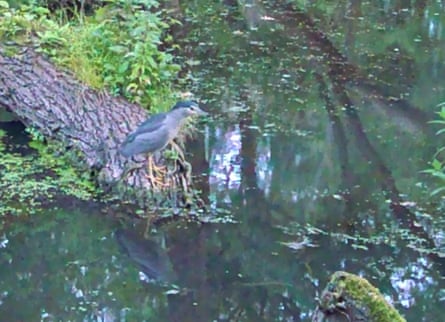
As well as birds, the estate is providing a home or hunting grounds for water voles, otters, pine martens and grass snakes.
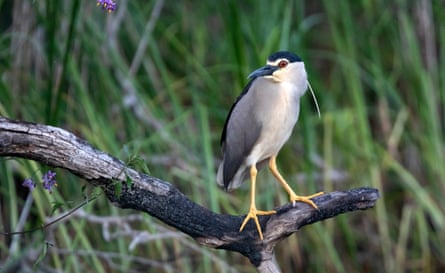
The black-crowned night heron typically grows up to 66cm (26in), roughly half the length of the grey heron, which is commonly seen in the UK.
It has grey plumage, yellow legs and a black “cap” from which trail long white plume feathers. As its name implies, it is mainly active at night.
The bird is widespread across Africa, Asia, the Americas and mainland Europe. According to the British Trust for Ornithology, the first confirmed night heron breeding in the UK was recorded in Somerset in 2017 but it is categorised as a scarce visitor.
Holnicote’s night heron was spotted close to a camera set up to provide a livestream of an area where beavers have been introduced to play a part in the landscape restoration.
Eardley said there were trout, sticklebacks, eels and European bullhead fish in the water there. “When we set up the camera, we weren’t sure how popular it would be but people have really got into it. The night heron appeared front centre.”
Over the past 500 years, England has lost approximately 90% of its wetlands. Work is being done through organisations and partnerships to restore, enhance, increase and connect the lost habitats.
For centuries the River Aller at Holnicote had been carefully controlled by landowners and farmers, largely confined to a narrow channel.
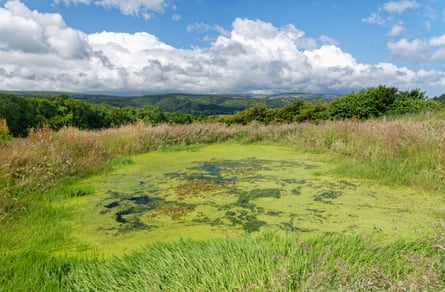
Inspired by schemes in the wilds of Oregon in north-west US, a stretch of the river was liberated, allowing the water to spill out and find its own way, creating smaller streams, more pools and boggy areas, better for flora and fauna, with the slower water flow making flooding less likely.
Eardley said it had led to a surge in creatures including reptiles, amphibians and insects – which in turn attracted predators.
While the night heron and white-tailed eagles – which have been re-introduced on the Isle of Wight after being driven to extinction in the UK – have been seen close to the beavers’ home, the cranes and storks have frequented the wider estate. “The birds are very visible indicator of an ecosystem getting more diverse.”
















 English (US) ·
  French (CA) ·