

PROTECT YOUR DNA WITH QUANTUM TECHNOLOGY
Orgo-Life the new way to the future Advertising by Adpathway
One of the biggest challenges when teaching anatomy is helping students move beyond memorizing lists of organs and instead understand that every body system works together to keep us alive. Students may know that the lungs belong to the respiratory system or that the kidneys are part of the urinary system, but they often struggle to explain how these systems interact.
This Body Systems Matching activity was designed to bridge that gap. Students begin by identifying the major body systems, then reinforce their understanding through matching exercises before applying their knowledge to real-world scenarios that demonstrate how multiple systems work together to maintain homeostasis.
Step 1: Identify the Major Body Systems
The first worksheet introduces students to the major organ systems using a series of simple anatomical illustrations. Instead of overwhelming students with dozens of labels, each figure highlights a single body system, making it easier to recognize the organs that belong together.
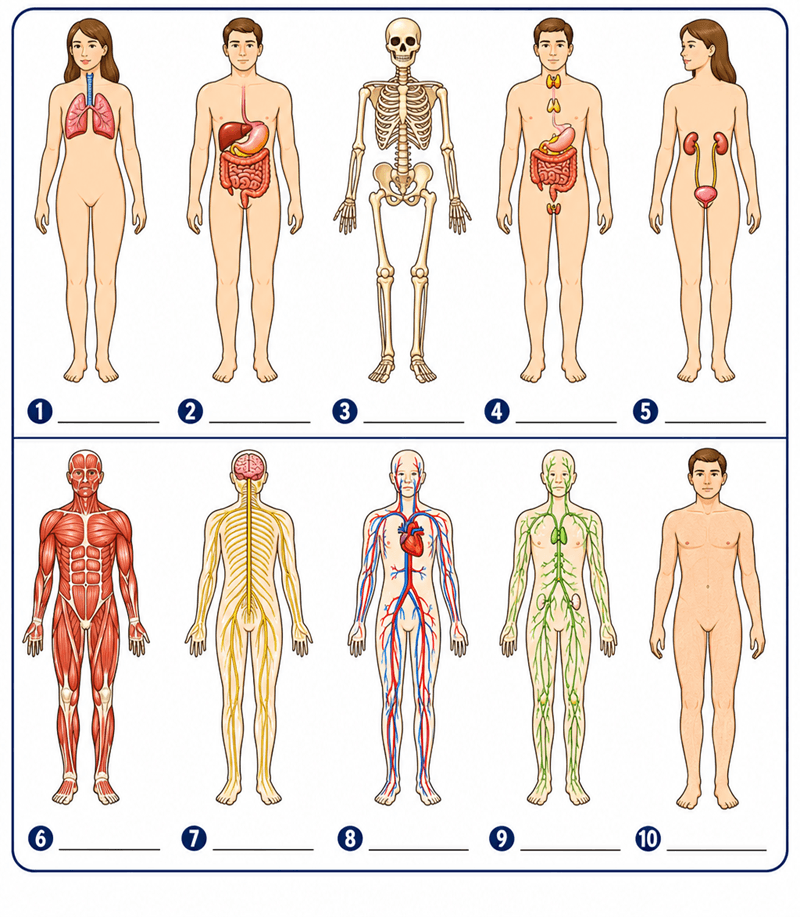
Students identify systems including:
- Respiratory
- Digestive
- Skeletal
- Endocrine
- Urinary
- Muscular
- Nervous
- Circulatory
- Lymphatic
- Integumentary
This visual identification activity works well as an introductory lesson, review, or bell-ringer before diving into the functions of each system.
Step 2: Match Each System to Its Function
After recognizing the body systems visually, students complete a matching activity that connects each system to its primary function.
Rather than simply recalling vocabulary, students practice making connections between structure and function. For example, they match the respiratory system with gas exchange, the circulatory system with transporting oxygen and nutrients, and the nervous system with coordinating responses to internal and external stimuli.
This section reinforces essential anatomy concepts while helping students develop a stronger understanding of how each system contributes to the body’s overall function.
Step 3: Challenge Questions
The final section asks students to apply what they have learned to everyday situations. Instead of asking, “What is the function of the respiratory system?” students answer questions like:
- Which body systems work together when you exercise?
- What systems respond after eating a large meal?
- How does the body respond to dehydration?
- Which systems help you pull your hand away from something sharp?
- How do body systems work together to heal wounds?
Related Resources
Chapter 1 Guided Notes and Chapter 1 Slides
Interpreting Graphics: Feedback Loops
Systems of the Body Graphic Organizer
Gummy Bear Dissection – Practice with Body Planes and Terminology













 English (US) ·
  French (CA) ·