

 9 months ago
229
9 months ago
229
PROTECT YOUR DNA WITH QUANTUM TECHNOLOGY
Orgo-Life the new way to the future Advertising by AdpathwayAstronomers have measured the mass of a free-floating planet for the first time. Comparable to Saturn, it’s surprisingly massive for such rogue worlds.
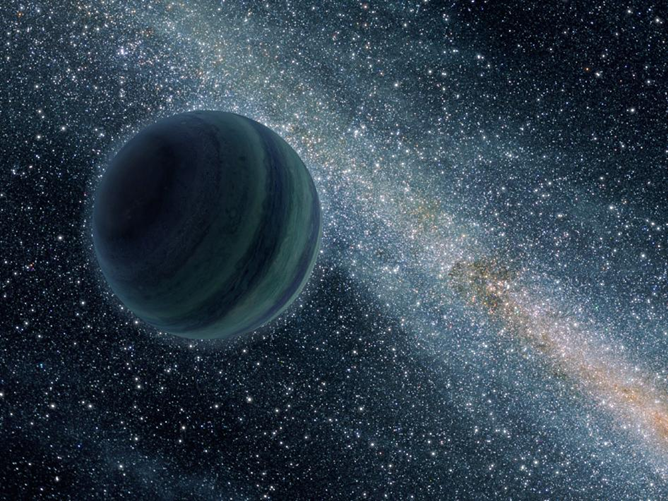 An artist’s impression of a free-floating planet drifting through space with the Milky Way in the background.
 NASA / JPL
Most planets orbit comfortably around their stars, but some worlds are not so lucky. Astronomers have discovered a number of these rogue planets, which float through the Milky Way untethered to a solar system.
Now, for the first time, they’ve directly measured the mass of one of these worlds, finding that it’s around Saturn’s mass. The planet might’ve been flung far from its star through a past gravitational interaction. But such encounters are surprising for a planet with such a hefty mass.
“This is the first clear detection and precise mass measurement of a likely rogue or very wide-orbit planet with a mass well below that of Jupiter,” says Scott Gaudi (Ohio State University), who wasn’t involved in the study.
Confirming the nature of free-floating worlds can shed light on the dynamic interactions that sent them wandering. The discovery of this Saturn-mass world is direct evidence for a planet that formed in its natal solar system before being cast out into the cosmos, either far from its original orbit or out of its solar system entirely.
Saturn Gone Solo
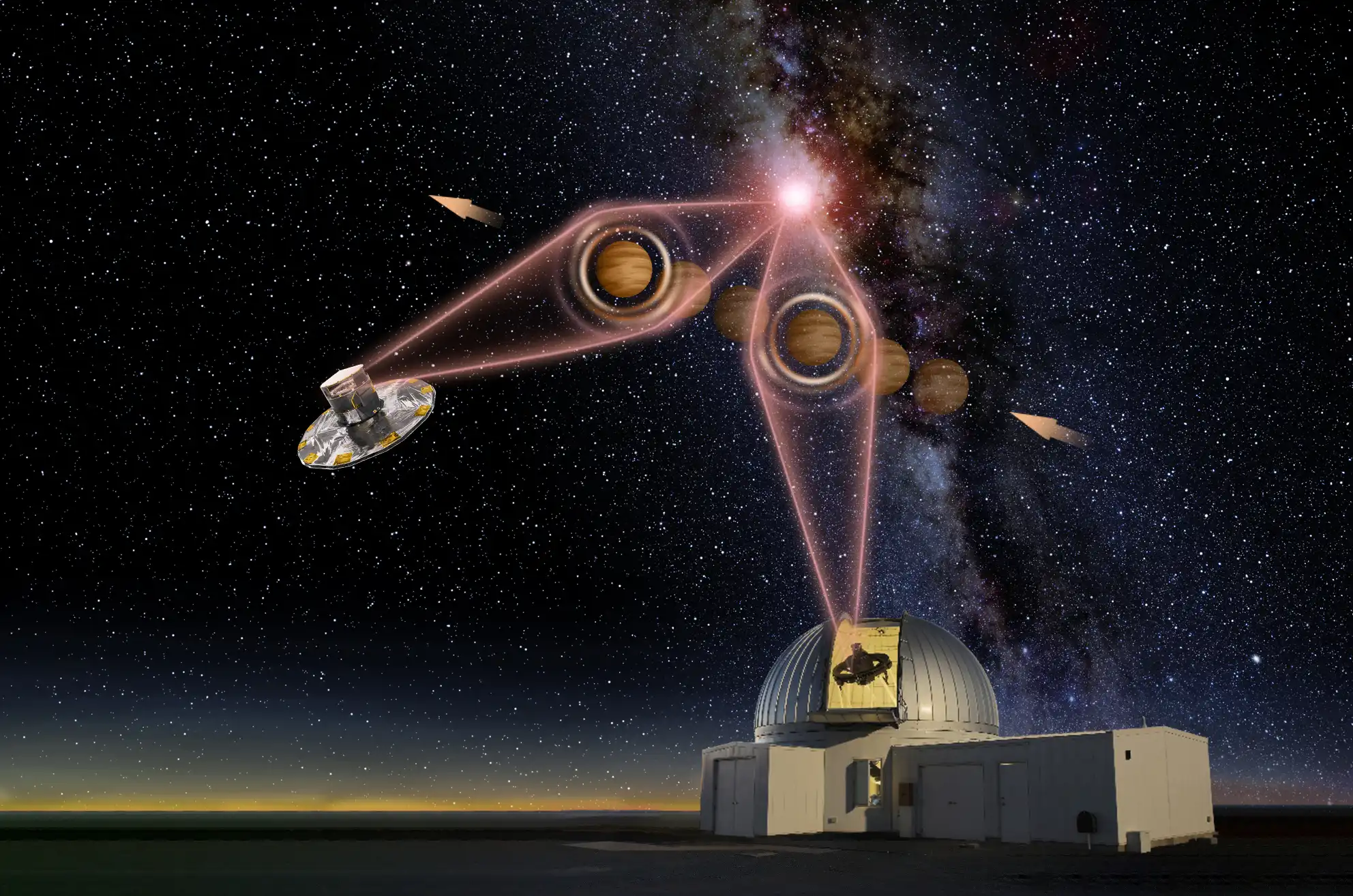 Observatories on the ground and in space captured a microlensing event, during which a planet passed in front of a star, bending and magnifying its light. Based on measurements taken from space and from the ground, a team of astronomers determined the planet's mass to be a little less than Saturn's.
Yu Jingchuan
Astronomers can detect rogue planets by a technique called gravitational microlensing. Because the gravity of a massive object, such as a planet, bends surrounding space, it can magnify and bendthe light from a bright background source, such as a star.
Multiple ground-based telescopes identified the event on May 3, 2024. Serendipitously, the object was within the Gaia space telescope’s field of view at the time, meaning that astronomers could simultaneously observe the same event from space.
Those measurements yielded a parallax, or the apparent shift in the planet and star’s positions when seen from two different vantage points. Measuring the relative parallax between the planet and the background star let astronomers pinpoint how far apart they are, which is crucial for measuring the planet’s mass.
Astronomers have detected nine other candidate rogue planets via microlensing. But because they weren’t observed from different vantage points, such as from Earth and space, their distances weren’t known, so their masses could be only roughly estimated.
Combining the planet’s distance with light curves from Gaia and ground-based telescopes that show how the star’s brightness was magnified over time, the team found that the planet has a mass around 22% of Jupiter’s — for comparison, Saturn is 30% Jupiter’s heft — and is located around 10,000 light years away from us.
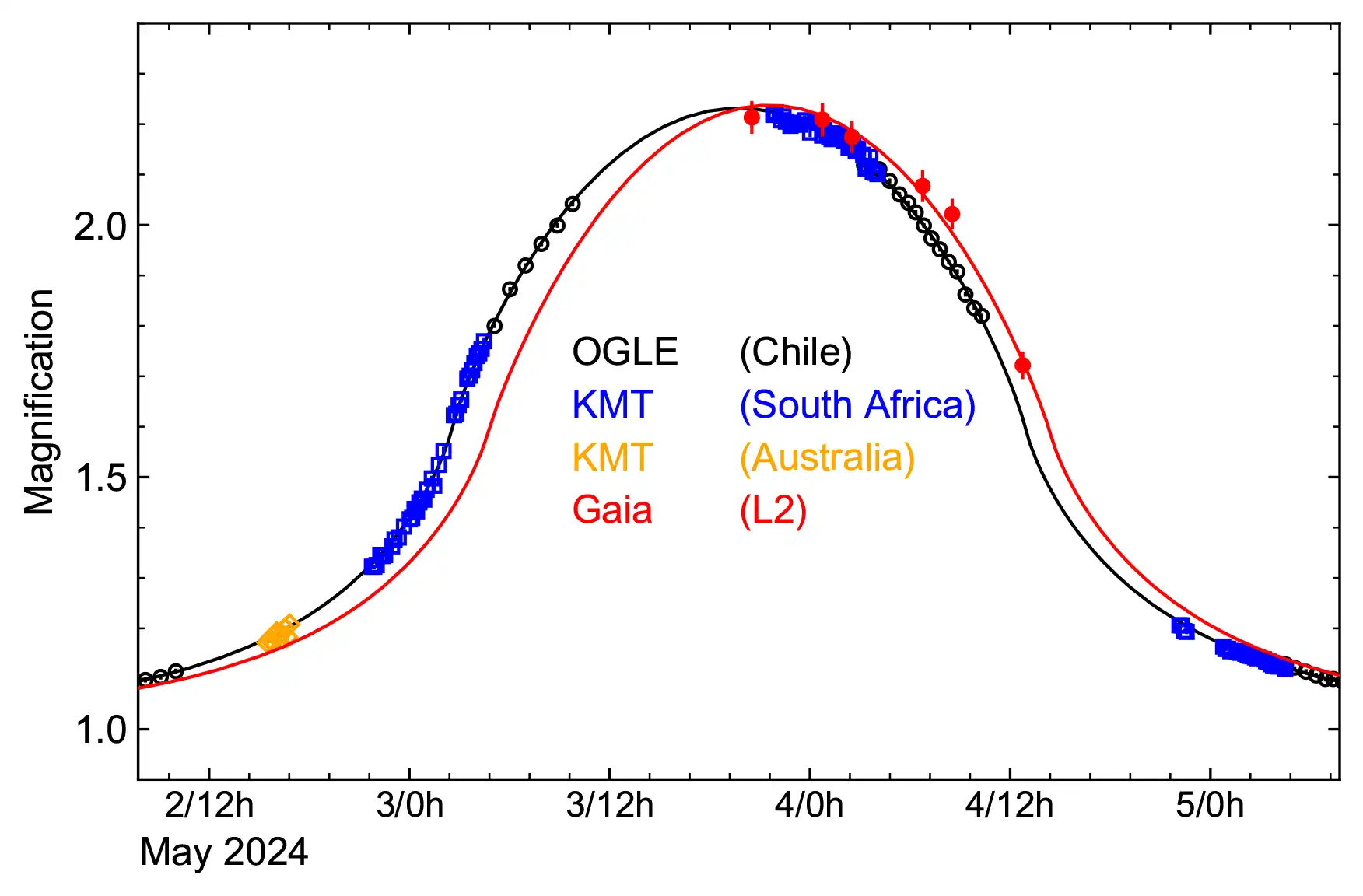 This light curve shows the brightening and fading of a background star, thanks to the magnifying effect of a Saturn-mass planet in the foreground. Data collected by the Gaia spacecraft are slightly offset from data collected from ground-based telescopes on Earth.
Dong et al. / Science
A gravitational interaction, perhaps with another planet, probably flung this exo-Saturn into an extremely wide orbit or completely out of its system, according to Subo Dong (Peking University, China), lead author of the paper published in Science. “A passing nearby star can also gravitationally strip a planet away from its host star,” Gaudi adds, or tug it out far enough to where it appears completely isolated.
However, the planet’s larger mass, hovering around that of a gas giant, makes it an unusual victim of gravitational interactions with another planet. “Generally, smaller planets are more susceptible to being repelled or ejected this way,” says Dong.
“Ejection typically requires interactions with even more massive planets,” Gaudi says. “As a result, rogue or wide-separation planets with masses like this one are expected to be fairly rare.”
In the Planetary Desert
In fact, the planet’s rarity places it right in the center of a so-called “Einstein desert,” where there’s a scarcity of microlensing events for objects of a certain mass. Astronomers believe that this desert corresponds to a gap between true planets and the more massive worlds known as brown dwarfs that astronomers have identified floating around the galaxy.
Brown dwarfs probably form more like stars — collapsing directly out of a gas cloud — while smaller worlds form like planets, coalescing in a swirling disk of material around their stars before being swept out of the system.
All nine previously discovered free-floating worlds appear to have been of planetary mass, Dong says. Without precise parallax measurements, astronomers used rougher methods to estimate those objects’ distances, and therefore their masses. They were “substantially smaller than Jupiter in mass, down to about Earth mass,” Dong says.
This planet, though, is more massive than expected, placing it squarely in the “desert.” Free-floating gas giants are not impossible though, Dong says, just relatively rare.
Several upcoming missions will enable astronomers to measure the mass of more rogue worlds. NASA’s Roman Space Telescope and China’s Chinese Space Station Telescope (CSST), both expected to launch in late 2026, will carry out large-sky surveys expected to detect hundreds to thousands of rogue planets using the microlensing technique. Simultaneous monitoring with ground-based telescopes will allow astronomers to measure the masses of the planets directly.
“With Roman and CSST, we expect to gain much better insights into the distribution of free-floating planets at the low-mass end, down to Mars and even lunar masses,” says Dong. Future observations will help reveal the different kinds of rogue worlds out there and the dynamic interactions that can fling planets far out of their systems.
















 English (US) ·
  French (CA) ·