

PROTECT YOUR DNA WITH QUANTUM TECHNOLOGY
Orgo-Life the new way to the future Advertising by AdpathwayBug of the Week is written by "The Bug Guy," Michael J. Raupp, Professor of Entomology at the University of Maryland.
August 17, 2026
Subscribers to Bug of the Week have noted the somewhat perplexing juxtaposition in the viewpoint of this blog. Sometimes we advise extreme prejudice against bugs like mosquitos and bed bugs, and sometimes we advocate benevolent treatment for insects like Monarch butterflies and solitary bees. This week we do a little of both with paper wasps, Polistes spp. Many of us have had the enlightening experience of coming just a bit too close to a paper wasp nest and being rewarded with a memorable sting. This happened to me recently as I tried to move two pieces of patio furniture and was surprised by the sting of a paper wasp intent on protecting her nest, which was nestled beneath the arm of a chair.
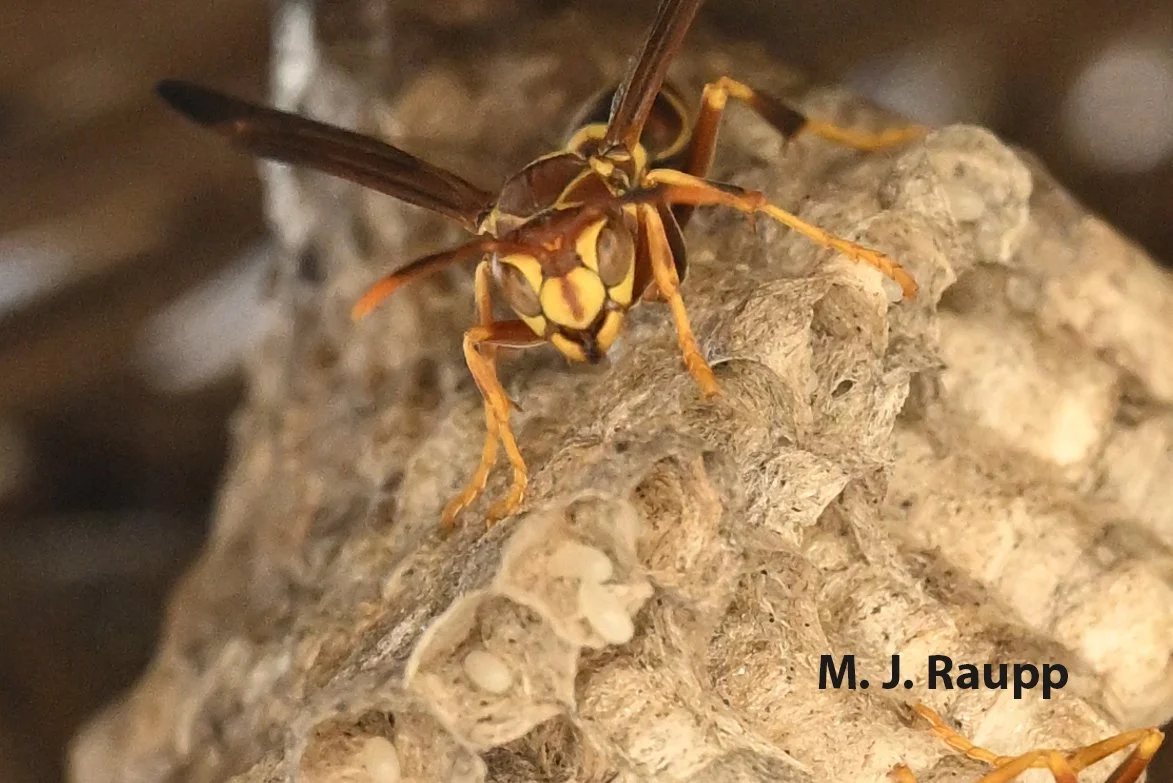
“Come one step closer to these eggs and I will teach you a lesson!”
While nests are typically located beneath overhangs of houses, sheds, or entryways of homes, virtually any horizontal surface shielded from rain can be a nesting site. In temperate regions like the DMV, in early spring nests are initiated by a female wasp called a foundress. The foundress survived the wicked winter in a sheltered spot, perhaps beneath the bark of a tree or behind a loose piece of siding on a home. The foundress uses her powerful jaws to gather wood fiber from trees and shrubs. She chews the fiber into pulp and molds the pulp into papery cells. The ever-enlarging nest is shaped like a parasol and suspended by a narrow stalk called a pedicel. After the first few hexagonal cells are constructed, the foundress deposits an egg within each chamber.
While rearranging some patio furniture, a paper wasp delivered an unexpected sting when I moved a chair. Beneath the arm of the chair, two fierce females were ready to defend their small nest. Nearby, under a picnic table, a larger nest was guarded by several wasps. In another video, watch how I evict these paper wasps from my furniture and house without the use of insecticides.
Eggs soon hatch into legless larvae. Her youngsters have healthy appetites, and the queen gets busy hunting food for her babes. Not all potential foundresses are successful in establishing a colony. Some may join an established nest where they assist the resident foundress in caring for the brood. The colony grows as summer progresses and more than a hundred workers may be produced in some species of paper wasps. Caterpillars are one of the favorite menu items for larvae of paper wasps, and in this way paper wasps are our allies in the fight against leaf-munching garden pests. By capturing droves of caterpillars, paper wasps reduce damage to our valuable crops and landscape plants. In addition to eating pests, paper wasps provide a second ecosystem service by pollinating plants. I often see them visiting mountain mints in my garden and goldenrods in the meadow.
Enough of the goodness of paper wasps. Let’s talk about what you can do at this time of year if you discover paper wasp nests in your patio furniture or under the roof of your porch. There are several commercial wasp sprays that will kill resident paper wasps and their youngsters developing in the papery nest. If you are allergic to stings of bees or wasps, or if you are simply fearful of wasps and their stings, wasp sprays may be a good option. You could, of course, employ an exterminator to get the job done. Due to their service roles as pollinators and biological control agents, I chose not to employ the insecticide route. Instead, I simply deliver a watery eviction notice to the wasps and encourage them to build their nests elsewhere.
Due to their service roles as pollinators and biological control agents, I chose not to employ the insecticide route. Instead, I simply deliver a watery eviction notice to the wasps and encourage them to build their nests elsewhere. I use a high-powered stream of water from a garden hose to displace the wasps. While they are floundering in disarray or have vacated the premises, I simply remove the nest and toss it on the lawn where fierce, hungry predators will dine on the eggs and developing larvae. Often a single watery eviction will suffice, but sometimes wasps will return and try again to build a nest. After another episode or two of a watery eviction, wasps seek other places to build their nests.
In a previous episode, I recommended simply knocking the nest down with a broom very early in season when but a single wasp or two was present. But by late summer, several aggressive females are present and ready to defend the nest. Instead of a broom, I use a high-powered stream of water from a garden hose to displace the wasps. While they are floundering in disarray or have vacated the premises, I simply remove the nest and toss it on the lawn where fierce, hungry predators will dine on the eggs and developing larvae. Often a single watery eviction will suffice, but sometimes wasps will return and try again to build a nest. After another episode or two of a watery eviction, wasps seek other places to build their nests. This mode of displacement allows the foundress and other wasps to continue their service as pollinators and assassins of pests and live to start another nest or perhaps join a different colony. So, maybe have a look beneath overhangs, in the carport, or at the entryway to your home and eliminate a potential problem now. If you discover a nest out by the barn or in another less worrisome place, maybe watch at a distance the antics of these interesting beneficial insects.
Acknowledgements
Two marvelous references, “The Insect Societies” by E.O. Wilson and “Biological studies of Polistes in North Carolina (Hymenoptera: Vespidae)” by R.L. Rabb, were used in the preparation of this episode. We thank Anne and Jim for providing inspiration for this episode.











 English (US) ·
  French (CA) ·