

 8 months ago
183
8 months ago
183
PROTECT YOUR DNA WITH QUANTUM TECHNOLOGY
Orgo-Life the new way to the future Advertising by AdpathwayDisclaimer: This site is not affiliated with the National Hurricane Center, Hurricane Hunters, Storm Prediction Center, or National Weather Service. ALL forecasts herein are the result of my analysis, (to which you will see me at times, insert excerpts from various agencies due to the nature of the importance of the information) and I am solely responsible for the content. As ALWAYS, follow the National Hurricane Center, National Weather Service, and your local Emergency Management officials for emergency decisions. In addition, this is strictly a FORECAST OFFICE. I CANNOT make decisions regarding travel plans, etc. My purpose, is to provide you the information, based solely on information I analyze, and the accuracy of the information at hand of the time of analysis, so you may make informed decisions.
(T. F. “Storm” Walsh)
Thanks to all of you that still follow my forecasts. I truly appreciate each and every one of you!
For those who have donated to my site, your help has been greatly appreciated. If you are not aware, donations to my site help pay for subscriptions to sites I use as well as software updates, which provide all the models and information used in my forecasts. To donate, please click the DONATE button to the right side of the page, or on the graphic of the dog. Any help you provide is immensely appreciated!
DONATIONS NEEDED AND APPRECIATED


I will reiterate, my forecasts are based on the available information at the time of analysis, and are only as accurate as the information analyzed and the solutions provided.
Good day everyone!
I will be out of the office on JAN. 27 to travel to Gainesville.
The Storm Prediction Center does not indicate any severe weather probabilities, for the week, however the CSU – MLP and NSSL ML forecast maps are currently indicating a probability for DAY 3 and DAY 4. Should a risk be introduced by the SPC, it will be included in the future synopses.
CSU – MLP AND NSSL ML DAY 3 AND 4 SEVERE WEATHER PROBABILITY


I will be using the ECMWF model for the main forecast graphics for winter weather forecasts. Over my years of forecasting, I prefer this model, as numerous articles depict the ECMWF to be the more accurate model as compared to the GFS. Here is an excerpt from an article I found:
The ECMWF model’s resolution is 9km or about 5.5 miles. The GFS has a resolution of 25km or roughly 15.5 miles. This resolution is the distance between two points on a grid that the weather model uses. The smaller the number, the better the resolution/quality of a forecast. The European Center for Medium-Range Weather Forecasts (ECMWF) model is another global numerical weather prediction model that is highly regarded for its accuracy. It employs advanced data assimilation techniques and sophisticated numerical algorithms to simulate atmospheric processes. The ECMWF model provides high-resolution forecasts for various meteorological variables, enabling forecasters to make more precise predictions. According to current weather forecasting standards, the ECMWF model is generally considered the most accurate for predicting snowfall totals, often performing slightly better than American weather models like the GFS.
For forecast temperatures less than 72 hours out in the forecast period, I prefer using the NAM (North American Mesoscale) model. This is what we refer to as a regional model, vice a global model, with its forecast grids within the North American continent. The NAM 3km only goes out to 60 hours, and the NAM 12km goes out to 84 hours.
Should a forecast indicate very cold temperatures, or cold snowy weather:

The following link is from the Animal Welfare Act, and provides guidelines for temperatures regarding your animal:
ANIMAL WELFARE ACT
https://www.aphis.usda.gov/sites/default/files/ac-tech-note-temp-req-dogs.pdf
UNITED STATES SATELLITE LOOP

WPC 12Z SURFACE MAP (LINKED TO SURFACE MAP/RADAR ANIMATION)

The QBO now appears to be in the beginning of shifting to the westerly phase according to the recent QBO graph, however I am in disagreement with this, as the winds from 30 mb – 10 mb indicate otherwise, as compared to the comparison graphs. It closely resembles the easterly phase from JAN 16.
CURRENT QBO PHASE

JAN 16 2026

QBO GRAPH PHASE COMPARISONS


How the QBO influences the polar vortex:
Easterly phase (QBO-E): This phase is associated with a weaker and more disrupted polar vortex. The weaker vortex is less able to contain arctic air, which can then escape and lead to colder outbreaks in lower latitudes.
Westerly phase (QBO-W): In contrast, the QBO-W phase is linked to a stronger and more stable polar vortex.
The following are links to articles regarding the QBO and SSW:
https://en.wikipedia.org/wiki/Quasi-biennial_oscillationhttps://en.wikipedia.org/wiki/Sudden_stratospheric_warminghttps://climateimpactcompany.com/quasi-biennial-oscillation-phase-and-sudden-stratospheric-warming-events/
https://www.google.com/url?sa=t&source=web&rct=j&opi=89978449&url=https://journals.ametsoc.org/downloadpdf/view/journals/atsc/71/1/jas-d-13-096.1.pdf
I know these synopses are probably getting boring, but there is really no change to the forecast yet. With the QBO now supposedly shifting into a westerly phase, the ECMWF stratosphere temperature and pressure anomalies forecast still indicates a sort of “tripole” increase in warming temperature and pressure anomalies. Though not situated over the Polar region, the forecast pattern will be as such to still create somewhat of a disruption in the Polar Vortex due to a tri-pole of various wind patterns, allowing for dips in the 500 mb level wind pattern and the 200 mb jetstream pattern. Higher pressure anomalies will be located close enough over the Polar region by the 27th, allowing for a continued disruption in the Polar Vortex.
00Z ECMWF 10 MB TEMPERATURE AND PRESSURE ANOMALIES 22 JAN. – 27 JAN.


As this setup continues to progress, the current “Rex Block” pattern will transition back to an”Omega Block” by the 27th. This will allow for Arctic air to continue plunge south into a good portion of the U.S.
ECMWF 00Z 5 DAY TEMPERATURE ANIMATION

This Rex and Omega block pattern can be seen in the 500 mb and 200 mb charts. You will note a deep dip in the jetstream in the 200 mb forecast chart, allowing for cold air to come south. You will note the differences in the following images between an Omega and Rex block:
OMEGA BLOCK (CLICK FOR EXPLANATION)

ECMWF NORTHERN HEMISPHERE 500 MB FORECAST MAP FOR 12z 22 JAN. AND 27 JAN.


200 MB FORECAST MAP (INDICATES JETSTREAM POSITION) 12Z 22 JAN. AND 27 JAN.


As the current continued progression of alternating high and low pressure across the U.S. continues, cold, strong high pressure will dominate the pattern. By this weekend, low pressure will develop across the Gulf Coast states bring in warmer air and moisture, moving quickly toward the ENE. This, along with cold high pressure building back in and associated wind flow around the combination of the low and high pressure, along with the forecast stratospheric setup, mid level pattern and jetsream pattern during the next 5 days, Arctic air will continue over central portions of the U.S., eastward with freezing temperatures once again reaching the Florida Peninsula on the 27th. As a result, snow will once again affect the large portion of the central U.S., all the way south to a portion of Texas, and ENE over the Great Lakes and NE regions. Blizzard conditions could be experienced over the Great Lakes region. Along with this pattern, decent amounts of freezing rain are now in the forecast, along with some sleet. The following you tube video gives a brief explanation of the difference between the both
FREEZING RAIN AND SLEET
https://youtu.be/r0J74ex6Iyo
00Z 120 HOUR ECMWF MSLP ANIMATION

ECMWF 00Z 120 HOUR SURFACE WINDS FORECAST


ECMWF SIGNIFICANT WAVE HEIGHT FORECAST

ECMWF MINIMUM TEMPERATURE FORECAST FOR JAN. 27, 2026


The following are forecast snowfall accumulation totals for the next 5 days, and precipitation totals by type.
ECMWF 120 HOUR FORECAST KUCHERA SNOWFALL TOTALS AND PRECIPITATION TOTALS BY TYPE

FREEZING RAIN

SLEET

SNOWFALL TOTALS

FREEZING RAIN

SLEET

The following are minimum temperatures for the succeeding day from the issuance of this synopsis:
MINIMUM AND APPARENT TEMPERATURES JAN. 23, 2026


APPARENT TEMPERATURE


WUNDERGROUND FROST AND FREEZE FORECAST FOR JAN. 23, 2026

WINTER STORM SEVERITY INDEX DAY 1 – 3 (LINKED FOR INTERACTIVE MAP)

The following NWS Watch / Warning map will provide local NWS information for your area. Click the image, then once it refreshes, click on your area of interest to view forecasts, any special weather statements, hazards or advisories for your area.
NWS WATCH / WARNING DISPLAY (LINKED…CLICK MAP, THEN YOUR AREA)
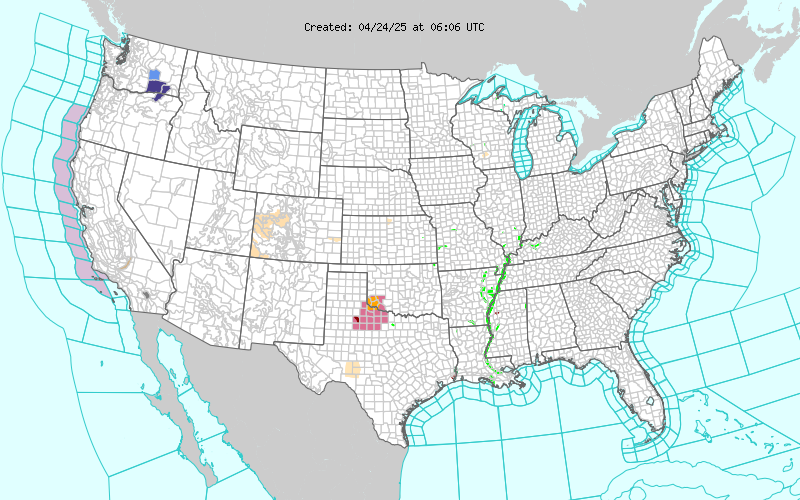
NWS DOPPLER RADAR LOOP (LINKED, CLICK RADAR MAP)

RAP RADAR (CLICK IMAGE THEN GO TO LOOP DURATION AND PICK LENGTH OF LOOP, THEN CLICK RADAR SITE)
WUNDERGROUND RADAR SUMMARY MAP (CLICK FOR UPDATES)
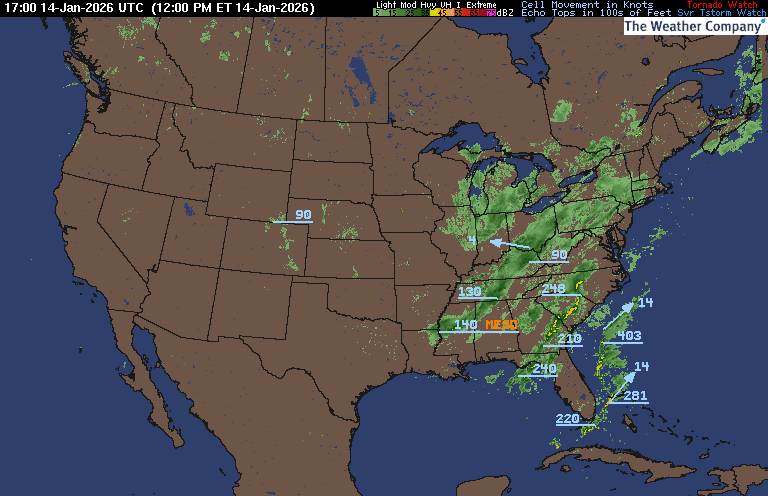 PRECIPITATION TYPE (CLICK TO ACCESS ANIMATION FEATURE)

CARIBBEAN RADAR (CLICK IMAGE)

You may direct any questions by contacting me personally, ANYTIME, at: [email protected]
Have a blessed day!
T. F. “STORM” WALSH III
GMCS, USCG (ret)
METEOROLOGIST / HURRICANE SPECIALIST /SEVERE WEATHER SPECIALIST













 English (US) ·
  French (CA) ·