

 5 hours ago
4
PROTECT YOUR DNA WITH QUANTUM TECHNOLOGY
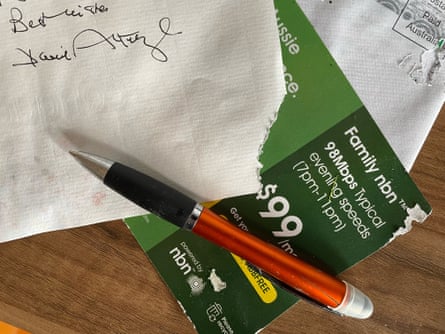
Orgo-Life the new way to the future Advertising by AdpathwayWe’ve all heard of snail mail – a term popularised since the advent of electronic mail – but who knew that snails eat mail? It might sound far-fetched but it’s true.
We have it on good authority from the ecologist Simon Mustoe, who said snails ate his letter from Sir David Attenborough, a BBC report announcing the closure of a Northumberland Royal Mail postbox because of snails “munching the mail”, and desperate people on the forums of the Australian hardware chain Bunnings claiming snails have “a real appetite for postal letters” and can “eat a whole letter in two days”.
This didn’t escape the comedian Jimeoin, who joked after moving to Australia that he had found a snail eating his mail and said to it: “You stupid snail, you’re supposed to eat lettuce, not letters.”
Dr John Stanisic, AKA the Snail Whisperer, says letters are processed vegetable matter so it makes sense that snails have an appetite for them – and not just for mail. Preparing for a two-day photoshoot for the Australian science program Catalyst “some years back”, Stanisic set up some snails in a Chinese takeaway food container and got a rude shock the next day: “Somehow, through the night, they got out and they’d eaten the front page of my running sheet.”
Exploring this is like following Alice into a virtual wonderland of these ancient gastropod molluscs – which include the eye-catching Mount Kaputar pink slug, the giant African snail, which can grow to the length of an adult human’s forearm, and the golden-haired snail – that harks back 350m years.
Mustoe, the author of Wildlife in the Balance and How to Survive the Next 100 Years: Lessons from Nature, explains that snails, one of the oldest known animal groups, consume waste, which is critical for ecosystems. So, he reasons, they could have helped prevent the late Devonian mass extinction which was caused by a surge in plant evolution and not enough animals to eat them.
Dr Isabel Hyman, a snail and slug enthusiast from the Australian Museum, says: “They’re very important in terms of their position in the food web. People tend to have a stronger connection to the idea of the mammals and birds … but those things need a flourishing ecosystem, which needs all the little invertebrates.”
Stanisic, who authored A Guide to Land Snails of Australia and is an honorary research fellow at the Queensland Museum, says Australia has about 2,500 native species, with exotic names including the rosy wolf snail, the red triangle slug and the leopard slug. He thinks they are fascinating. “People seem to think a good snail is a dead snail, but I’ve come to realise that snails are a very complex animal in their behaviour and they’ve really got everything down to a T.”
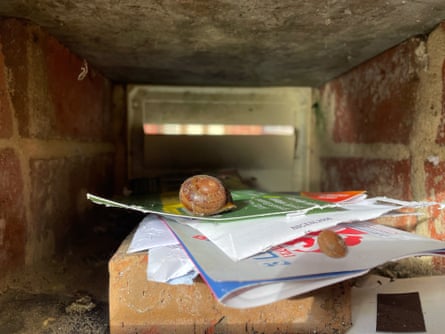
Australian native snails don’t do well in disturbed habitats. It’s the common garden variety, introduced from Europe 120 years ago, that appear to be the letter-munching culprits. They are most likely to seek refuge in letterboxes in humid conditions and a ready source of food is a bonus. Moisture is a matter of survival for snails, Stanisic explains, which they need to create two types of mucus: one they exude from cells under their “chin” to create slime trails to walk on. “The other is this slime network over their entire body, which just pumps out moisture all the time to keep the snails active.”
Hyman concedes that in Australia common garden snails can be considered pests – “that give a really bad rap to all the native species” – but urges a mindful approach to controlling them. “I have no compunction in feeding them to blue tongue lizards or something like that. What we don’t want to do though is introduce poisons that might also be impacting our native invertebrates.”
Blue tongue lizard populations are collapsing in urban areas because of these poisons, according to Mustoe. Snail pellets can kill their natural predators, which in Australia include birds, mammals, insects, toads, turtles and wild turkeys. Snail pellets can also kill pets – personally I know someone whose French bulldog found a packet, munched on them and died.
How do we stop them eating our mail without hurting innocent bystanders? Hyman recommends a two-pronged approach. First, copper tape provides an effective barrier by creating an uncomfortable electric charge when the snail’s mucus contacts the metal. This can be combined with creating a sharp angle, which they don’t like crawling over.
She adds that sand could be placed around letterboxes, which is uncomfortable for snails to slither over. In a similar vein, others suggest diatomaceous earth, coffee grinds or crushed eggshells. Snail baits are an effective option, according to Stanisic, but they will kill native snails as well so shouldn’t be used if your property borders any undisturbed habitat, like bushland, where they are likely to be found. Products containing iron are also safe options – but again will kill native snails.
More broadly, Mustoe has a pragmatic approach. “There’s no magic bullet with any of this stuff because you’re looking at animals that have been evolving for hundreds of millions of years, who are among the most resilient and widespread animals on the planet. Slow and steady wins the race – you’re never going to beat them.”
He suggests humans need to be more resilient. “Clean your letterbox out and check your mail regularly.”















 English (US) ·
 French (CA) ·