

 20 hours ago
11
20 hours ago
11
PROTECT YOUR DNA WITH QUANTUM TECHNOLOGY
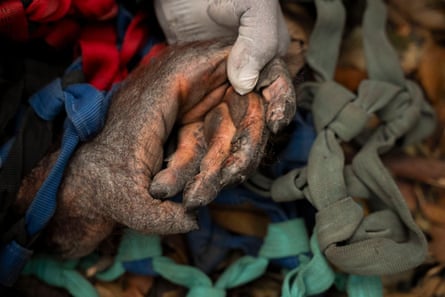
Orgo-Life the new way to the future Advertising by AdpathwayThe mother’s hands were peeling from walking on the torched ground. Her eight-month-old baby, which clung to her side, was dehydrated and thin. The pair, named Mama Abu and Abu (“ash” in Indonesian), were found in an oil palm subsidiary estate, rescuers say.
The orangutan pair were saved last month from wildfires that are devouring Indonesia’s forests and peatland, unleashing thick smog, and destroying the habitat of some of the planet’s most vulnerable species.
Primate specialists from the International Union for Conservation of Nature (IUCN) have called for urgent international assistance to help control the fires, warning this week that thousands of orangutans could be killed, injured or displaced.
Wildfires happen every year in Indonesia, where fire is often used to clear land to make way for palm or pulp plantations. But the arrival of a supercharged El Niño has brought especially dry conditions, causing blazes to spread rapidly across parts of Sumatra, Kalimantan (the Indonesian part of Borneo) and Papua.
The fires have also taken hold across peatland, which is extremely hard to extinguish as it smoulders underground. In its natural state, it should be waterlogged, but over recent decades, vast areas have been drained by industrial agriculture, leaving it highly flammable.
Habitat containing 52% of the total Bornean orangutan population is now affected by the fires, according to a statement from the IUCN’s primate specialists.
They are not the only animals affected, however. Blazes have also spread into the habitats of five gibbon species, all of which are listed as endangered on the IUCN Red List. Geopix, an environmental NGO, warned earlier this month that 4,500 fires had been detected across 21 Sumatran elephant habitats over recent months.
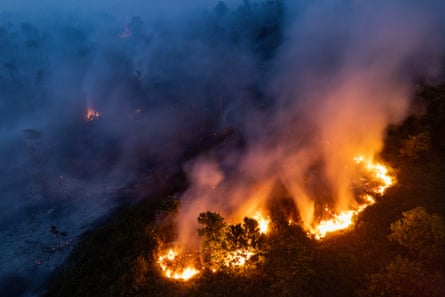
“I believe that the toll on wild animals being burned, dead, because of the fires is huge,” says Dr Karmele Llano Sanchez, a veterinarian and co-founder and CEO of Yiari, a non-profit focused on primate and habitat conservation, which rescues orangutans and other species from torched forests.
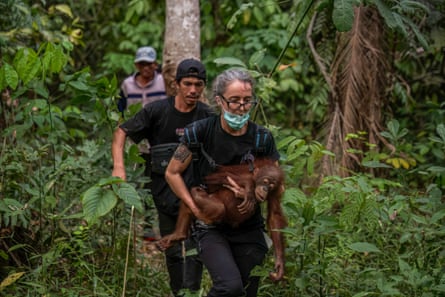
Even animals that survive the catastrophe can face long-term consequences. Food availability falls in the aftermath of fires as forests struggle to recover, and the risk of conflict between animals can rise if they are displaced and forced to live closer to each other. Experts believe that, as with humans, there will also be health impacts for animals that have lived with months of dense smog.
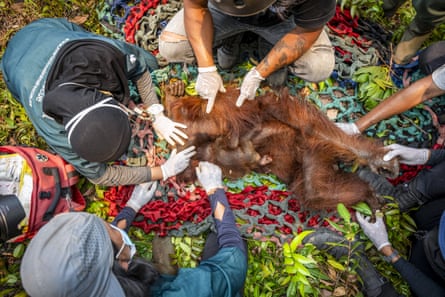
So far, more than 20 orangutans, as well as other species such as pangolin, have been evacuated from the fires by Yiari, which is working alongside West Kalimantan’s Natural Resources Conservation Agency, searching the forests for animals in need and responding to reports from the public.
One of the rescued orangutans died, probably due to smoke inhalation.
Others have been found with burns on their hands after touching the scorching ground, or are hungry and dehydrated.
“It hasn’t rained in 80 days here, and everything is dried and burned,” says Sanchez. “[There are] no leaves and no fruits – nothing they can eat.”
Animals that are evacuated are given sedatives through a dart, which can be fired as high as 30 metres into the trees. A team of about 10 people will hold a net to catch the animal as it tumbles from the branches. An adult male orangutan can weigh about 70kg.
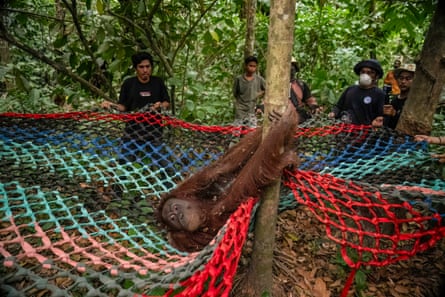
If a mother is carrying very young offspring, they usually fall together, with the baby clinging to its mother.
Such evacuations are a last resort, says Sanchez, undertaken when the area of forest is destroyed: “Otherwise they will for sure die.”
There are many animals in peril that simply can’t be reached: proboscis monkeys, which are endangered, Sunda pangolin and snakes – including a python and king cobra – have all been found dead, according to local media reports.
Forestry minister Raja Juli Antoni told media the wildfires could continue until early November, with the rainy season expected to arrive late. An estimated 600,000 hectares (1.4 million acres) were damaged by fire in August, according to the environmental group YKAN.
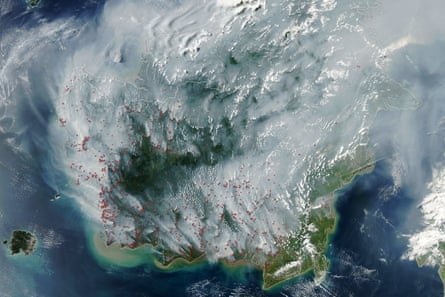
Researchers have observed that large fire events have been followed by unusually high litterfall, where leaves and small branches drop from trees. This is probably because smog has blocked sunlight, preventing photosynthesis, says Dr Susan Cheyne, co-director of Borneo Nature Foundation International, which has conducted studies on the trend.
“Even though the fires are out at this point there is still a knock-on effect on food,” says Cheyne, who is also vice-chair for the International Union for Conservation of Nature primate specialist group section on small apes.
Such die-offs of leaves occur just as dry season returns, just when species such as orangutan need to eat more, as they rely on flowers and leaves rather than the sugary fruits and pulp that are abundant during the rainy season.
Erin Vogel, professor at Rutgers University in New Jersey, says the forest can take years to recover, with trees producing less fruit afterwards, possibly due to a decline in pollinators.
In the longer term, tree diversity across burned peat forests can remain suppressed even 12 years on, research has shown. If fires recur, this risks trapping forests in a permanently degraded state.
The full extent of the long-term impact of the fires on surviving orangutans’ health is unknown. During smoky periods orangutans show ketosis, a sign of increased fat breakdown. It’s believed this is because the smoke raises energy demands, probably by forcing the immune system to work harder.
Research published after the 2015 fires found orangutans called less in heavy smoke, and that they had reduced vocal quality. Most vocal changes persisted for two months after the smoke had cleared and probably signalled changes in health, researchers concluded.
Gibbons, which rely on song to attract mates, cement bonds and defend territory, have also been found to sing less when exposed to heavy smoke.
“We know how [smog] impacts humans in the long term – it can lead to medical problems, breathing problems, asthma, cancer, infections, future lung capacity issues,” says Vogel. “So, I think, there’s no reason to predict that it wouldn’t affect them the same way.”
Further studies are needed, but for now, research sites themselves are threatened by the flames. Both the Tuanan orangutan research station in Central Kalimantan, and Rangkong research station in West Kalimantan, have been threatened by fires in recent weeks. Staff and local people have worked to halt the spread, setting up improvised sprinkler systems and clearing the ground cover. Localised rains have brought some relief at Rangkong, though staff fear this may only be temporary. At Tuanan, where there is still no rain, the fire fighting continues day and night.
Decades of research are at risk, says Vogel, who is co-director of the Tuanan orangutan research programme. Academics there have studied the same trees, 2,500 in total, and the same individual orangutans for 23 years, accumulating a crucial body of long-term data.
The IUCN says “urgent technical and financial support” are needed, but that the emergency response must be followed by greater investment in re-wetting peatland, addressing deforestation, and ensuring burned forests are restored, not converted into plantations.
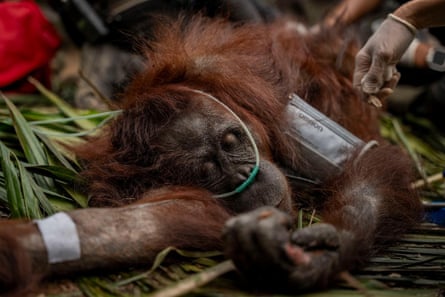
For now, rescuers continue to search the forests for wildlife at risk. The mother and baby rescued last week are now being held at a quarantine centre run by Yiari.
When it is safe, they will be released in a new location – one with enough food and no other orangutan populations that might compete with them for territory. “We need to look for a location that is safe, that is a good forest,” says Sanchez. “It is not easy. But we are trying to do our best to find a place that is suitable for them.”
Find more age of extinction coverage here, and follow biodiversity reporters Rebecca Ratcliffe, Phoebe Weston and Patrick Greenfield on the app for all the latest news and features

















 English (US) ·
  French (CA) ·