

 2 hours ago
6
PROTECT YOUR DNA WITH QUANTUM TECHNOLOGY
Orgo-Life the new way to the future Advertising by AdpathwayA controlled instrumented-vehicle study tracking motorists across urban street networks demonstrates that self-reported aberrant driving profiles correspond directly to physical driving actions, while revealing that the manifestation of these personal traits depends heavily on surrounding roadway geometry. Researchers observed forty-five licensed Portuguese drivers across repeated laps of an urban circuit in the city of Coimbra to determine whether behavioral tendencies recorded through the Manchester Driver Behaviour Questionnaire align with real-world vehicle management. The investigation confirmed that individuals who report frequent infractions and aggressive maneuvers consistently adopt higher travel speeds, heavier braking upon entering circular junctions, and sharper acceleration when departing them. In contrast, drivers who report elevated rates of non-intentional errors systematically exhibit reduced speeds and muted acceleration rates, reflecting an operational style that counterbalances attentional or execution deficits. Crucially, the observable differences in speed stability and driving variability emerged almost exclusively within complex intersections, demonstrating that road design acts not merely as a passive physical boundary but as an active filter that governs how driver dispositions translate into practical risk.
For decades, transport safety professionals have relied on questionnaire instruments to classify habitual driving traits across wide populations, yet researchers have faced ongoing debates over whether paper-and-pencil self-assessments reliably predict actual vehicle control on real streets. The Manchester Driver Behaviour Questionnaire, first introduced by Reason and colleagues, categorizes aberrant actions into deliberate violations, unintentional errors, and minor attentional lapses. While prior meta-analyses established that questionnaire scores correlate with retrospective crash records, critics frequently suggested that shared self-reporting biases might inflate those statistical associations. Furthermore, earlier naturalistic and simulator investigations often yielded conflicting evidence regarding whether subjective error and violation scores explain moment-to-moment velocity choices or operational control. Road safety analysts increasingly recognize that speed choice constitutes the primary proximal determinant of impact probability and crash severity, yet traditional evaluation methods aggregated driving metrics across entire road trips rather than examining how individual tendencies surface when traversing specific, geometrically distinct highway features.
To evaluate these dynamics under rigorous experimental conditions, the research team recruited forty-five experienced motorists residing or working in Coimbra, comprising twenty-five women and twenty men with a mean age of 43.33 years and an average of 22.60 years of licensing. Participants were selected from an established testing cohort and were required to possess at least ten years of regular driving practice while remaining sixty-five years of age or younger to prevent confounding effects associated with novice inexperience or age-related sensory declines. Nineteen participants reported an historical involvement in at least one at-fault collision involving structural damage or personal injury. Before taking the wheel, every motorist completed a validated Portuguese adaptation of the short-form Manchester questionnaire containing twenty-four items scored on a six-point Likert scale. Psychometric assessment established a robust three-factor framework encompassing infractions and aggressive driving across seven items, non-intentional errors across nine items, and everyday lapses across six items, with two items removed to optimize internal consistency and scale reliability.
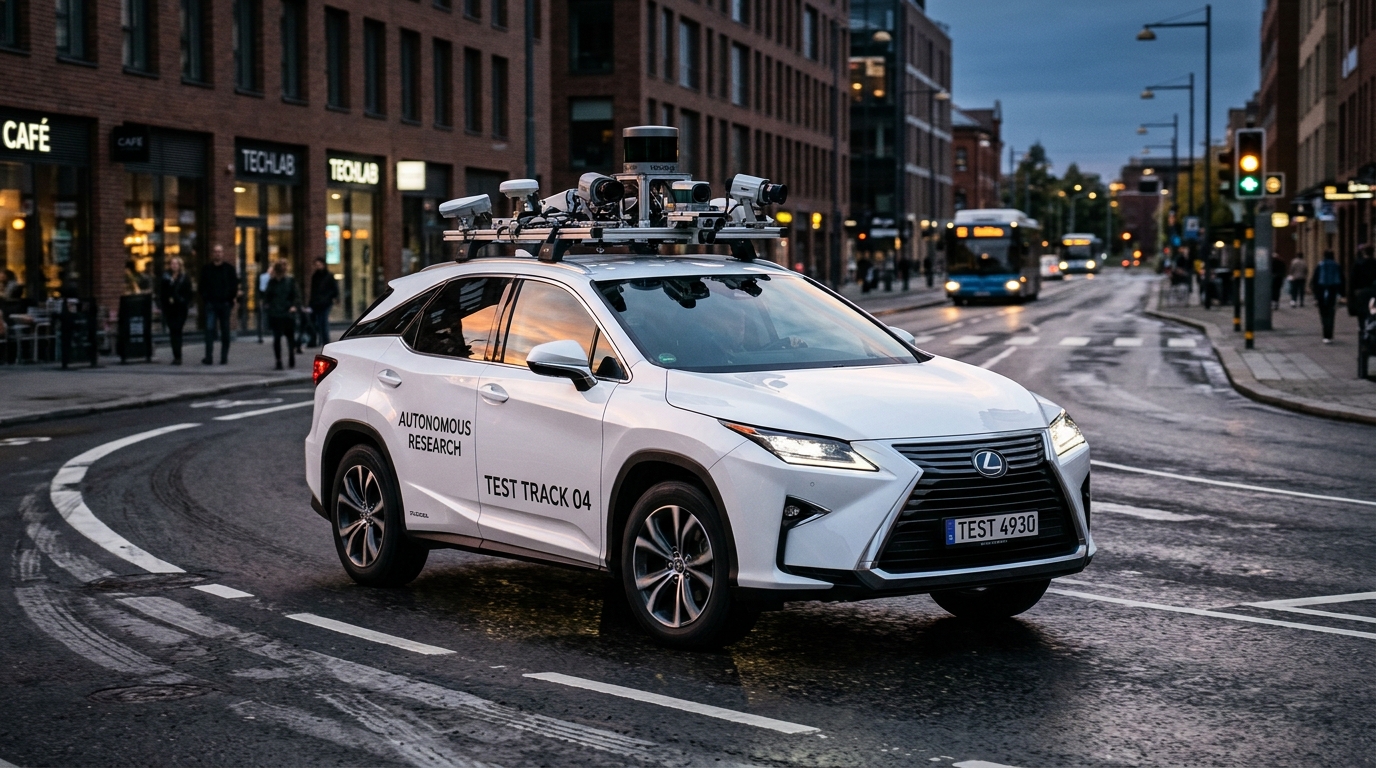
The physical test track consisted of a dedicated 3.7-kilometer urban driving circuit within Coimbra encompassing six roadway segments, six modern roundabouts, and thirteen pedestrian crosswalks, five of which were regulated by traffic signals. The field trials took place across two months during daylight hours on working weekdays, strictly avoiding peak congestion periods and wet weather conditions to maintain uniform surface adhesion and visibility. Participants drove an instrumented passenger car equipped with an integrated Race Technologies DL1 MK3 data acquisition unit featuring a three-axis accelerometer and a twenty-hertz global positioning system receiver accurate to within three meters of geographic position and a tenth of a kilometer per hour of velocity. A pedal position transducer monitored throttle activity at twenty hertz, while a synchronized multi-camera video array captured driver facial movements and external traffic conditions. Every motorist completed ten consecutive circuit laps totaling roughly one hour of continuous driving, with the initial accompanied lap and the second independent lap discarded to eliminate vehicle familiarization effects and route novelty.
Data extraction protocols isolated periods of unimpeded travel to prevent confounding influences from surrounding vehicles, using forward-facing camera recordings to verify genuine free-flow conditions where no leading traffic occupied the immediate visual envelope. Mean velocity and standard deviation were computed for individual laps across each segment and intersection crossing. To ensure experimental precision, straight segments designated as T1 and T6 were removed from analytical consideration; segment T1 lacked sufficient linear distance and suffered from driver deceleration near researcher stations, whereas segment T6 possessed steep longitudinal gradients that could mechanically distort baseline throttle input. Across roundabout crossings, researchers measured average speed between entry and departure points, internal speed variation, approach deceleration, and departure acceleration across locations featuring unobstructed visibility and negligible roadway inclination. Descriptives indicated widespread speeding across the cohort, with eighteen percent of participants maintaining aggregate average speeds exceeding seventy kilometers per hour, while merely two percent stayed within the official urban limit of fifty kilometers per hour.
To address the repeated-measures structure and account for unobserved behavioral variance among participants, the analysts formulated thirty-eight separate random-parameter linear regression models using maximum simulated likelihood estimation with two thousand Halton draws in NLOGIT software. These models evaluated mean velocity, velocity standard deviation, peak deceleration, and peak acceleration while incorporating driver age, biological sex, crash history, and sequential lap dummy indicators to detect potential trial fatigue or familiarity learning. Fourteen separate models examined mean speed and fourteen addressed velocity variability across roadway segments and roundabout crossings, complemented by five models each for entry braking and exit acceleration. Rather than forcing coefficients to remain identical across all drivers, the random-parameter formulation permitted parameters to vary stochastically across the sample whenever significant individual dispersion was detected, thereby capturing personal operational heterogeneity that standard fixed-effects frameworks conceal.
The resulting mean velocity equations revealed that infractions and aggressive driving scores produced statistically significant, positive relationships with travel speed across every straight road segment and across roundabout intersections. Motorists reporting higher intentional violations consistently traveled faster along tangents and negotiated intersection curves at elevated velocities. In stark opposition, non-intentional error scores yielded statistically significant negative parameters across all straight corridors and most roundabout movements, indicating that drivers conscious of their cognitive errors consciously or instinctively moderated their velocity. Lapses exerted sparse, inconsistent influence, showing negative associations in only three roadway segments and two roundabouts. Historical crash involvement was positively linked with higher mean speed across road corridors, whereas age exhibited modest negative coefficients, indicating slightly quicker travel among younger motorists. Notably, the numerical coefficients linking aggressive tendencies to vehicle speed were substantially smaller inside roundabouts than along straight tangents, showing that geometric curvature restricts absolute velocity differentials.
The analysis of speed variability uncovered a fundamental functional divergence between straight corridors and circular junctions. Along open road segments, the regression models detected no statistically significant association between any questionnaire dimension and the standard deviation of vehicle speed, demonstrating that motorists maintained uniform cruising consistency regardless of behavioral classification. Within roundabouts, however, the infractions and aggressive driving index demonstrated statistically significant positive associations with speed dispersion across four separate intersection movements, whereas non-intentional error scores were negatively associated with speed variation across three circular junctions. This divergence indicates that circular intersections, which demand rapid steering adjustments, tight lane tracking, gap evaluation, and deceleration control within narrow spatial confines, amplify latent individual differences.
Braking and acceleration profiles at intersection boundaries further substantiated these behavioral distinctions across urban roadway geometries. In deceleration models evaluating roundabout approaches, high scores on infractions and aggressive driving significantly predicted harder braking maneuvers across all analyzed entry points, though estimated effect magnitudes remained below unity. Conversely, motorists with elevated lapse or non-intentional error scores exhibited notably gentler deceleration rates, avoiding abrupt velocity reductions prior to entering circulating traffic lanes. Exit acceleration equations mirrored this dichotomy: aggressive driving tendencies positively predicted intense throttle application across every measured roundabout exit, while error-prone drivers applied smoother, lower acceleration inputs when re-entering downstream traffic lanes. Demographic covariates registered minimal influence across maneuver models, although male drivers exhibited slightly stronger acceleration on two exits and drivers with past collision history displayed harder approach braking at specific complex junctions.
Collectively, these empirical observations demonstrate that driver behavioral profiles identified via self-reported questionnaires maintain strong ecological validity under real-world operating conditions, while establishing that safety risk cannot be treated as a static human characteristic. Because aggressive tendencies manifest through heightened speed and rapid control inputs, while unintentional errors prompt compensatory deceleration, personal dispositions interact continuously with local roadway geometry to generate observable risk.
Subject of Research: Interaction between self-reported driver behavior questionnaire dimensions and urban roadway geometry in vehicle operations
Article Title: Does road context matter? Linking DBQ dimensions to real-world driving behaviour in urban road segments and roundabouts
Article References: Félix Dourado, J., Ferreira, S., Amancio, E. C., Bastos Silva, A., Maia Seco, Á., & Cecy Gadda, T. M. (2026). Does road context matter? Linking DBQ dimensions to real-world driving behaviour in urban road segments and roundabouts. European Transport Research Review, 18(1), Article 51. https://doi.org/10.1186/s12544-026-00805-5
Image Credits: AI Generated
DOI: 10.1186/s12544-026-00805-5
Keywords: Driver Behaviour Questionnaire, Urban Speed Choice, Instrumented Vehicles, Roundabout Geometry, Traffic Safety Research, Speed Variability, Non-Intentional Errors, Aggressive Driving, Road Infrastructure, Driver Profiling, Random-Parameter Regression, Free-Flow Speed, Deceleration Patterns, Acceleration Profiles, Ecological Validity, Self-Explaining Roads

















 English (US) ·
 French (CA) ·