

 18 hours ago
5
18 hours ago
5
PROTECT YOUR DNA WITH QUANTUM TECHNOLOGY
Orgo-Life the new way to the future Advertising by AdpathwayTwo ocean basins that have risen and fallen together for at least four centuries are coming apart, and the only comparable disruption in the paleoclimate record required a run of major volcanic eruptions to produce it. That is the finding of a study by researchers at the Woods Hole Oceanographic Institution, published on August 26 in Nature Communications and recirculated in science coverage this week.
The practical concern is not dramatic ocean behavior. It is forecasting. Seasonal climate prediction leans heavily on the idea that conditions in one basin tell you something useful about another. If the Indian Ocean stops tracking the Pacific the way it has historically, the statistical relationships built into seasonal rainfall outlooks may lose accuracy, and those outlooks feed decisions about reservoir management, planting schedules and drought planning in the United States and abroad.
The timing gives the paper immediate relevance. NOAA's Climate Prediction Center reported on September 10 that El Niño is strengthening, with a greater than 90 percent chance of a very strong event through Northern Hemisphere fall and winter and a 75 percent chance that October through December produces a historic event exceeding any El Niño back to 1950. Tropical ocean behavior is being stress-tested from two directions at once.
Coupling, Explained in Practical Terms
The connection researchers study runs through the Walker circulation, the loop of rising and sinking air across the tropics that governs where rain falls. Conditions in the Indian Ocean have historically responded to what the Pacific does, and that relationship helps shape rainfall, temperature, and atmospheric circulation across the tropics.
Scientists have observed since the 1980s that the relationship has weakened, with the Indian Ocean increasingly behaving independently of what Pacific conditions would predict. Researchers have linked that shift to greenhouse gas forcing. The difficulty has always been the length of the record. Reliable instrumental data cover less than a century, which the authors note is too short to determine whether such a decoupling could also have arisen naturally.
Reading Four Centuries of Corals and Stalagmites
To extend the record, the team turned to tropical paleoclimate archives: coral skeletons, tree rings and stalagmites, reconstructing conditions in both basins back to the early 1600s.
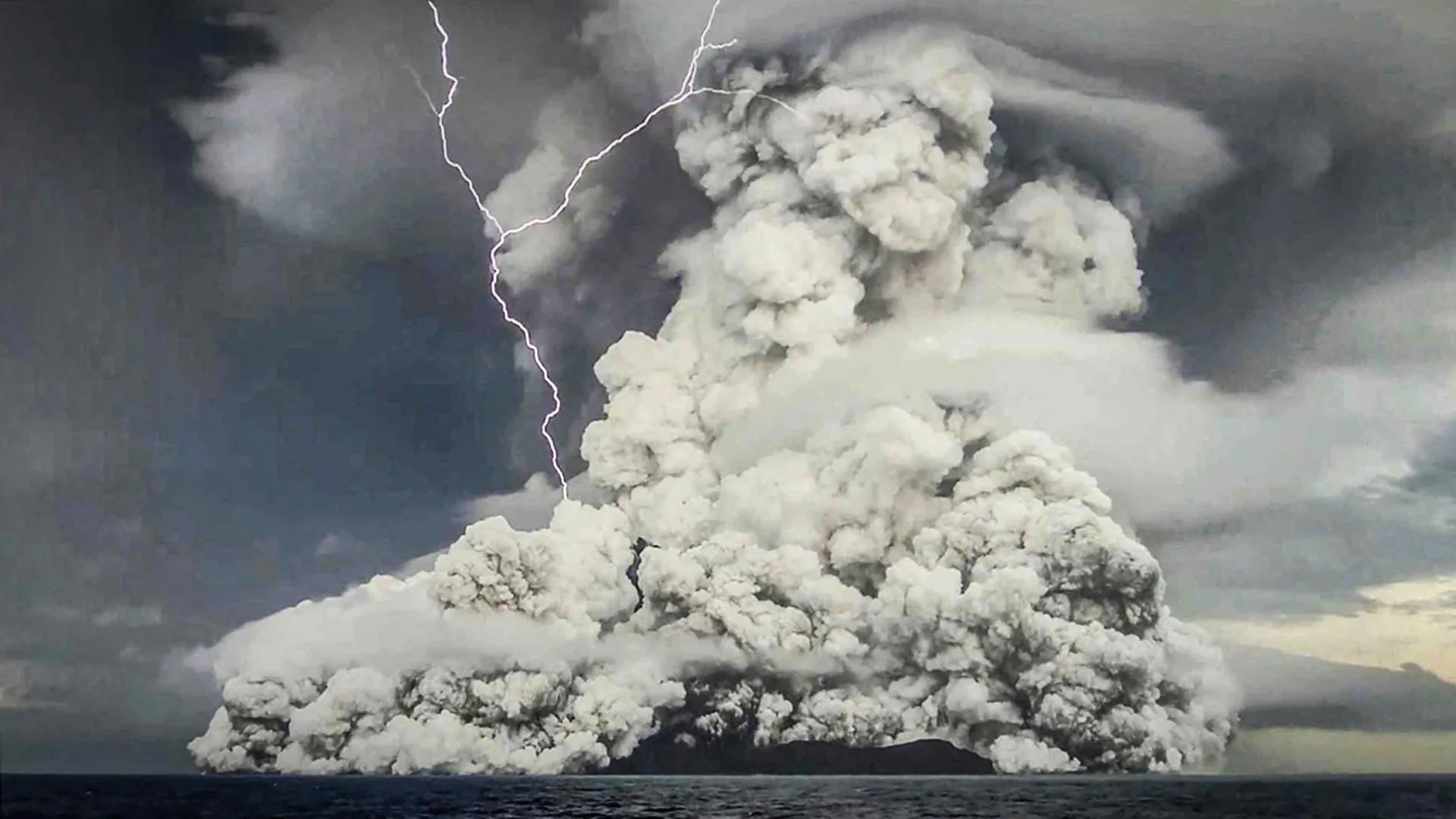
The reconstruction shows the two basins largely coupled through the pre-industrial era, with one clear exception. Between 1810 and 1850, the relationship changed significantly, and the team attributes that to a series of large tropical volcanic eruptions that weakened the Pacific's usual influence. Climate model simulations supported the interpretation, and the size of the disruption depended on both eruption strength and the background climate conditions at the time.
The modern comparison is the part that drew attention. The paper reports that the recent decoupling, driven by global warming, is unprecedented relative to what the reconstructed record shows, including during periods of strong volcanism.
"This is one of the first studies to examine the breakdown in the connection between the Pacific and Indian oceans using evidence from past climates, modern observations, and climate models," said co-author Caroline Ummenhofer, a senior scientist at WHOI, in the Woods Hole Oceanographic Institution's summary of the work. She added that showing how volcanic eruptions can weaken the relationship is only one outcome, and that the study helps frame how exceptional the recent breakdown is.
Ummenhofer framed the contribution as one of confidence rather than discovery. "The modern data we have is limited and doesn't go back far enough. With climate models and paleo-records, we are now able to say with more confidence that the recent changes we are seeing are really quite exceptional," she said.
Co-author Delia Oppo, an emeritus research scholar at WHOI, pointed to the physical reason this is possible. "The Indian Ocean is a huge heat reservoir, and it can decouple from what the Pacific Ocean is doing," Oppo said, as reported by Phys.org. "The results of this study underscore the independent behavior of the Indian Ocean." Lead author Shawn Wang is a former WHOI graduate student and postdoctoral researcher now at the University of Colorado Boulder.
Where the Evidence Is Strong and Where It Is Not
This is a reconstruction and modeling study, not a direct measurement of the past. Proxy records carry dating uncertainty; they are unevenly distributed geographically, and reconstructing a circulation index from corals, tree rings, and stalagmites involves statistical choices that other groups may make differently. The volcanic attribution for the early 19th century is supported by both proxies and simulations, which is stronger than either alone, but it remains an inference.
The claim that the modern change is exceptional is a statistical comparison against reconstructed intervals, and the authors state it that way. The study does not project when or whether the coupling will recover, and it does not quantify how much forecast skill might be lost.
Readers should also be clear about what this study is not. It is not a single-event attribution finding. Nothing in it says that any particular drought, monsoon failure or storm season was caused by the decoupling.
The Pathway to American Households
The connection to a household in Phoenix, Sacramento, or Kansas City runs through forecast quality, and it is indirect but real. Water managers in the Colorado River Basin, irrigation districts in California's Central Valley and wheat growers across the southern Plains all use seasonal precipitation outlooks that draw on documented relationships between tropical ocean conditions and North American weather. When those relationships shift, outlooks issued with a given confidence level can verify less often.
The current El Niño illustrates how much weight sits on these patterns. Forecasters used it to correctly anticipate a suppressed Atlantic hurricane season and an active eastern Pacific. At the same time, U.S. Drought Monitor data valid September 8 shows 49.12 percent of the United States and Puerto Rico in drought. Drought planning in those states depends on outlooks holding up.
For households, there is no action to take today beyond a general one. Treat seasonal outlooks as probabilities rather than schedules, and rely on short-range National Weather Service forecasts for decisions about the week ahead.
Ummenhofer's summary of the central result was direct. "A key finding is that global warming and human emissions are now overwhelming the Pacific's natural influence on the Indian Ocean," she said.
What Readers Want to Know
What did the study find? The Indian and Pacific oceans stayed climatically linked through most of the past 400 years, with one exception in the early 19th century tied to volcanic eruptions. The modern weakening appears unprecedented by comparison.
How did researchers look back 400 years? They reconstructed conditions using tropical paleoclimate archives, including coral records, tree rings, and stalagmites, then compared the results against climate model simulations.
Why does ocean coupling matter to people? Relationships between ocean basins underpin seasonal rainfall and temperature outlooks. If those relationships change, forecasts built on historical behavior may become less reliable.
Does this mean seasonal forecasts are wrong now? No. Forecasters correctly anticipated this year's suppressed Atlantic hurricane season. The concern is longer-term skill, and the study does not quantify how much accuracy could be lost.
Is this connected to the current El Niño? Not causally. The strengthening El Niño makes the research topical, and NOAA's next ENSO update is scheduled for October 8.
What are the main limitations? Proxy reconstructions carry dating and coverage uncertainty, the results depend on statistical and modeling choices, and the study does not attribute any individual weather event to the change.
Who funded the research? Public science funding, according to WHOI's summary of the work. No industry or advocacy funding was disclosed.
© 2026 NatureWorldNews.com All rights reserved. Do not reproduce without permission.













 English (US) ·
  French (CA) ·