

 3 hours ago
3
PROTECT YOUR DNA WITH QUANTUM TECHNOLOGY
Orgo-Life the new way to the future Advertising by Adpathway
The legend of the horsemen of the apocalypse goes back to the first century AD. It is a gripping image which has transcended cultures. The best-known of the horsemen is Death, riding an ashen-coloured horse. This is the only one given a name in the original. One horseman, riding a black horse, brings famine, making grain unaffordable but leaving luxuries (oil and wine) unaffected. One horseman rides a fiery red horse and brings war. The remaining horseman, on a white horse, has lost it meaning over time. Originally, it represented conquest. In the early 20th century, the white-horse man was renamed: it became Pestilence, based on the fact that in the original, the horsemen brought death by ‘sword, famine, and pestilence’.
Ever since the origin of the legend, there have been times when it seemed one or more of the four horsemen were about. There have been wars. Famine could strike at any time; it needed only one bad harvest. And epidemics, of diseases not known now, would come and go; descriptions of the symptoms sound strangely unfamiliar to us.
And there was one time when all four seemed about, riding across the entire known world. It was a bad time. It was the beginning of the Dark Ages.
Events
It had been a bad time. Sixty years after the fall of the Roman empire, Europe had fragmented into dozens of small, warring states. Still, a vestige of Roman life survived across Europe. The new rulers were not barbarians (even if one tribe gave us the name Vandals), and they kept their regions functioning. Some trade continued and in some places (but not Britain) Roman land owners and their villas continued under the new regimes. Many Roman cities survived. But war was common and cities were falling in disrepair. Life was deteriorating.
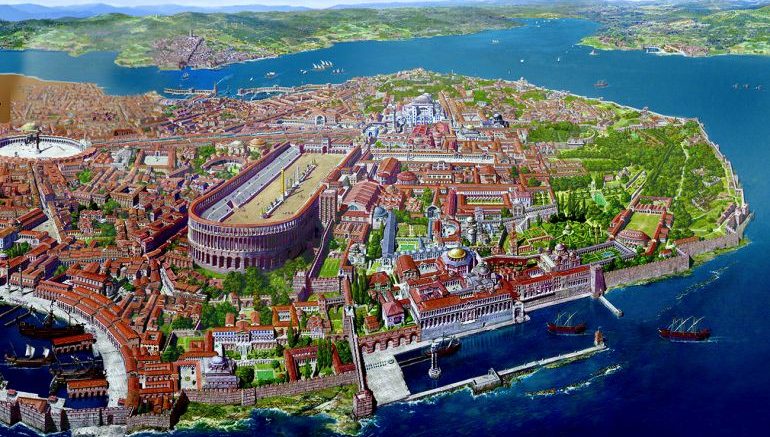
Constantinople during the Eastern Roman empire
But there was hope of better things. The Eastern Roman empire had survived the fall of Rome. It ruled the region of Greece, Turkey, Palestine and Egypt, incorporating a substantial part of the old empire. A new, dynamic emperor, Justinian, had taken the reigns, and he was set on re-establishing the old borders. Africa and Italy were being conquered, and for the first time in a century, Rome was again Roman. The Hagia Sophia was being constructed. A new future was just around the corner.
But that future never came. A decade later, Europe lay devastated, farm land fallow and cities abandoned. Instead of a renaissance, it was the onset of darkness. And it all started in the year 536.
The first inkling of the disaster came in March of that year. Michael the Syrian, a bishop writing in the twelfth century is one of our sources. He probably quoted John of Ephesos, an ecclesiastical historian of the sixth century, and describes the event as follows (quotes in this post are taken from Antti Arjava): “In the year 848 [536/37 CE] there was a sign in the sun the like of which had never been seen and reported before in the world. If we had not found it recorded in the majority of proved and credible writings and confirmed by trustworthy people, we would not have recorded it; for it is difficult to conceive. So it is said that the sun became dark and its darkness lasted for one and a half years, that is, eighteen months. Each day it shone for about four hours, and still this light was only a feeble shadow. Everyone declared that the sun would never recover its original light. The fruits did not ripen, and the wine tasted like sour grapes.”
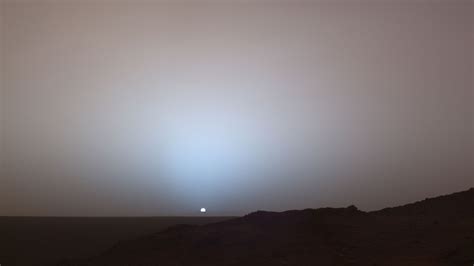
The principal historian of the age was Procopius. He came from Caesarea in Palestine, and as legal advisor accompanied general Belisarius who fought most of Justinian’s battles. (The two fell out later. Generals and reporters can be an unstable combination.) During 536 and 537 Procopius was with the armies in Africa and Italy. He wrote: “And it came about during this year that a most dread portent took place. For the sun gave forth its light without brightness, like the moon, during this whole year, and it seemed exceedingly like the sun in eclipse, for the beams it shed were not clear nor such as it is accustomed to shed. And from the time when this thing happened men were free neither from war nor pestilence nor any other thing leading to death. And it was the time when Justinian was in the tenth year of his reign [536/37].”
Several documents mention strange weather in 536 and 537. Cassiodorus, in Italy, comments after nearly a year of haze: “So we have had a winter without storms, spring without mildness, summer without heat.” Further east, things were different. In Mesopotamia, the winter of 536/537 was a bad one: “from the large and unwonted quantity of snow the birds perished.”
Another, unnamed Syriac chronicler writing probably later in the sixth century, adds earthquakes and storms: “And [Pope Agapetus] came with them to Constantinople in the month of March in the year fourteen [536]; and Severus was there and Anthemius was chief priest. And the whole city was disturbed at the arrival of Agapetus; and the earth with all that is upon it quaked; and the sun began to be darkened by day and the moon by night, while ocean was tumultuous with spray, from the 24th of March in this year till the 24th ofJune in the following year fifteen [537]. And Agapetus, when he appeared before the king, had a splendid reception from him.” No one else mentions earthquakes or storms, suggesting a fair amount of exaggeration or false facts. Not every ancient record is true!
Location
The same Syriac chronicler gives information on the extent of the haze. The text continues: “And this we have seen from the events themselves, when many wars broke out in the west and that tyranny was dissolved, while India, and the Persian realm, and whatever dry land lies toward the rising sun, were not troubled at all. And it was not even likely that those regions would be affected by the calamity because it was in Europe that the moisture in question evaporated and gathered into clouds dimming the light of the sun so that it did not come into our sight or pierce this dense substance.”
The passage suggests that Persia and India had not been affected by the haze. There is doubt whether China was affected. There is one mention from China which may indicate a haze, saying that Canopus could not be seen. This star is very low on the southern horizon in southern China (south of 38 degrees), and can only be seen during clear weather. But apart from this indirect indication, none of the Chinese documents mention a haze or powerless Sun.
This may be related to latitude. The haze was reported from locations above 35 to 40 degrees latitude. The areas that did not have the haze (Persia, India) are below approximately 35 degrees northern latitude, and this also includes most of China. The haze may thus have been confined to higher latitudes.
Famine
Michael the Syrian mentioned that fruit did not ripen in 536. Others also mention issues with food. Italy appears to have had a bad harvest, as Ravenna had to be supplied from the other side of the Adriatic which apparently had had a better harvest. John Lydos writing in Constantinople during the 540s, says “If the sun becomes dim because the air is dense from rising moisture – as happened in the course of the recently passed fourteenth indiction [535/36] for nearly a whole year, when Belisarios held the consular office, so that the produce was destroyed because of the bad time – it predicts heavy trouble in Europe.” (The reference to moisture should be discounted, as everything suggests that this was ‘dry fog’, i.e. a high altitude haze.) It mentions that produce was ‘destroyed’ – but does not state how.
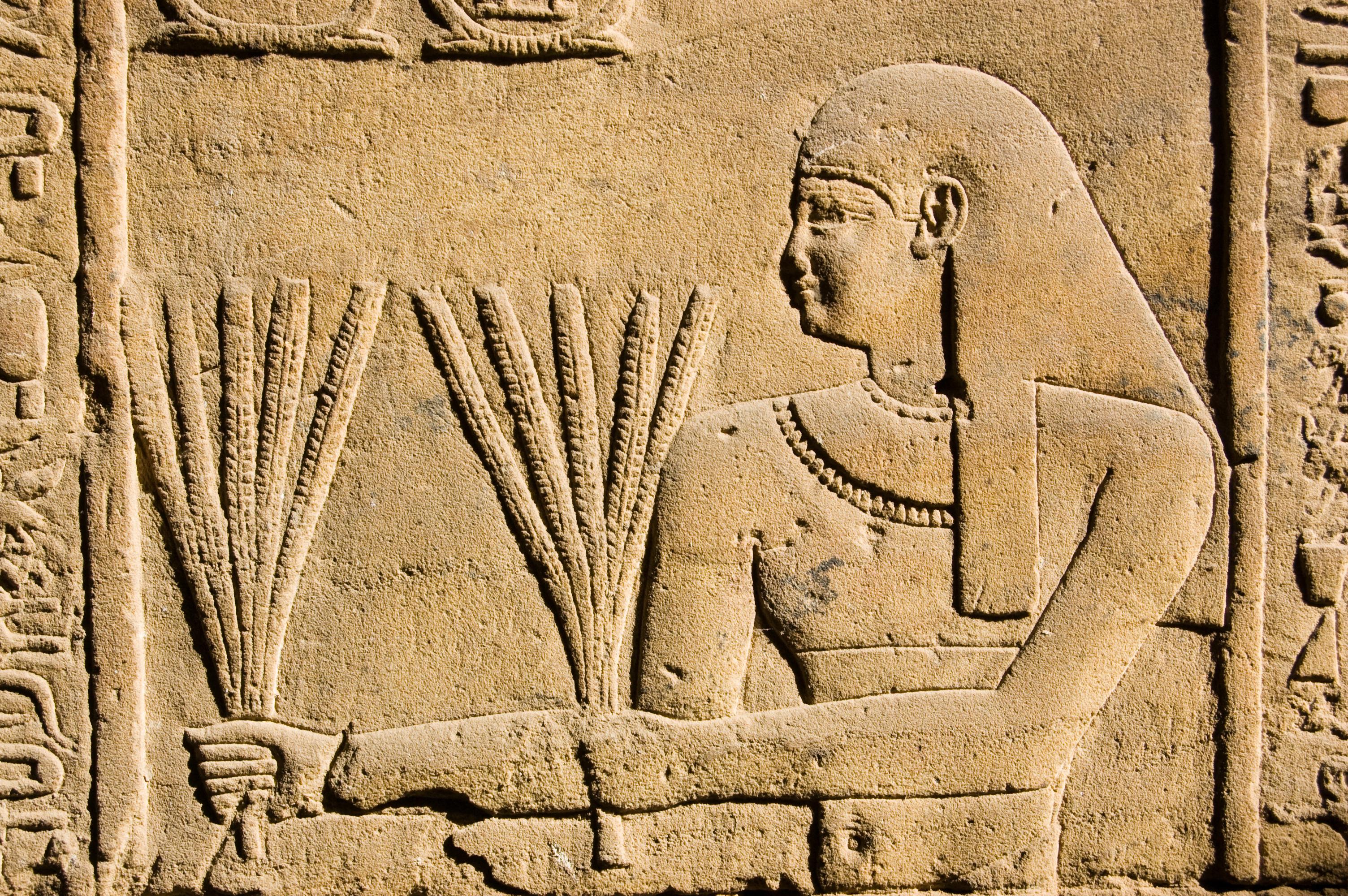
Priest carrying wheat. Temple of Horus, Edfu, Egypt.
Much of the grain in the empire came from Egypt. The lack of ripening of fruit suggests that the summer had been very cool, presumably because of the haze. However, this would not have affected the grain (and in fact cooler weather could have been beneficial). Photosynthesis may have been reduced by the haze, but we don’t know whether the dense haze had covered Egypt. However, food production in Egypt is mostly dependent on the availability of water. The Nile obtains its water from the monsoon in central Africa. This monsoon can fail after volcanic eruptions: both the Eldgja and Laki events caused low water levels in the Nile. But the reason for the ‘destruction’ of produce is conjecture. A little more scientific training of the writers could have helped a lot!
The problems in Italy became much worse. Northern and Central Italy, which remained under Ostrogoth control, had a severe famine in 538, with one report stating that 50,000 people died. It was attributed to the fact that the land had not been cultivated during the previous year. Whether this was due to the lingering haze or to the war between the Romans and Ostrogoths is not stated.
There were also problems elsewhere. Irish documents mention a ‘failure of bread’ in 536 and again in 539. The British Annales Cambriae refers to a death toll (‘mortality’) in Britain and Ireland in 537, but frustratingly does not give a cause. China appears to have been severely affected. Reports mention severe drought and dust storms, but also snow, hail and frost in southern China in the summers of 536 and 537. The Nanshi (“History of the South”) mentions what follows: “famine happened in 538, and the Imperial Court decided on the 30th of the January of the year, to implement an amnesty to the tax – cut to it’s 12 southern provinces where famines were observed, especially to those who were unable to pay the tax.” (translation taken from https://history.stackexchange.com/questions/51147/what-are-some-chinese-sources-testifying-the-extreme-weather-events-of-535-536-c) The drought appears to have started in 535, which if correct means it predated the haze. A worse famine ensued in northern China. One document gives the startling number of 70% to 80% mortality among the population of one area, and states that cannibalism occurred.
When studying extreme weather, it is important to check when it began. Documents tell of a severe drought in Persia in 536 (this would have been during the summer before the snowy winter). However, this drought started long before the haze. In the Levant, a very dry period began around 522, lasting several decades and which caused water shortages from Persia to Constantinople. Thus, there was environmental stress already well before the eruption. In the Roman empire, the quarter century 526-550 had the highest number of recorded famines for the entire period 100 BC to 800 AD, but these may not be all related to the 536 haze. The long-term drought may have been an important factor. Conflicts also do not help: wars and food production are an uneasy combination.
The haze acerbated the effect of the drought, but by and large the Eastern Roman empire was well organized and could survive a few poor harvests. The worst famine happened in Ostrogoth Italy, perhaps because the people there had little access to food resources elsewhere. The British isles were somewhat affected. China may also have suffered from a lack of organized food distribution. This was the time when the Northern and Southern Dynasties were in perpetual civil wars. The elite had better things to do than providing food.
What happened elsewhere in the world is not well known, due to a lack of written sources. To know more, we needed to look into other, non-written records. And the results of those investigations were much worse than what had been expected. This really was an apocalypse.
Of ice and trees
A good way to study the past is by using ice cores. These are obtained from glaciers: every year a new layer of ice forms from compacted snow, and these layers can be recognized and counted as if they were tree rings. Find a deep enough glacier, and the record can go back a long time. And the icecaps of Greenland and Antarctica are very deep indeed.
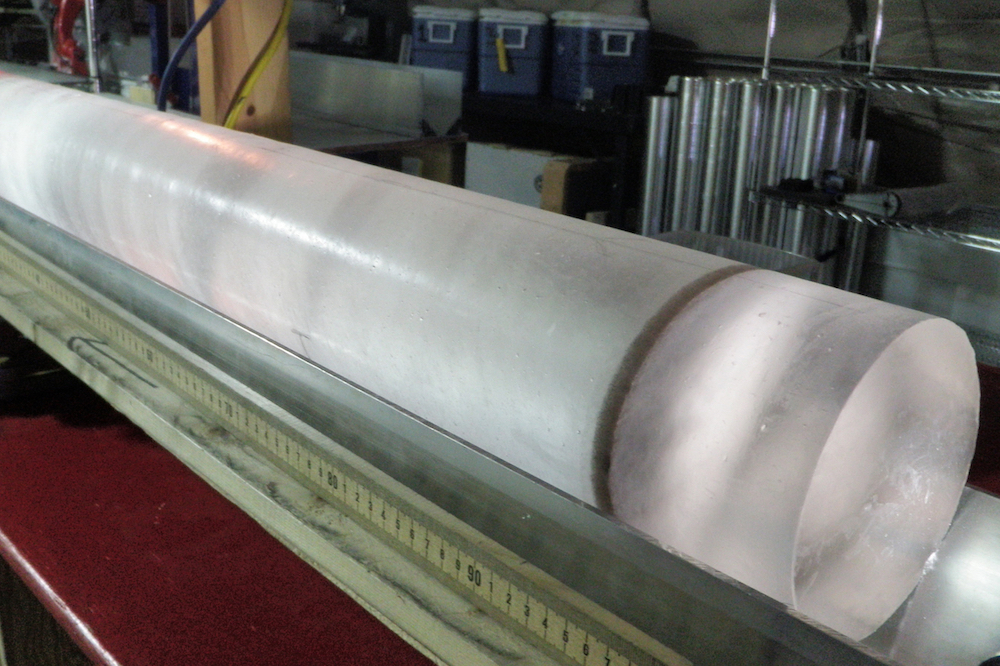
Ice core from Antarctica, with a dark layer of volcanic ash
The ice is very good at providing evidence for old volcanic eruptions. In the best case, an annual layer in an ice core contains tephra particles which signify an eruption and which allows the specific volcano and year of eruption to be identified. This is rare, because tephra tends not to travel far. More commonly, the eruption is indicated by sulphate. The amount of sulphate in the ice core depends on the size and sulphur content of the eruption, and on the distance from the glacier.
Exact timing of the eruptions has proven somewhat difficult. The annual layers can be thin and difficult to recognize. Counting errors add up, and past a millennium can easily reach 5-10 years. Luckily, it can be calibrated using a second record of the past: tree rings. These are easily counted; the science of counting rings is called dendrochronology. By combining different tree-ring records, an accurate timing has been reached going back several millennia. The width of the rings indicate how grow-some the weather was in that year. In a bad year, there may also be frost damage inside the ring, if a hard frost occured during the growing season. And occasionally, the wood contains other indicators. Twice in the past 2000 years there was a spike in the amount of beryllium in the atmosphere, possibly due to massive solar flares. The beryllium layers can be identified both in the trees and in the ice, and can be used to bring the two in line with each other.
The plot below shows the ice core and tree ring record for the period around the year 536. The top panel show the Greenland ice core, and the bottom panel the Antarctica ice core. The middle panel shows the tree rings, where green indicates the relative width of the ring and orange the change in summer temperature indicated by the tree rings. The top panel shows an impressive spike in the year 536. It was indeed an eruption. But where?
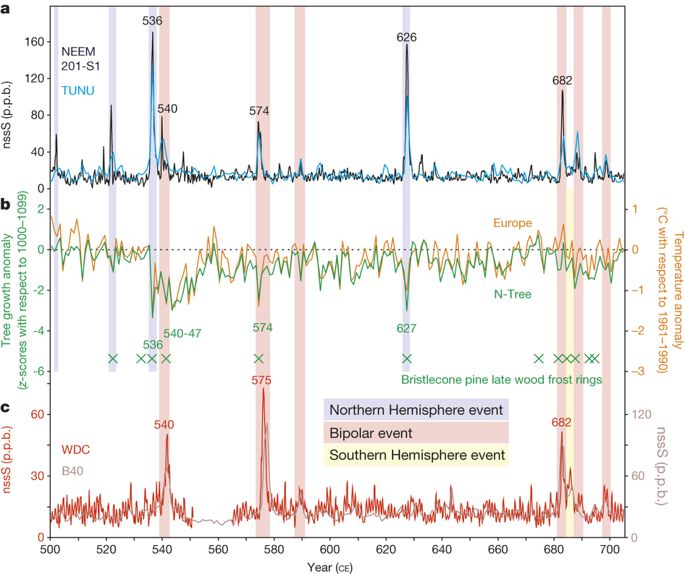
Helpfully, volcanic ejecta have difficulty crossing the equator. Northern eruptions tend not to spread to the southern hemisphere and vice versa. Tropical eruptions, on the other hand, pollute both hemisphere. Therefore, comparing Greenland and Antarctic ice cores allows one to see where an eruption happened. A sulphate spike seen only in Greenland is normally from a volcanic eruption in the northern hemisphere. One present with comparable strength in both ice cores is from a tropical eruption. The spike in 536 was present only in the Greenland ice. This means that the eruption happened somewhere in the northern hemisphere, and not in the tropics.
But on closer look, both ice cores showed a second spike in AD 540. Apparently, two volcanoes were involved, a northern one in 536, and a tropical one in 540. And that was a surprise.
The European (Irish and Scandinavian) tree rings provided further information. A sharp temperature drop was apparent in 536, followed by an incomplete recovery. A second drop occurred in 540, and now the recovery was extremely slow: only by 550 were the trees back to normal. Clearly, the second eruption had had a major impact in Europe. But this had not been apparent from any of the written documents. Something was missing.
Micheal Sigl et al (2015) rank the eruptions of the past 2500 years in terms of total amount of sulphate, converted to something called ‘global forcing’. That is a number that indicates how much of the power in sunlight is intercepted by the sulphate layer. The Sun provides us with 1000 Watt per square meter (assuming that it is directly overhead). The top-ranked eruption was in the year 426 BC, from an unknown volcano: it reduced global sunlight by 35.6 Watt per square meter. On this list, the 536 event is number 18, and the 540 eruption is number 5. If they had happened simultaneously, it would have ranked as number 3, after the 426 eruption and Samalas in 1257.
(In case anyone asks: Laki is included, and it ranks as number 8.)

The local impact on Europe may be very different from the global effect listed in the table. Regarding temperature drop in Europe (last numeric column), the 536 eruption is the top dog, and the 540 eruption ranks number 4, just after Tambora.
So Europe -and the world- was hit by a double whammy, which together made for one of the worst volcanic events of the past 2500 years – for Europe, possibly the worst one. That agrees with the tree ring record in which this decade is the coldest in the northern hemisphere over the entire period. The evidence is seen in trees at every northern continent: this was not just limited to Europe or the Atlantic area (as for Laki) but affect a much wider area. The time around this decade is sometimes known as the LALIA: the Late Antique Little Ice Age which covers roughly the 6th century. But this decade was the core of it, and possibly the only part. It is not clear that without this decade, the century would have qualified for such a term, even if there was increasing drought already before 530.

Number of sites across the northern hemisphere showing different types of tree ring damage. Any year will have some poor weather somewhere, but in 536 that damage was everywhere, and it continued for a decade. Source: Buntgen et al 2022, Science Bulletin 67, 2336
It leaves several questions. Which volcanoes were responsible for the coldest decade? Why is the 536 eruption clear from the documents while the 540 eruption seems to have gone unnoticed? Were there effects elsewhere in the world? The answer to the second question turned out to be sobering: the disaster was clear to see – we just hadn’t connected it to a volcanic eruption.
Volcanic suspects
Before accusing particular volcanoes, we first need to put to rest two widely reported myths. The first of these came from a book by David Keys who claimed that a large eruption had taken place at Krakatoa in 536. There are severe problems with this claim: the Java myths which he based it on give a date which is a century off, and do not clearly refer to Krakatoa; there is also no local evidence for any such eruption. In all likelihood, this never happened. (Krakatoa is also in the wrong place for a northern hemisphere eruption)
Mike Baillie, famous for his research on tree rings, for a while moved away from a volcanic cause for the 536 event. This was because originally the timeline for the ice cores did not match up with the tree ring chronology, leaving no obvious volcanic candidate. He argued that an impact with a comet could have caused the event. There are many problems with this idea, and the mismatch was eventually solved by a better ice core chronology. (If you are interested: you need a large comet to supply enough sulphur; I estimated 5 km diameter. Something that size will punch through the atmosphere, hit the ground and leave all kinds of hints – such as, where have all the dinosaurs mammals gone, and why do we suddenly have a 100-km crater in Mexico? Stratospheric sulphate would be far from the only urgent problem.) Baillie (now retired) went back to favouring a volcanic cause. The comet has gone away (they always do) – but as with Krakatoa, the story still surfaces regularly. Myths can be long-lasting.
But let’s go back to the real world. Which volcanoes were to blame?
There is strong evidence that there were two eruptions in short succession from both the ice cores and the tree rings. The first eruption shows up only in the northern hemisphere. The reports of haze all come from further north than 35 degrees. Further south, including much of China, the skies were apparently clearer. The tree rings which show the poor weather of 537 are also from high northerly latitudes, 50-70 degrees. Finally, although the haze was problematic and caused food shortages, there are no reports of unsurmountable problems for the Roman empire with its access to Egyptian grain. It all points at an eruption at mid to high latitude, badly affecting northern regions. The haze first appeared on March 24, 536, suggesting that the eruption happened (or started) around the ides of March. However, the tree ring damage began later in the years, after the spring growth. That may either indicate an eruption closer to summer, or it may be because the temperatures took a while to be affected by the haze.
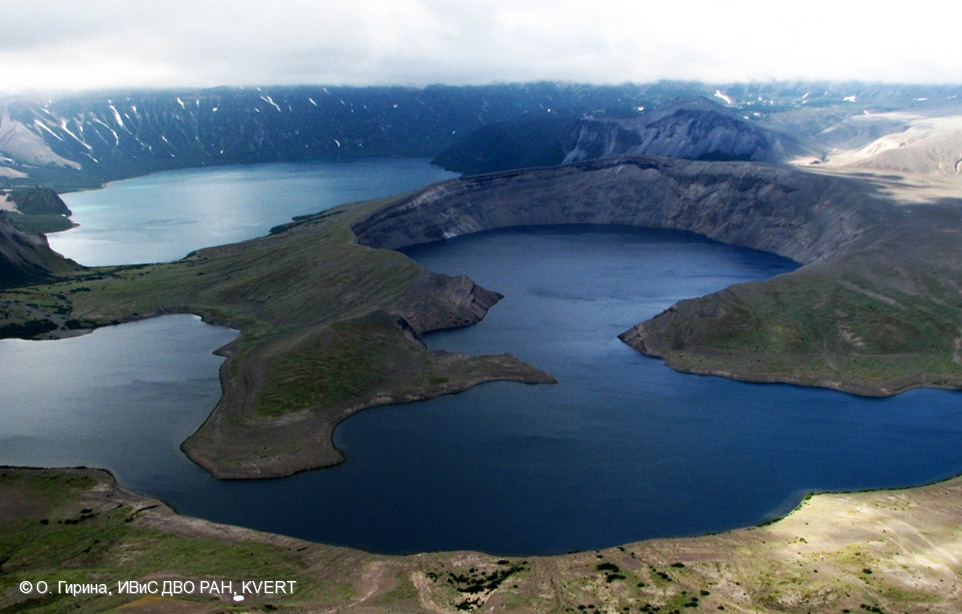
Ksudach
But this has not been enough to identify the culprit: we remain unclear about which volcano may be to blame. Tephra found in a Greenland ice core points at North America but not at a specific volcano. The sulphur isotopes indicate that the first deposits came from tropospheric winds, and later via the stratosphere. The pattern is that same as from Alaska’s Katmai’s eruption of 1912. The difference between the onset of the haze and the tree damage some months later may be related to an early tropospheric ejection, followed by a stratospheric one. For instance, think a smaller eruption which aft a while causes caldera collapse. Tropospheric sulphate does not cause cooling while stratospheric sulphate does.
In 2018, a few tephra fragments with an Icelandic signature were found in ice cores from a glacier in the Alps, but again without a specific volcano attached. But Iceland has been ruled out for the main event: a huge explosive eruption in Iceland which could cause stratospheric sulphate for over a year would leave plenty of signs all over Iceland – nothing has been found. An effusive eruption would not put sulphates high enough to reach Constantinople (Laki did not manage this) and again, there would be a huge and obvious lava field somewhere. Iceland frequently explodes, and the Alpine tephra could easily come from other, unrelated Icelandic eruptions.
A Pacific-ring volcano appears most likely. On the map, the eye is quickly drawn to Alaska and its arc of Aleutian islands. Is one of its islands perhaps missing? The White River Ash (Mount Churchill) has an alibi: it comes from two eruptions, one around 840 and one around 60, which are not consistent with 536. Which is a pity, because the size of the eruptions would fit the occasion: the ash even reached Europe. Perhaps its alibi is false, and a large eruption in between is hiding in the data? Or was the eruption on the other side, in Kamchatka or the Kuriles? The largest caldera-forming explosion there is dated 1650-1900 BP which almost fits: Ksudach caldera V, the second largest known caldera event in Kamchatka during the Holocene. Tephra from this explosion has been found in North America. But it is estimated at ‘only’ 20 km3 of tephra: it seems a bit small and a bit too early for the 536 event. Opala, nearby, had a significant eruption around 600 AD, where the eruption column reached 20 km, but the 10 km3 of tephra seems rather small to explain the events of 536. No other smoking gun has yet been found, and neither Japan, Kamchatka or North America show other significant tephra deposits around this time. The discussion is not over, but Ksudach, Opala and Churchill might all be worth another look. Otherwise, the lack of a clear ash layer suggests that we should be looking at an isolated island volcano, in which case the Aleutians and the Kuriles are the most likely regions.

Opala volcano Source: https://www.kamchatsky-krai.ru/fotografii-kamchatki/opala/88-96.htm
(We could also look at the Azores. It has frequent eruptions: about one every 20 years. (The last one was more than 25 years ago. I just mention it.) The events there can reach VEI6, and the Azores are well placed to affect the Mediterranean. Recently it has been suggested that some of the tephra in European peat bogs that was attributed to Jan Mayen in reality comes from the Azores. But again, a smoking gun is lacking and this should have been obvious.

The caldera lake of ilopango
The second eruption, in 540, affected both hemispheres, and must have been a tropical eruption. And it was a serious eruption, which deposited 10% more sulphate in the ice than Tambora managed. Tree rings narrowed worldwide and temperatures appear to have dropped significantly, with several very cold years. The southern hemisphere was less affected than the north: this may be because it has more ocean to moderate temperatures, or because in the north it came on the heels of the 536 eruption. There are no reports of haze. El Chichon has been suggested, but although it may have had an eruption at approximately the right time, there is no evidence for anything on the scale of Tambora. Taal too has been suggested in the popular media, but the evidence for an eruption at this time is rather slim (to non-existent, really). Pago in PNG might be possible: it has frequent large eruptions and had two major ones around this time, although neither has been dated to this specific time. Rabaul, Hankow Reef and Bismarck have also been mentioned but perhaps more out of desperation than based on actual evidence.
The one that got away
In 2010, a strong candidate for the 540 eruption was identified: Ilopango, the largest lake of El Salvador, up to 13 by 17 km across and 70 km2 in area, surrounded by cliffs up to 500 meter high. The beauty is bewitching, but this is the dangerous beauty of Cleopatra. This beauty hosted the largest explosion in El Salvador. The lake is a water-filled silicic collapse caldera. It is located in a pull-away graben, something it has in common with Toba. Just the water volume of the lake alone (12 km3) shows that this was not a minor event, and of course the actual explosion would have been much larger. The area is surrounded by a thick white ignimbrite, up to 30 meters thick, which extends into neighbouring countries. Most of the tephra went south and south-east. The eruption had been dated to 240 AD, until Dull et al, in 2010, measured a carbon-14 date of a charcoaled tree trunk buried underneath a pyroclastic flow, and improved the date to within the period 450-545 AD. Although not quite accurate enough for a secure identification, it made Ilopango the plausible source for the 540 eruption. Dull et al claimed it as the source of the 536 eruption, but it is too far south for that.
The volume of the eruption is estimated at 84 km3 of tephra, or a high VEI6. At 15 degrees north, it fits the requirement for a tropical eruption and an eruption this size would have affected both hemispheres. Central American volcanoes have typically a high sulphur content of 1000 ppm or more. This means Ilopango can have had 40% more sulphate than Tambora, even though it was a smaller eruption.
Ilopango is a repeat offender. The oldest dated eruption occurred 1.7 million years ago. Since that time it has exploded regularly, including three events in the past 57,000 years. The largest event produced over 100 km3 of tephra. It should now be safe for quite some time (there was a minor eruption in 1880) but one may wonder about the wisdom to build the capital, San Salvador, only 10 kilometers from the caldera.
But this identification was quickly ruled out again. Ice core dating for tephra found in Greenland indicates that this major eruption happened in 431+-2, over a century too early. The local archaeology support this early date. The 2021 paper by Victoria Smith et al. (https://www.pnas.org/doi/10.1073/pnas.2003008117) removed our best candidate. Insignificant left us with two major unknown eruptions. Somewhere, the true scars must still be hiding.
This causes a bit of a conundrum. When dated to 540, Ilopango was seen as having a significant climate impact. But when dated to 431, it does not seem to have caused much cooling in spite of its large size. There is a lot of interest at the moment in explaining why similar volcanoes can have such different impacts. The amount of sulphate is a major part: when dated to 431, Ilopango becomes much less sulphate-intense. The double-whammy may also be important: large volcanoes within 7 years seem to have caused more severe climate impacts, perhaps because the second event happens in a pre-cooled world.
Impact of the 540 eruption

Isopach for the Ilopango tephra
The 540 event coincided with significant upheaval in Central America. The Maya were a very long-lasting civilization who clearly knew how to survive and prosper in their rain forest environment. Over 2000 years of history, their empire showed several collapses and set-backs. This included a century-long interruption from around 550, when building work ceased and some cities were abandoned. Tikal, the main Maya city of the time, was defeated and suffered significant damage. The period is called the Maya Hiatus, and its start is shortly after the 540 eruption. The Maya civilization overall was less affected, and eventually there was a full recovery, although in El Salvador (badly affected by Ilopango a century earlier) it took decades to centuries before a few sites became re-occupied. The Mayan had bigger set-backs at other times, which are thought to be drought-related. But the Hiatus may have been triggered by environmental stress caused by the mystery eruptions.
Teotihuacán, near modern Mexico city, was the largest city in Central America, with a population in excess of 100,000. It was one of the wonders of the ancient world. If you ever have the chance, do visit – but be careful with what you buy from the street vendors. The city was burned and abandoned around 550, apparently by its own people as there is no sign of any invasion. This is a far more significant event than the Maya Hiatus: Teotihuacán, the most powerful city in all of the Americas, became abandoned and was forgotten. There is a strong case for major upheaval in the area and the 540 eruption is a major suspect. But without strong evidence that the eruption was in this area, the relation would have been in the long-distance effects. The cold (dry?) climate of the decade may have played a role in the upheaval, rather than the proximity to the eruption.
Elsewhere, we have Chinese reports of events in this period. “the extraordinarily strange climate continued, finally the Emperor declared on November 541: Applying the Road Of Heaven in order to share the benefit of the earth’ is the old proverb by sages. Except for the lands for the Imperial Household, let us give all the abandoned lands and mulberry fields and houses to the poor. We will look into the labor power of these poor, and in accordance with it, let’s give them the appropriate size of arable lands.” The famines in southern China worsened throughout the 540’s.
Let’s return to Europe. There is no indication that the weather in the Eastern Roman empire was particularly bad during 540, and no haze was reported apart from an unclear mention of ‘poisonous air’ related to the coming epidemic. If there was haze, it is likely to have been much less strong over the Mediterranean than it was in 536. But the lack of reports may in part be due to other reasons: few personal records were written during the catastrophe that enfolded in the 540’s, and those discussed more urgent events. The medieval historian Roger Wendover describes that in 540/541 there was “a comet seen in Gaul so vast that the whole sky seemed to be on fire”. That can’t have been a comet (which would have been in many manuscripts of the time), but perhaps is the 540 eruption, with Krakatoa-like skies. But the veracity of the claim is rather unclear.

Tree rings at high time resolution. Source: Mike Baillie, 2015.
If instead we trust in tree rings, the impact of the 540 eruption is very clear. The tree rings show that there was a pronounced dip in temperature in 536 when the climate cooled by as much as 3 degrees for Scandinavia and Siberia, and is estimated at -1.4 oC over the entire northern hemisphere. Trees across the northern hemisphere show the impacts with frost rings and other evidence for damage. The temperature mostly recovered over the next three years, but in 540/541 there was another drop, again to 2-3 degrees below normal. This dip lasted 10 years. Note that the recovery in 542 may have been real but it may also be due to inherent year-on-year fluctuations in the data.
The old Scandinavian literature contains the concept of the Fimbulwinter. It comes from the
Prose Edda, written up in the 13the century but based on older oral traditions. The story is that of a winter lasting for several years: “a winter will come called Fimbulwinter. Then snow will drift from all directions. There will then be great frosts and keen winds. The sun will do no good. There will be three of these winters together and no summer“. A similar tradition exists in the Finish Kalevala, with a winter lasting ten years. There is discussion whether this is based on a real event: in this case, the period 536-545 is by some distance the best candidate, when both eruptions are considered. The 536 event by itself was rather brief to account for the three-year Fimbulwinter. (In the Finnish Kalevala, the winter even lasted a full decade.) But the two together may fit.
Why did the temperature continue to decline for years after the 540 eruption? Stratospheric sulphate lasts at most 3 years before it has all returned to the ground, and over this time the depth of the haze steadily reduces. Tambora caused one particularly cold year. We can speculate that the double eruption caused the cold period to last long enough to cool the Atlantic ocean, which could have prolonged the cold spell. Separately, the eruptions were large but perhaps not exceptionally so. Together they caused the coldest decade in the northern hemisphere over 2000 years, with a cooling that was 50% larger than that of the double eruption of 1809 (unknown) and 1815 (Tambora). Globally, the decade was ‘only’ the third coldest. The northern hemisphere was hit hardest.
Models
The 536 sulphate haze was obvious for a full year. Models show that for the sulphate to remain aloft such a long time, the explosion must have reached a height of about 25 km. The plot (from Toohey et al. 2016) shows the predicted reduction in strength of sunlight at the latitude of Constantinople. The 30hPa line corresponds to about 25 km altitude; the other two are lower. The amount of sulphate that was used is consistent with the ice core data. Shortly after the eruption, sun light was down by 65%, and even by the end of the year it was still down by 33%. Above 60 degrees latitude the reduction was even a bit worse. The models suggest that the impact of 540 eruption would have been similar, making the lack of written records surprising but explaining the strong tree-ring signal.

The effect on summer and winter temperatures is shown in the next plot, taken from the same paper. The colours show the average effect over the decade. The very large anomaly over part of the Arctic ocean is because of the expansion of sea ice, which in the simulations almost reaches Iceland. It is possible that in later years, the melting of this newly formed ice cooled the Atlantic ocean, and caused cooling up to 550.

The temperature drop in Northern Europe was severe. This had consequences. Both Finland and Sweden suffered a population crash around this time with many settlements disappearing. Eastern central Sweden was partly abandoned, and according to one estimate, the population of Scandinavia halved. (Other estimates put the decline as less.) The cold weather is a possible cause. In high-latitude climates, farmers are normally resilient against a severe winter. (The main issue may be access to water.) Cities can be a bit more affected, especially if snow and ice prevent supplies from reaching them. Later in the Middle Ages, things became worse, and cities could quickly run out of food in bad winters. A critical point was bread: this required the water mills to run, in order to grind the grain. If the rivers were frozen, the mills stopped – and soon there was no more bread. But farming communities tended to store sufficient food to last the winter and spring.
A cold summer was a much bigger problem. That meant that less food could be grown, and winter supplies might run out. Such a summer may have put an end to the Viking settlements on Greenland. Several cold summers in a row could be disastrous. Was this what happened? There are also suggestions that the poor summers allowed a fungus, to infect the rye and barley. The fungus, Claviceps pupurea, causes food poisoning, potentially fatal, to people and animals. On the island of Gotland, off the Swedish coast, the settlements were burned by invaders. Were the invaders starving farmers from the main land? They didn’t settle: the island became temporarily abandoned. Norway also showed a population decline at this time, with a 75% decline in burials in southern Norway. There may have been population crashes also in Germany and the Netherlands, but very little is known about this.
But whether these changes were caused by the eruptions is difficult to assess, and the declines may also have occurred over a longer period. Archaeology rarely gives exact dates. Disasters often have more than one cause, and the impacts can play out over many years. The worldwide evidence for upheaval in the mid-6th century is consistent across different continents, which argues for a common cause, but that does not rule that other, more local causes, played a role.
And there were other horsemen about.
The Justinian plague
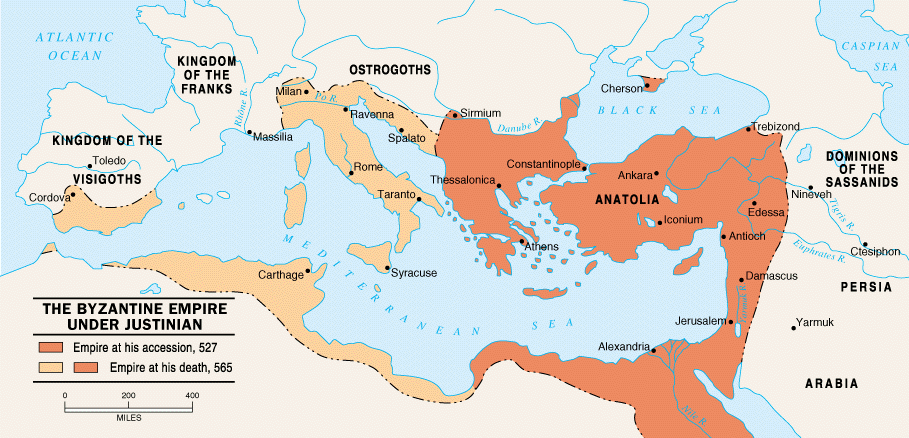
Justinian was among the greatest emperors of the Roman empire. He took power in 527 AD. At the time, the Western Roman empire was long lost, and the Eastern empire was fighting a war of attrition with the Persian empire. Justinian managed to buy off the Persian empire, albeit at considerable cost: 11000 gold pounds each year. That freed up the army, and he began to expand into the Mediterranean. Carthage in North Africa fell in 534, in a battle that ended the Vandals as a major power. The re-invigorated Roman armies invaded Italy in 535 AD and quickly took Naples and Rome from the Ostrogoths. The Ostrogoth armies came back and besieged Rome for a full year, but the Romans managed to hold the city and in 538 the Goths retreated. By 540, much of the Italian peninsula was back under Roman control. The empire was well and truly being re-established, with its new capital in Constantinople.
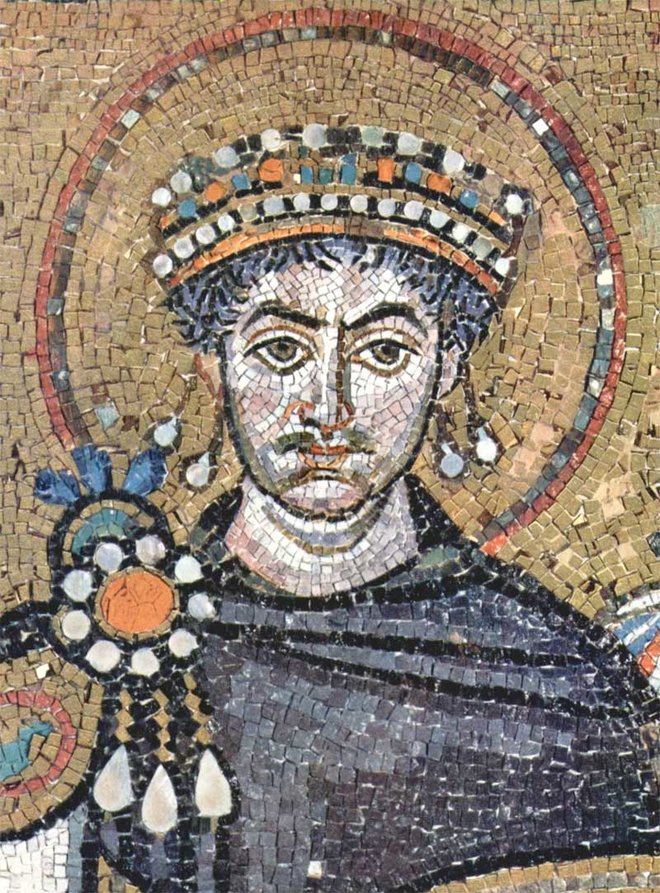
Justinian I
It is interesting to guess what might have happened. On the one hand, the warring parties were evenly matched and Justinian would have had to commit many more troops to gain a lasting conquest, as he had done in North Africa. The invasion seemed half-hearted. On the other hand, if successful and perhaps in alliance with the Goths, a large Mediterranean power could have given stability and a critical mass for technological progress. Civilization could have skipped many hundreds of years, directly into the world of the late Middle Ages. It was not to be.
The apocalypse started in 541 when a new disease appeared in Egypt. One report states that it had originated in Ethiopia, but this must be considered doubtful: it was common to blame Ethiopia for mishaps. Procopius tells the story:
“It began with the Egyptians who live in Pelusium. It divided and part went to Alexandria and the rest of Egypt, and part to the people of Palestine, the neighbours of the Egyptians, and from there overran the whole earth. This disease always began from the coast and then moved up to the country inland. The plague lasted in Byzantium [Constantinople] for four months and was at its peak for about three. At the beginning not many more people died than usual, then the disaster grew greater, and finally the number of dead reached five thousand a day, and then attained ten thousand and even more than this.”
The numbers may be overstated, but the death toll is believed to have exceeded 250,000, out of a population of 500,000. The effect was devastating:
“At that time it was not easy to see anyone in Byzantium out of doors; all those who were in health sat at home either tending to the sick or mourning the dead. If one did manage to see a man actually going out, he would be burying one of the dead. All work slackened; craftsmen abandoned all their crafts and every task which any man had in hand.”
The disease moved on, but became endemic in the Mediterranean and eventually returned to the city in 558 AD. Agathius wrote:
“During that year at the beginning of spring a second outbreak of plague swept the capital, destroying a vast number of people. From the fifteenth year of the reign of the Emperor Justinian when the plague first spread to our part of the world it had never really stopped, but had simply moved from one place to another, giving in this way something of a respite to those who had survived its ravages. It now returned to Constantinople almost as though it [had] been cheated on the first occasion into a needlessly hasty departure. People died in great numbers as though seized by a violent and sudden attack of apoplexy. Those who stood up to the disease longest barely lasted five days. People of all ages were struck down indiscriminately, but the heaviest toll was among the young and vigorous and especially among the men.”
The disease started with a fever, and within a day progressed to the classical plague symptoms. It became so bad that people reportedly started wearing name tags when going out, so that if they died suddenly they would not be buried anonymously. Constantinople may have lost 40% to 60% of its inhabitants. The empire overall is said to have lost 10 million people. The total population of the empire was around 25 million; it implies a mortality rate similar to the Black Death. Farming was badly affected, with many farms empty and abandoned. Famines followed in 542, 545, and 546.
The plague had significant impacts. New wars broke out with Persia, and the man power to fight three fronts (including North Africa) was no longer available. Much of Italy had to be given up, until the Persians (whose armies were also being decimated) could be bought off again. After 550, new armies were send and Italy was conquered again, against an equally depleted Ostrogoth army. A successful incursion was made into Spain. Now the Eastern Roman empire reached its greatest extent. But the armies were much smaller, and largely consisted of mercenaries. Agathius wrote “whereas there should have been a total effective fighting force of six hundred and forty-five thousand men, the number had dropped during this period to barely one hundred and fifty thousand.” There were not enough people left to keep control of such a large empire. The economy had also become impoverished. Gold coins after 540 contained much less gold than those minted before. In 568, Italy was invaded by the Lombards and Roman control of the area crumbled.
If the plague hadn’t come, it seems possible that the Roman empire would again have controlled the entire Mediterranean, and possibly Central Europe as well. That was no longer possible. Instead the empire began its slow contraction to its eventual demise, nearly a millennium later.
What was this disease? The symptoms were those of bubonic plague, Yersinia Pestis. This identification has been challenged, mainly because there were some symptoms which were not present in the later plague epidemics, and because it started in Africa rather than Asia. However, DNA fragments found in graves point at bubonic plague. The plague originally came from China and it may first have spread with the westward migration of the Huns, establishing itself in the area. A different strain of this bacterium would later cause the Black Death, and a third variety caused the 1894 Asian epidemic.
Over the next 200 years there were a number of outbreaks, until the disease finally disappeared around the year 750. The overall death toll over those 200 years is estimated as between 50 and 100 million. This was at a time when the world population was perhaps 300 million.
What caused the sudden spread? The plague is carried by the fleas on rats, but can possibly also be transmitted through human fleas, person to person. The bacterium makes the fleas ravenous; flea bites now infect the next victim. The plague quickly became a disease of the poor. Both in 540 and in 1347, the plague followed a major volcanic eruption. In 1347, the disease spread from the Crimea, where poor, wet and cold weather was the trigger, perhaps causing rats to invade the food stores which were shipped around. In 540, the food came from Egypt with a very different climate. One paper proposes that the exceptionally cool summer benefited the Egyptian rats, and allowed their numbers to explode. Something allowed plague-carrying rats to get into the grain storage. The fact that the disease always started at the coast shows that ships carried the rats, probably as part of the grain transport. In times of shortage, there may have been pressure to ship as much food at as fast a pace as possible. Fast food can be a killer.
It has been suggested that a deficiency of vitamin D, caused by the lack of sun, made the population vulnerable to the plague. This does not fit well with the dates, as the sunless year was several years before the epidemic. If 540 too was a year of haze, this was not recorded.
The plague spread beyond the Eastern Roman empire. Much less is known about this, because of the lack of local written records after the retreat of the first Roman empire. Archaeology has found that skeletons in an early medieval cemetery in Aschheim, Bavaria contained DNA from Y. Pestinus. The disease had either managed to cross the Alps or spread independently to here. The DNA also showed that although it was first recorded in Africa, the 541 plague, like the 1345 and 1894 epidemics, had its origins in Asia. Similar evidence was found in France, where Gregory of Tours reported that plague was raging by 543, noting “soon no coffins or biers were left. 6 or more were buried in one grave.”
Much less is known about the spread of the plague elsewhere in Europe. The best documentation exists for Ireland, albeit written down some 50 years after the events. The 6th century Irish invented their own word for the disease: blefed. The Annals of Tigernach mention ‘a great mortality, which is called blefed’ and which according the the Annals of Ulster arrived in 545. Nearby, Maelgwn, king of Gwynedd in Wales, was said to have died of the “Yellow Plague of Rhos” around 547. The lack of written records in Britain makes it hard to know whether the plague reached here. (There is a written history by Gildas, dated to 540, but his story is in poor agreement with what we know from other sources.) However, there is indirect evidence that there were significant changes, at the end of so-called ‘sub-Roman Britain’ (the period after the Romans had left but before the anglo-saxon became the dominant power). Whether this was due to famine or plague is not known. By 540 AD, romanized Britains remained in power in the centre, west and north, and Saxons held power in the southeast, up to York and Bournemouth. This stable situation collapsed in the next few years, and by 550 the AngloSaxon expansion resumed. The important Roman town of Calleva Atrebatum (in Hampshire) disappeared around or shortly after 550.
The de-peopling of Scandinavia may have been due to either famine or plague. The former is perhaps more likely. Plague-carrying fleas need temperatures of at least 10-15 C, and this would only have been reached in summer, and possibly not at all during the decadal temperature minimum.
A word of caution is needed here. It is always hard to proof exactly what happened when and why. For much of the world, we lack written documents. Archaeology rarely gives dates accurate to a decade. In Britain, we know that the cities changed and declined after the Romans left, but we don’t know exactly when they were finally abandoned. The Anglo-saxons knew the Roman cities – they build new settlements a few kilometers away. The suggestions that the events after 536 fatally weakened the remaining cities is plausible but can not be proven. In America, it is not possible to proof a link between events such as the fall of Teotihuacán and the eruptions even though it seems likely. More research is needed – especially a more precise date for Ilopango would be useful. The strongest case for catastrophe outside of the Roman Empire comes for the tree ring record. This really was a period with exceptionally cold weather. No country survives well with a lack of food. And where we have a good written record, we know that this decade was apocalyptic (Roman empire) or highly damaging (China). The fact that the timing approximately coincides with significant changes elsewhere makes it plausible that other places were also badly affected. Understanding the past is like Plato’s prisoners in the cave, who can only see shadows on the wall and from that have to infer what is happening outside. But here, the shadows seem terrifying.
The four horsemen
Ten years after the Roman empire reached its greatest promise, its future had been lost. And the catastrophe went further, encompassing China, Mexico and Scandinavia. Perhaps 10% of the world population died. The apocalypse came swiftly, unexpectedly, and without anyone knowing where it came from. Either of the two eruptions would have been survivable. The combination of the two left the world vulnerable. The four horsemen saw their chance and rode out: famine, war, plague and death attacked and destroyed the weakened civilizations.
This is how the Dark Ages began. One disaster was manageable. Two simultaneous disasters became a catastrophe. And the third disaster truly brought apocalypse.
Albert Zijlstra, March 2019
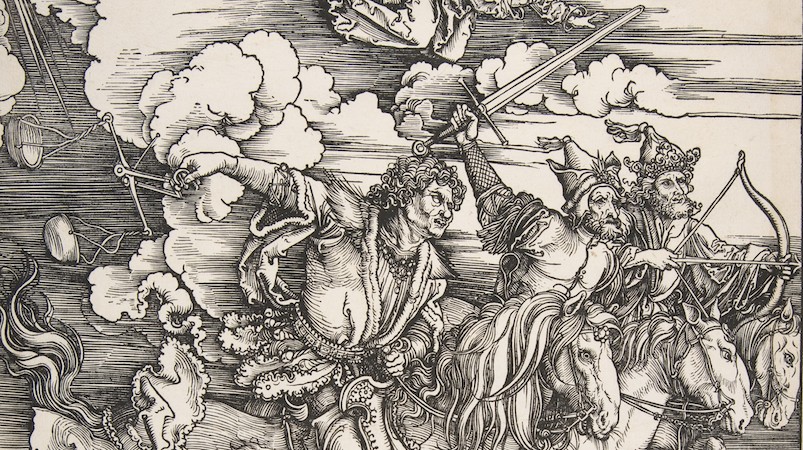
part of Four Horsemen. Albrecht Duerer, 1498
Many articles can be found on these events, although few tell the full story. Scientific papers can be harder to locate. Here are some of the papers I used for writing this post.
Michael Sigl et al., Nature, 543–549 (2015): Timing and climate forcing of volcanic eruptions for the past 2,500 years
Joshua North, Armstrong Undergraduate Journal of History, 3, no. 1 (Jan. 2013): The Death Toll of Justinian’s Plague and Its Effect on the Byzantine Empire https://www.armstrong.edu/history-journal/history-journal-the-death-toll-of-justinians-plague-and-its-effects-on-the
Antti Arjava: Dumbarton Oaks Papers, Vol. 59 (2005), pp. 73-94: The Mystery Cloud of 536 CE in the Mediterranean Sources
Bo Gräslund and Neil Price, 2012, Antiquity, 86, p 428-443: Twilight of the gods? The ‘dust veil event’ of AD 536 in critical perspective
Matthew Tooney et al, Climatic Change (2016) 136:401–412: Climatic and societal impacts of a volcanic double event at the dawn of the Middle Ages
Mischa Meier, Early Medieval Europe 2016 24 (3) 267–292: The ‘Justinianic Plague’: the economic consequences of the pandemic in the eastern Roman empire and its cultural and religious effects
Ulf Büntgen et al, Science Bulletin (2022) 67, 2344: Global wood anatomical perspective on the onset of the Late Antique Little Ice Age (LALIA) in the mid-6th century CE
Eirini Anagnostou et al, Boreas (2025) 54, 1: The AD 536/540 climate event in Sweden – a review<
And some Volcanocafe posts related to this topic
When eruptions make a difference
The Maya collapse: a history in three volcanoes
The Mayas and their lack of volcanoes









 English (US) ·
 French (CA) ·