

 8 months ago
197
8 months ago
197
PROTECT YOUR DNA WITH QUANTUM TECHNOLOGY
Orgo-Life the new way to the future Advertising by AdpathwayAstronomers might have found a moon half the mass of Jupiter orbiting in a nearby system, based on the wobbles of its host world.
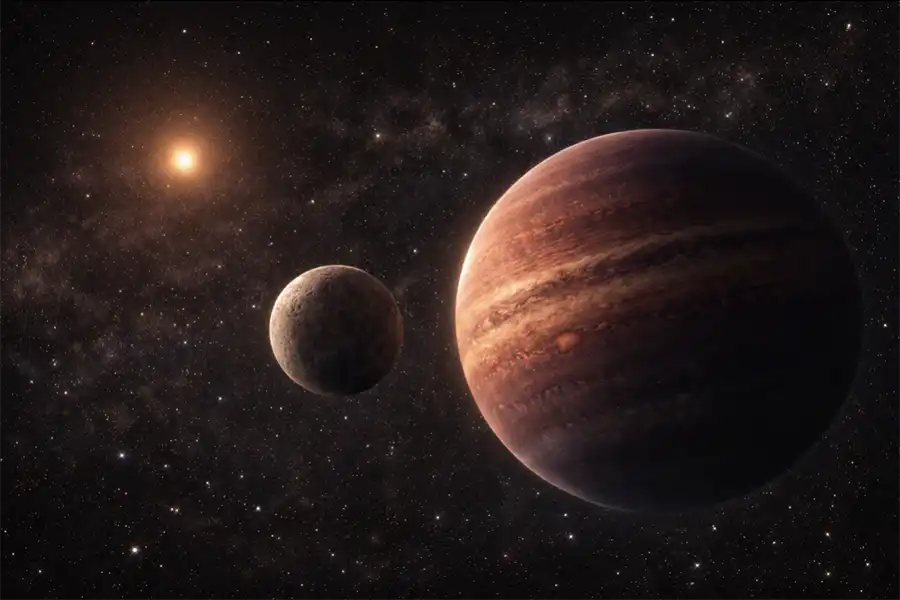 An artist’s impression of the HD 206893 system shows a substellar companion orbiting the star. The world could itself host a massive exomoon.
 DR / Paris Observatory
Exoplanet hunters have a new frontier: exomoons. While there are many ideas out there for how to go after them, astronomers have only found tentative evidence of their existence so far. Now, for the first time, astronomers have tracked a potential exomoon by looking at the wobbles of the world it orbits.
The potential moon circles HD 206893 B, a brown dwarf , or failed star that was unable to sustain fusion in its core. Around 133 light-years away in the constellation Capricornus, HD 206893 B is nearly 20 times as massive as Jupiter and orbits a young star comparable to our Sun.
The study, led by Quentin Kral (Paris Observatory), proposes looking for exomoons using a technique called astrometry, the precise tracking of a celestial object’s position and motion. By measuring the brown dwarf’s six-year orbit, the team discovered a periodic back-and-forth motion, occurring on a nine-month cycle, that could originate from the gravitational tugs of a moon nearly half the mass of Jupiter.
The exomoon would be the first detected, highlighting astrometry’s potential for finding other moons around planets. But the evidence is weak, and the signal could just as easily result from noise.
“We’re really pushing the limits of our data to see a potential signal of an exomoon,” says Jason Wang (Northwestern University), a coauthor on the paper published in Astronomy & Astrophysics. More observations can help either confirm the detection or rule it out once and for all.
Finding a Moon in the Wobbles
Between 2019 and 2025, the team observed the system with GRAVITY, an instrument on the European Southern Observatory’s Very Large Telescope Interferometer (VLTI) that can capture extraordinary precise astrometry. Using interferometry, GRAVITY combines photons collected by multiple smaller telescopes to achieve enough resolution to spot a swimming pool on the Moon.
That resolution is necessary to image this crowded system. Besides the brown dwarf that orbits at nearly 11 astronomical units — a little more than Saturn’s distance from the Sun — there’s a second giant world, about 11 times more massive than Jupiter, that’s orbiting the same star nearly 4 astronomical units out (which would put it just inside Jupiter’s orbit in our system).
To make matters more complicated, the young star also has a disk of debris swirling beyond these objects’ orbits, with a gap that might be caused by a third object, this time a Jupiter-mass planet.
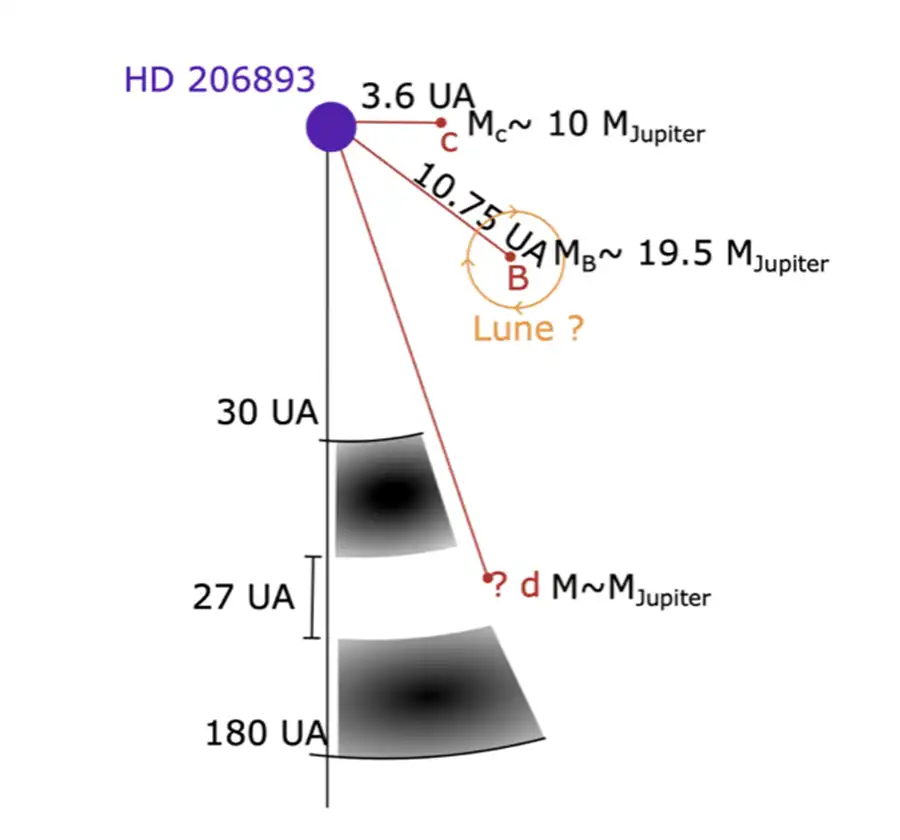 Diagram of the HD 206893 system and its candidate exomoon
 DR / Paris Observatory
The team considered different possible moon masses and orbits that could cause the signal they observe, finding that a moon around half of Jupiter’s heft could orbit it at roughly 0.2 au. But astronomers aren’t confident yet that the signal is moon-like.
For one, unaccounted-for noise in the data could masquerade as an exomoon detection. The moon scenario fits the data slightly better than a fit without a moon, but not with enough confidence to merit a solid find. “Certainly, getting follow-up data will help test whether this signal is real,” Wang says.
“Their detection is marginal at best,” says René Heller (Max Planck Institute for Solar System Research, Germany), an exomoon hunter who wasn’t involved in the study. “I’m more inclined to say that these are systematic effects,” he adds, which would rule out the exomoon possibility.
Nonetheless, the study “shows that the community is really interested in the search for extrasolar moons,” he adds.
Another expert agrees: “I don't find this very convincing due to lack of statistical significance,” says Eric Agol (University of Washington), who wasn’t involved in the study, “but the technique is interesting and promising for future work.”
Know Thy Planet, Know Thy Moon
If real, this exomoon would be far more massive than any in our own solar system. There isn’t an agreed-upon definition of what constitutes an exomoon, in part because there have been no surefire discoveries.
Some astronomers argue that the center of mass between a moon and its host object must reside within the host. Heller adopts this definition: “If [the detection is] real, then I think it should rather be referred to as a binary planet,” he says, since the center of mass is outside of the brown dwarf’s radius. (In this case, Pluto and Charon would likewise be binary dwarf planets.)
Others, like Kral, define a moon by the mass ratio between the host and satellite. At half of Jupiter’s mass, the mass ratio between the brown dwarf and its putative satellite would be comparable to the Earth-Moon system.
Exomoons could also help astronomers by serving as laboratories to probe planet formation and evolution. For example, Earth’s Moon contains a record of our planet’s bombardment by asteroids. And the Galilean moons shed light on Jupiter’s own formation, as they coalesced within a disk around the gas giant 4.5 billion years ago.
Astrometry has the potential to discover exomoons quite different from those in our own solar system. Given that it requires observing light from planets themselves, astrometry would mainly target moons around far-out, massive companions at least a few times heftier than Jupiter. The technique could also discover moons lighter than Earth, if they orbit far enough from their host planet. “It may be a very prolific technique in the close future,” Kral says.
“When we looked outside of our solar system for planets, we found so many that we never imagined to exist,” Wang says. At least some of those planets must have moons; we just haven’t yet been able to detect them yet. With its potential to discover moons around other worlds, astrometry is one more tool to explore the next frontier of planetary science.
















 English (US) ·
  French (CA) ·