

 6 hours ago
7
6 hours ago
7
PROTECT YOUR DNA WITH QUANTUM TECHNOLOGY
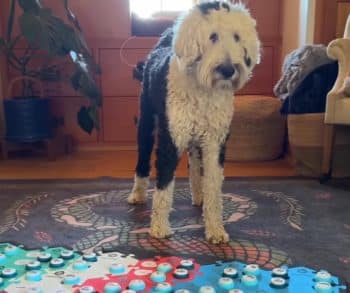
Orgo-Life the new way to the future Advertising by AdpathwaySome dogs communicate with a bark, a nudge, or a meaningful stare. Bunny, a 7-year-old Sheepadoodle, has another way to make herself understood. With a large soundboard filled with buttons representing different words and ideas, she has developed a remarkable communication routine with her person, Alexis Devine. What began as Alexis’s hope for a deeper connection with her dog has grown into an ongoing exploration of choice, understanding, and just how much dogs may be capable of expressing when given another way to communicate.
 Credit: Instagram
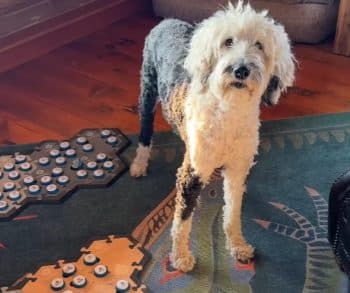
Alexis began learning about communication buttons before Bunny even came home. Inspired by the kind of close human-animal bond often portrayed in stories like Lassie, she wondered whether buttons could give her dog another way to express her wants, needs, and experiences. Over time, that experiment became part of their everyday life. Bunny’s soundboard eventually grew to include around 110 buttons, with Alexis consistently modeling words during their daily interactions.
Rather than viewing the board as a trick, Alexis sees it as a way to offer Bunny more agency and choice. Bunny can use the buttons alongside familiar canine communication, including body language, movement, facial expressions, and vocalizations.
When Bunny Said Something Was Wrong
One of Bunny’s most memorable moments showed why that additional form of communication could be useful. Bunny used her buttons to communicate the words “ouch,” “stranger,” and “paw.” The unusual combination caught Alexis’s attention because it appeared to indicate that something about Bunny’s paw felt wrong.
 Credit: Instagram
When Alexis examined her, she discovered a foxtail embedded in the webbing between Bunny’s toes. Without the buttons, Bunny might still have shown discomfort through licking, limping, or changes in behavior, but her use of buttons gave Alexis another signal to investigate. The experience became one of the clearest examples of how closely Alexis had learned to pay attention to Bunny. Their communication system was not replacing Bunny’s natural behavior. Instead, it had become another part of the way they understood each other.
Bunny’s abilities have also attracted scientific interest. She has participated in the They Can Talk research project associated with the Comparative Cognition Lab at the University of California San Diego, contributing data to research exploring how dogs interact with augmentative interspecies communication devices.
The research surrounding button-using animals continues to explore important questions about what dogs understand and how their button presses should be interpreted. Bunny’s participation offers researchers an opportunity to study these behaviors in a more systematic setting rather than relying only on viral clips.
For Alexis, however, the experience has always been about more than individual words. Living and communicating with Bunny has encouraged her to become more observant, patient, and aware of the emotions shaping their interactions.
Bunny still has energetic periods and moments of reactivity. The soundboard has not transformed her into a perfectly predictable dog, nor was that ever the goal. Instead, the buttons provide another bridge between two companions who are continually learning how to understand one another.
 Credit: Instagram
Alexis has also shared that the process has helped her reflect on her own experiences with overstimulation and reactivity. By learning to recognize Bunny’s needs and respond more thoughtfully, she has discovered lessons that apply to herself as well.
Their relationship shows that meaningful communication does not always require perfect understanding. Sometimes it begins with simply giving another being more opportunities to be heard and then taking the time to listen.
This content was created with AI assistance and edited by the iHeartDogs team.
















 English (US) ·
  French (CA) ·