

PROTECT YOUR DNA WITH QUANTUM TECHNOLOGY
Orgo-Life the new way to the future Advertising by Adpathway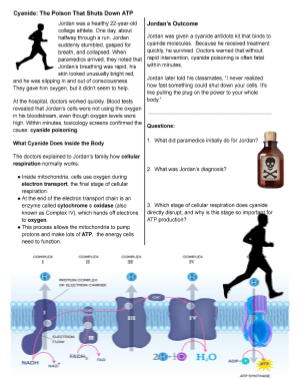
If you’re looking for a high-engagement way to teach the electron transport chain, this case-study activity is a perfect fit. Instead of memorizing steps in isolation, students learn how cellular respiration works by investigating what happens when it stops. Follow the dramatic scenario of a runner who collapses after accidental cyanide exposure.
The story hooks students immediately, and the worksheet walks them through how cyanide blocks cytochrome c oxidase. This shuts down the electron transport chain, and prevents cells from using oxygen. Students analyze symptoms, connect them to mitochondrial function, and use their knowledge of ATP production to explain why cyanide is so deadly.
This is a short mini-case study that is designed to be a “hook” for a unit on cellular respiration. Students do not need to have background knowledge about the process. The story focuses entirely on the electron transport chain, and does not include the Calvin cycle. I also find the subject can be uninteresting for students, but if you add a little bit of a “murder mystery” and some history about cyanide poisoning, that can spark interest. My freshman do a related case on the Chicago cyanide murders.
This exercise can work for beginning students or as a review for older students in AP or 2nd year biology.
The activity includes:
- A short narrative case study
- A clean, student-friendly diagram
- Step-by-step notes on the electron transport chain
- Analysis questions and labeling
It’s an excellent way to reinforce key concepts like electron carriers, ATP production, oxygen’s role in respiration, and the importance of mitochondria in high-energy tissues. This worksheet works well as an introduction, review, or station activity—and it sparks great discussion about the connection between biochemistry and real-world toxicology.
Related Resources
AP Biology Class Site – Includes all of the activities I use for my class
Cellular Respiration Overview – simple worksheet with vocabulary and labeling exercise
Graphic Organizer of Cellular Respiration – fill in a graphic using a word bank

















 English (US) ·
  French (CA) ·