

 7 months ago
175
7 months ago
175
PROTECT YOUR DNA WITH QUANTUM TECHNOLOGY
Orgo-Life the new way to the future Advertising by Adpathway Snowdrops photo by Kate St. John | Red-winged blackbird photo from Wikimedia
12 March 2026
Phenology is the study of the times when natural phenomena recur throughout the year.
At the beginning of this century, before the Internet was so accessible, Chuck Tague wrote a bi-monthly paper newsletter called The Nature Observer News that listed outings, nature club meetings, and what to expect outdoors in the upcoming half of the month.
In 2008-2009 I collaborated with Chuck to post a phenology for Western Pennsylvania based on his articles in The Nature Observer News. He created the lists about 20 years ago from his observations at the time. Since then our climate has gotten warmer and some nature events occur earlier than they used to, enough to jog them a half-month.
Thinking about what you’ve seen in recent weeks, have any of these nature events moved backward to a prior half-month? Are they all on time this spring?
I’ve marked the differences I’ve seen with an (X) and descriptions at the end.
 Maple trees with sugar pails (photo from Wikimedia Commons)
Phenology (20 years ago) for LATE FEBRUARY
- Ice melts in the lakes.
- Ducks, swans and geese fly north.
- Maple sugaring time begins.
- Turkey vultures return, just one or two at first. (X)
- Skunk cabbage pokes its head out of the snow.
- European Starlings become glossy and their beaks turn yellow for spring.
- The days are getting longer. By the end of February the sun sets after 6:00pm.
 Common grackles and red-winged blackbirds flock (photo by Nancy Magnusson via Flicker Creative Commons license)
Phenology (20 years ago) for EARLY MARCH
- Noisy flocks of red-winged blackbirds.
- First of the Year common grackles. (X)
- Large flocks of robins sing at dusk and dawn for about two weeks.
- Intensive peregrine falcon courtship.
- First flowers in gardens: Snowdrops, crocuses, forsythia (X)
- Mud Season: switch from snow boots to mud boots.
- Jacket Weather (instead of the winter coats) (X)
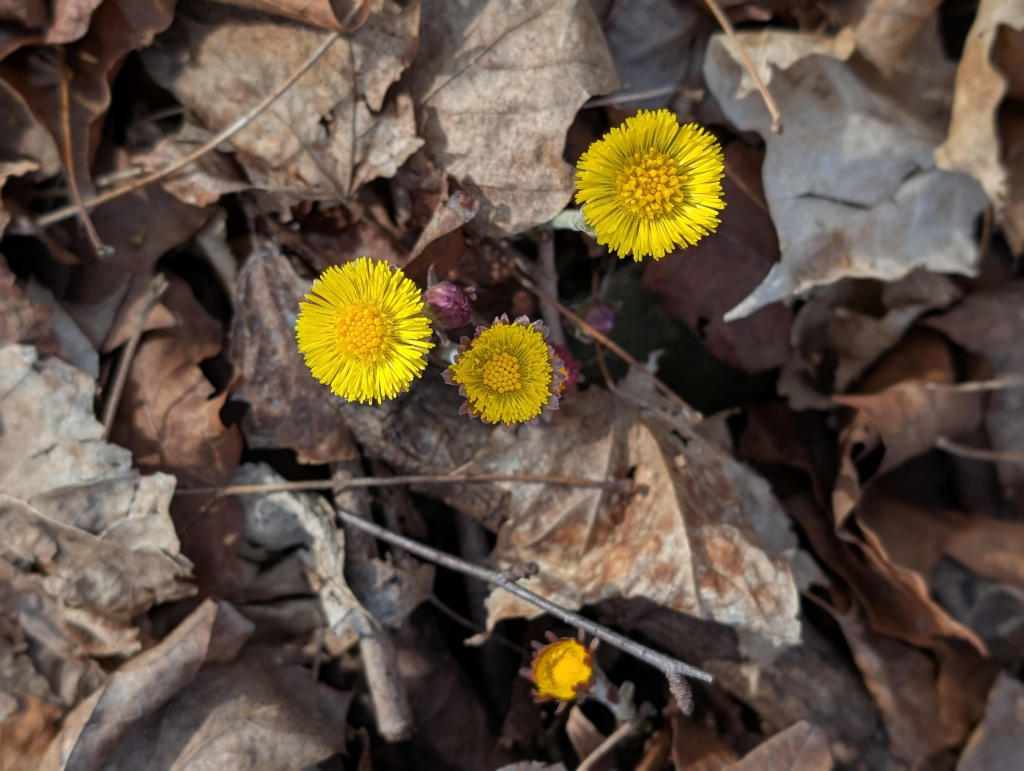 Coltsfoot at Barking Slopes, 25 March 2025 (photo by Kate St. John)
Phenology (20 years ago) for LATE MARCH
- Migrating ducks, geese and tundra swans on local lakes.
- Tree swallows, eastern phoebes and eastern bluebirds arrive.
- Garden flowers and trees: Daffodils, tulips, ornamental cherry.
- Woodland flowers: coltsfoot, harbinger of spring, snow trillium
- Skunks and groundhogs are getting active
- Peregrine falcons lay eggs and begin incubation.
- American woodcocks “peent” and twitter in their aerial mating dance. (X)
- Spring peepers and wood frogs are singing and mating. (X)
Changing Expectations of Spring: Then and Now
Here are the discrepancies I’ve seen in the past few weeks.
- I saw a turkey vulture on 10 February at Emsworth Dam. This was a half-month early but I didn’t think much about it because I thought they stayed in that area of the Ohio River all winter.
- First of the Year common grackles came back in late February. They did not wait for early March.
- Jennifer Zimmerman commented that the first sighting this year of crocus in my Moon Twp yard was 2/21 and several bees on the crocus 2/28. Crocuses were early by a half month.
- We skipped Jacket Weather for summer clothes on 7 March when the high went up to 78°F.
- American woodcocks were here doing their sky dance in early March. However they dance for at least a month so it may be that the phenology is pointing out their later dances.
- Spring peepers and wood frogs began singing in early March (as reported by friends). They did not wait until the second half of the month.














 English (US) ·
  French (CA) ·