

 3 months ago
120
3 months ago
120
PROTECT YOUR DNA WITH QUANTUM TECHNOLOGY
Orgo-Life the new way to the future Advertising by AdpathwayShun Nonaka, Yokohama National University in Japan, discusses his article: Non-random species loss weakens functional diversity and species asynchrony, destabilizing grassland communities
Why does the order of species loss matter?
When we think about biodiversity loss, we often ask a simple question: how many species are disappearing? This is important, but it is not the whole story. In real ecosystems, species are rarely lost at random. Grazing, drought, and climate variability can affect some species more strongly than others. This means that two grasslands may lose the same number of species but experience different ecological consequences depending on which species disappear first. We wanted to understand whether the order of species loss changes grassland stability, and the processes that support it.
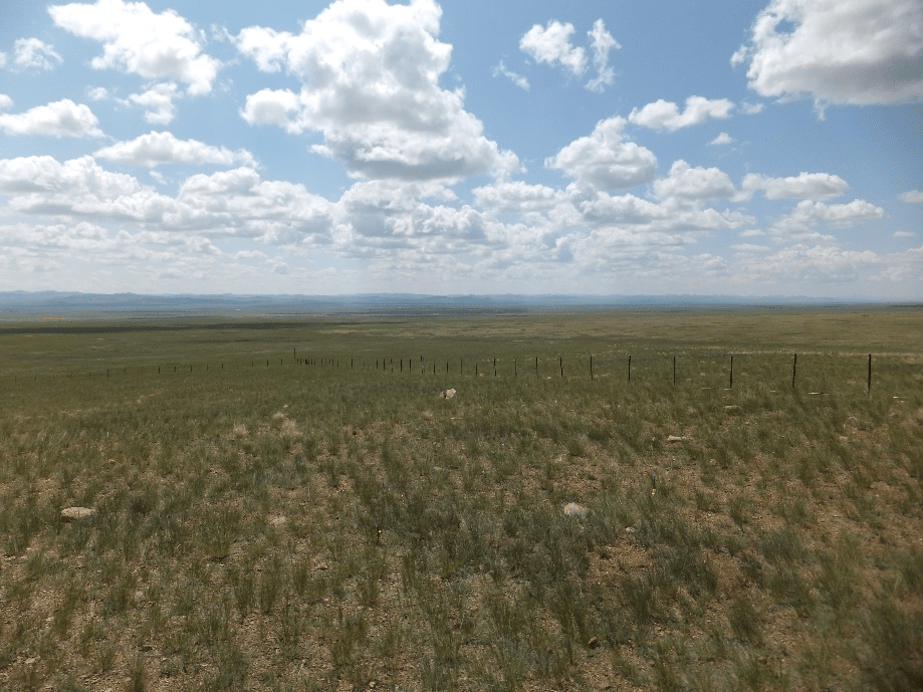 Semi-arid grassland in Hustai National Park, Mongolia, where the species-removal experiment was conducted. Photoby Takehiro Sasaki.
A field experiment in a Mongolian grassland
To test this, we performed a field manipulation experiment in a semi-arid grassland in Mongolia. In 2013, plant species were removed from experimental plots following four different sequences based on their abundance ranking at the experimental site: starting from the most abundant species, starting from the least abundant species, removing species from both ends of the abundance ranking, or removing species at random. We then followed the plant communities from 2014 to 2016, recording the abundance of each species. This allowed us to examine community stability and several processes associated with stability.
To have a deeper understanding of these processes, we also assessed functional diversity, species stability, and compensatory dynamics. Functional diversity describes the variety of plant traits in a community; for this we measured six functional traits linked to the ability of plants to acquire resources such as light and nutrients: leaf height, leaf dry matter content (LDMC), leaf area, leaf mass per area (LMA), leaf carbon content, and leaf nitrogen content. Species stability describes how stable individual species are through time, weighted by their abundance. Compensatory dynamics occur when increases and decreases among species partly cancel each other out.
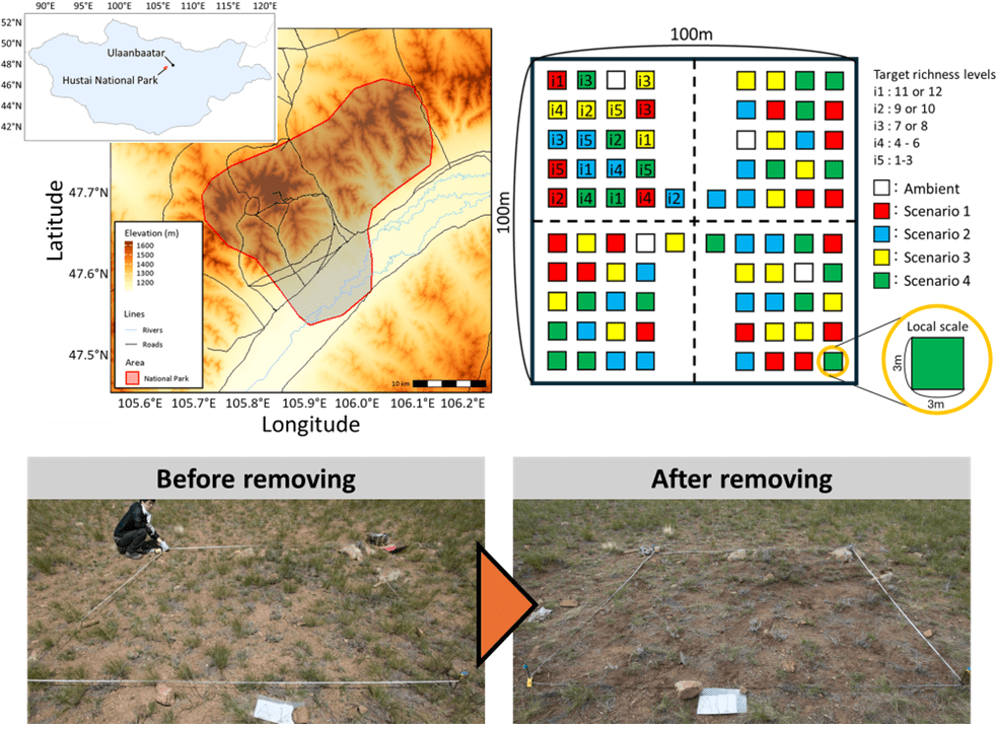 Experimental plots and design used to test how different sequences of plant species loss affect community stability. Photos by Shun Nonaka.
Stability was not the whole story
Our first result was surprising. Over the short period of our study, community stability did not clearly decline as species richness was reduced. If we looked only at the overall stability value, the grassland appeared relatively robust to species loss.
However, this apparent stability hid important differences. The consequences of species loss depended strongly on the order in which species were removed. When species were removed sequentially from the high-abundance end of the local abundance ranking, functional diversity declined, which in turn reduced species stability. When species were removed from both ends of the abundance ranking, compensatory dynamics were weakened. In contrast, when the loss sequence started from low-abundance species, the short-term effects on community stability were relatively small. Random species loss also failed to reproduce the same changes in stabilizing pathways observed under more ordered, non-random loss sequences.
In short, the grassland could look stable from the outside, while its internal support system was being reorganised.
This reminded us that the overall stability value does not tell the whole story. A community may appear stable for a few years after disturbance, while the processes maintaining that stability have already shifted.
Why this matters
Our study highlights that biodiversity loss is not only about how many species disappear. It is also about which species disappear first, and what roles those species play. This matters because many experiments and models still use random species loss as a baseline. Assessments of random species loss are useful, but it may miss important consequences of more realistic, non-random loss pathways. If abundant or functionally important species disappear first, a grassland may lose stabilising processes before a clear decline in overall stability becomes visible.
Grasslands support livestock production, carbon cycling, soil conservation, and biodiversity. Predicting how they will respond to global change therefore requires us to understand which species are vulnerable, what roles they play, and how their loss reshapes the community.
Looking ahead
Our experiment followed plant communities for three years after species removal. A key next step is to ask whether these altered stability pathways persist, strengthen, or disappear over longer periods.
Another important question is how these hidden changes interact with climate extremes. Semi-arid grasslands are exposed to strong year-to-year climatic variability, and future droughts, heatwaves, or other extreme events may reveal vulnerabilities that are not obvious under normal conditions. Combining long-term monitoring with measurements of biomass and ecosystem functions will help us understand whether apparently stable grasslands are truly resilient.
About me
I am a Master’s student at Yokohama National University, where I study how biodiversity changes driven by environmental change affect ecosystem functioning and stability in grassland and moorland ecosystems. I am especially interested in the mechanisms that allow ecosystems to remain stable, or become vulnerable, under pressures such as climate extremes, grazing and land-use change.
 Shun Nonaka (the author) in a dry grassland in Inner Mongolia, China, in 2025, during a separate survey.Photoby Kenshin Kawamura.












 English (US) ·
  French (CA) ·