

PROTECT YOUR DNA WITH QUANTUM TECHNOLOGY
Orgo-Life the new way to the future Advertising by AdpathwayNorthern Arizona’s forests offer birders a memorable mix of small, energetic, and intelligent songbirds. Among the most engaging are the Mountain Chickadee (Poecile gambeli) and the Bridled Titmouse (Baeolophus wollweberi). These beauties belong to the tit family (Paridae) and share curious, lively behaviors, yet they differ noticeably in appearance, habitat, and population. Learning to tell them apart—and knowing how to find them during winter —adds wonder to birding in the north.
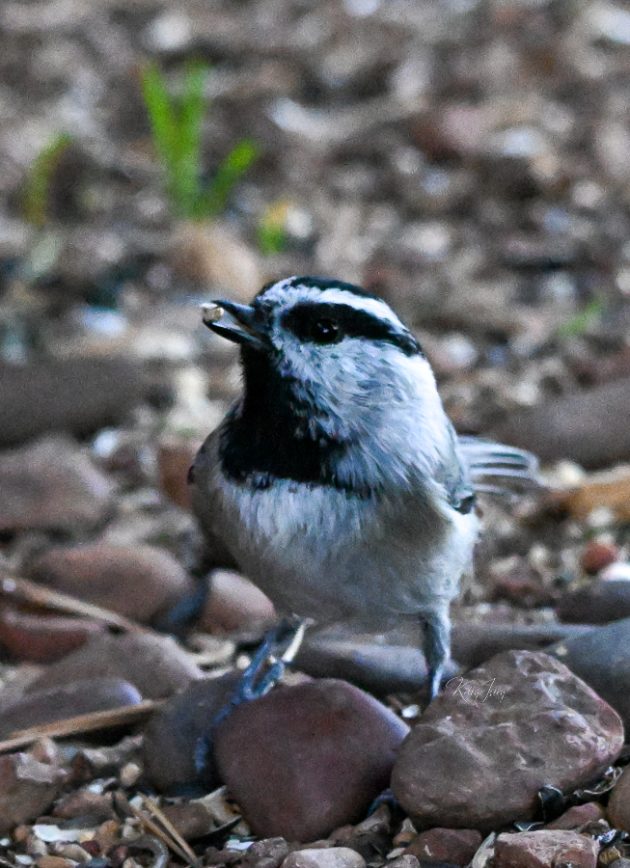
Intelligence and What to Look for
The Mountain Chickadee is a well-known resident of higher altitudes. Compact, it has a classic black cap, gray back, pale underside, and the bib of chickadees. Its most distinctive feature is the bold white eyebrow stripe above the eye— that immediately separates it from other chickadee species. Birders often spot this stripe first as the bird flits and flutters through the trees.
In The Genius of Birds, Biologist John Marzluff reminds us that Chickadees are among the most intelligent birds for their size. Studies show they are highly cognitively flexible, quickly assessing danger and food availability while sharing social announcements as needed. That familiar “chick-a-dee” call includes critical information. As an example, the number of “dee” notes rise with the potential threat level. Making their songs a form of detailed communication rather than a simple, beautiful alarm.
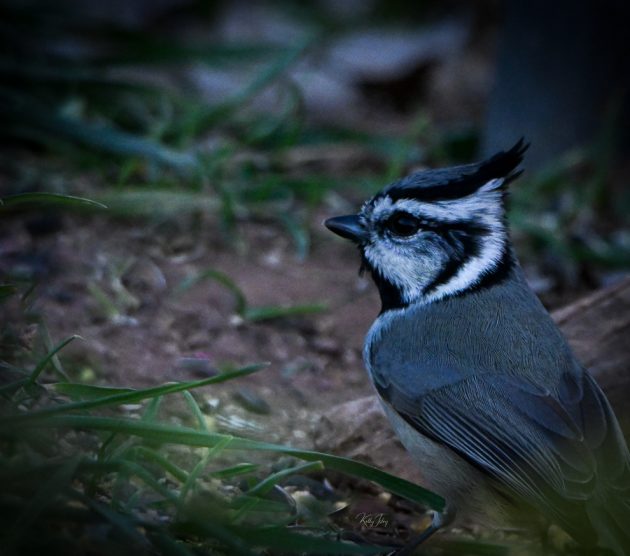
The Bridled Titmouse is similar in size and intelligence but more elongated in shape. It sports a short gray crest and a striking black-and-white facial pattern resembling a bridle or little mask. Although they are missing the chickadee’s eyebrow stripe, its contrasting face and crest make it one of Arizona’s most visually distinctive small songbirds.
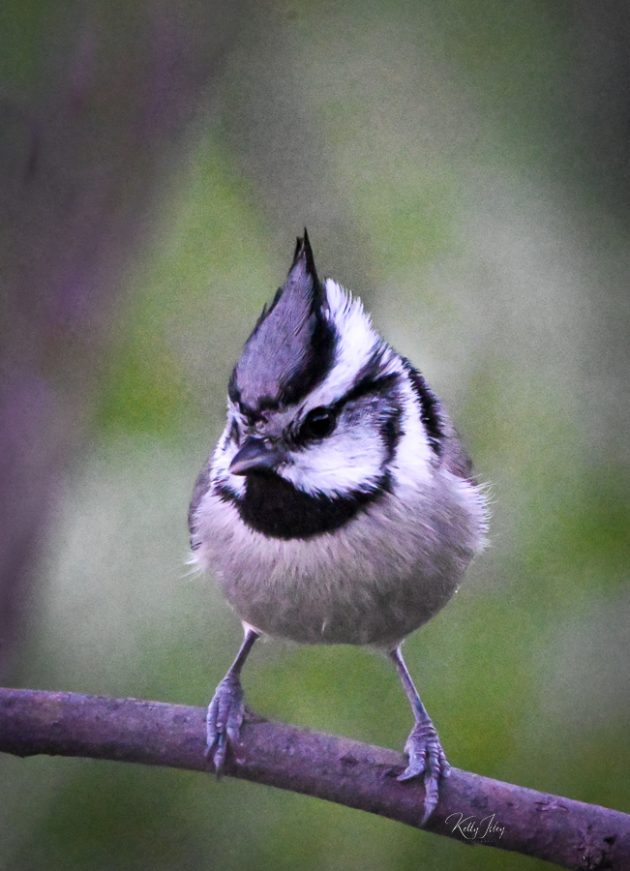
Both species are on the move, flitting through the trees in search of food. To some birders, their songs may sound similar initially, but over time, they reveal that the Bridled Titmice produce quicker, higher-pitched whistles. While the Mountain Chickadees give a deeper chick-a-dee-dee.
Range and Habitat
Mountain Chickadees favor ponderosa pine and mixed conifer forests, usually above 6,000 feet, though harsh winters can drive them to visit habitats as low as 4,500 feet. They forage along trunks and branches, gleaning seeds, berries, and insects. During the winter months, Chickadees often join mixed-species flocks with kinglets, nuthatches, and woodpeckers. This is a strategy that helps to improve predator avoidance and foraging success.
Bridled Titmice prefer oak-pine, oak woodlands, or pine-juniper habitats. The larger populations are in southeastern and central Arizona. However, suitable habitat extends into northern Arizona, including Sedona and Cottonwood. They are especially prevalent where oaks mix with pinyon, juniper, or ponderosa pine. It is worth noting that Mountain Chickadees occur widely across the West, whereas Bridled Titmice are limited to the southwestern United States, chiefly southwestern New Mexico and Arizona.
Behaviors
Both species share key traits. These two beloved songbirds are intelligent sentinels (lookouts) and active foragers, often probing bark for insects or hanging upside down. Both join mixed-species flocks in winter and are cavity nesters, using natural tree holes, nest boxes, or former woodpecker cavities. Remember to take a closer look at crest presence, facial markings, and habitat to correctly identify these songbirds.
Where to Find Them
Fall and winter are great times to observe Mountain Chickadees, which are common around the San Francisco Peaks, the Mogollon Rim, Flagstaff, the White Mountains, Cottonwood, and Sedona. Consider taking binoculars to look at the upper branches of pines and firs along trails; they can be found foraging along trunks in milder weather, and around campgrounds.

Bridled Titmice are less predictable in northern areas but can be seen in oak-pine transition zones, canyon woodlands, and riparian corridors near Sedona, Cottonwood, and Prescott, especially where mixed flocks are active.
In the springtime, both species become more territorial and vocal. Mountain Chickadees pair up and inspect nesting cavities in conifers, while Bridled Titmice establish breeding territories in mid-elevation oak woodlands. If you are an early riser, you are in luck, as Spring mornings are often the best time to enjoy their songs and see them.
Bringing It All Together
From oak-lined canyons to the fantastic pine-covered slopes, northern Arizona provides ideal habitat for both the Mountain Chickadee and the Bridled Titmouse. Whether they are calling from a springtime nest site or you see them in a mixed winter flock, both species reward curiosity, careful observation, and patience.


















 English (US) ·
  French (CA) ·