

 1 year ago
256
1 year ago
256
PROTECT YOUR DNA WITH QUANTUM TECHNOLOGY
Orgo-Life the new way to the future Advertising by AdpathwayAstronomers discovered a small, free-floating object that’s accreting matter at a breakneck pace, suggesting that some planet-size worlds could form similar to stars.
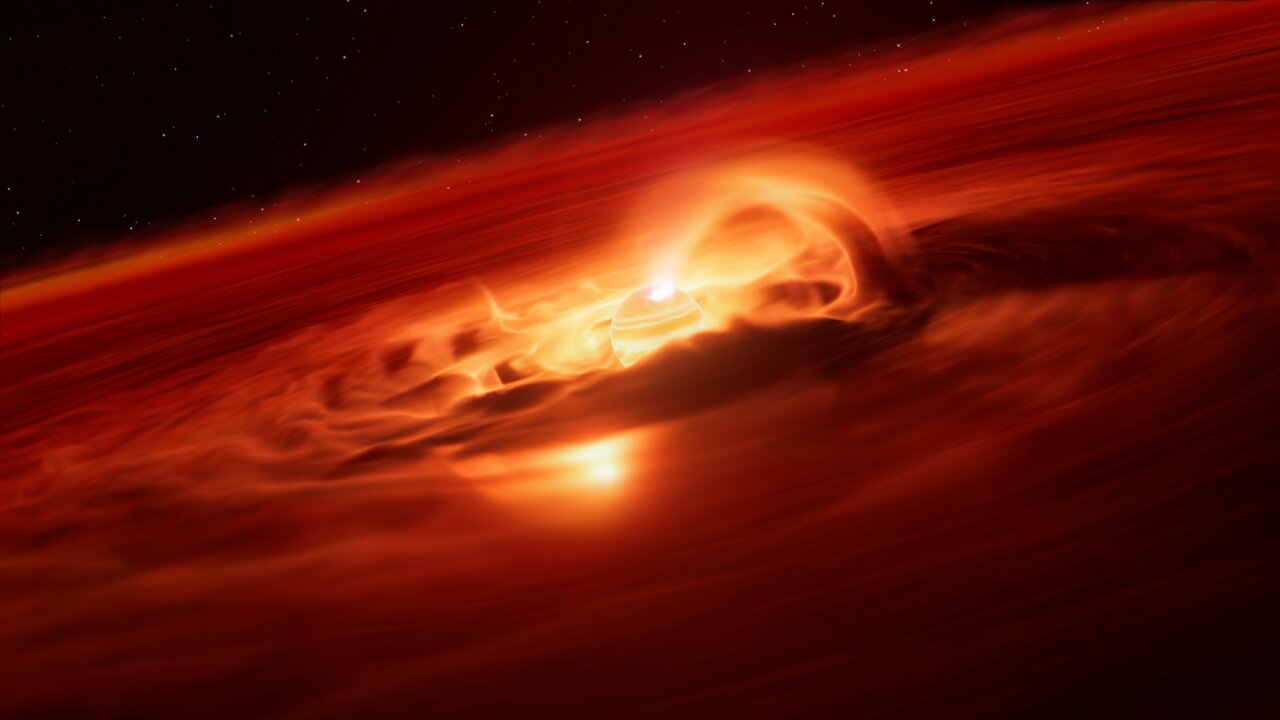 An artist’s impression shows Cha 1107-7626, a solitary, fast-growing world surrounded by gas.
 ESO / L. Calçada / M. Kornmesser
Around 620 light-years away in the Chameleon constellation, a free-floating world is gobbling up material at an extraordinary pace. But while the object, Cha 1107-7626, seems planet-like — it has 5 to 10 times the mass of Jupiter and is almost three times its size — its vociferous appetite for matter suggests that it’s forming more like a star.
The world has its own accretion disk, a swirling mass of gas and dust that appears around young stars as they form — and its appetite is only growing. In June 2025, astronomers discovered a rapid increase in the amount of material being sucked into the object. By August, the rate had increased eightfold: The world is now accumulating a staggering 6 billion metric tons of material per second.
While astronomers have found dozens of worlds like Cha 1107-7626, known as “free-floating planetary-mass objects,” their origins remain ambiguous. Despite being comparable to giant planets in size, mass, and atmospheres, these worlds are often solitary, unlike planets, and accompanied by disks, like young stars.
“This object sits really isolated in the Chameleon cloud,” says Aleks Scholz (University of St. Andrews, UK), a coauthor on the paper published in The Astrophysical Journal Letters. “At this point we think it most likely formed like a star, on its own.”
Cha 1107-7626 is the lightest object ever observed to have such a strong burst of activity, called an accretion burst. Studying this activity can reveal how these renegade worlds form and influence their environment, and whether they are more akin to planets or stars.
A Burst of Activity
The team observed the object with the Near-Infrared Spectrograph and Mid-Infrared Instrument on the James Webb Space Telescope (JWST), and the XSHOOTER instrument on the Very Large Telescope (VLT) in Chile. The team took spectra of the object, measuring the intensity of its light over different wavelengths from April to August. Molecules absorb and emit light at specific wavelengths, leaving a mark on the spectra. The team observed spectral features from certain molecules brightening between June and August, indicating that the disk was heating up as Cha 1107-7626 accumulated matter at a faster rate.
The team saw signs of hydrocarbons in the spectra, suggesting that the disk is carbon-rich, and they noticed that water vapor appeared in the disk during the burst, though it was absent before. “Accretion bursts change the chemistry of their surroundings,” Scholz says.
While these chemical changes have been observed as baby stars accrete material, this discovery is the first time it’s been seen in an object still of planetary mass. The team also found evidence that the object’s magnetic field was guiding the inflowing gas, another phenomenon seen in stars.
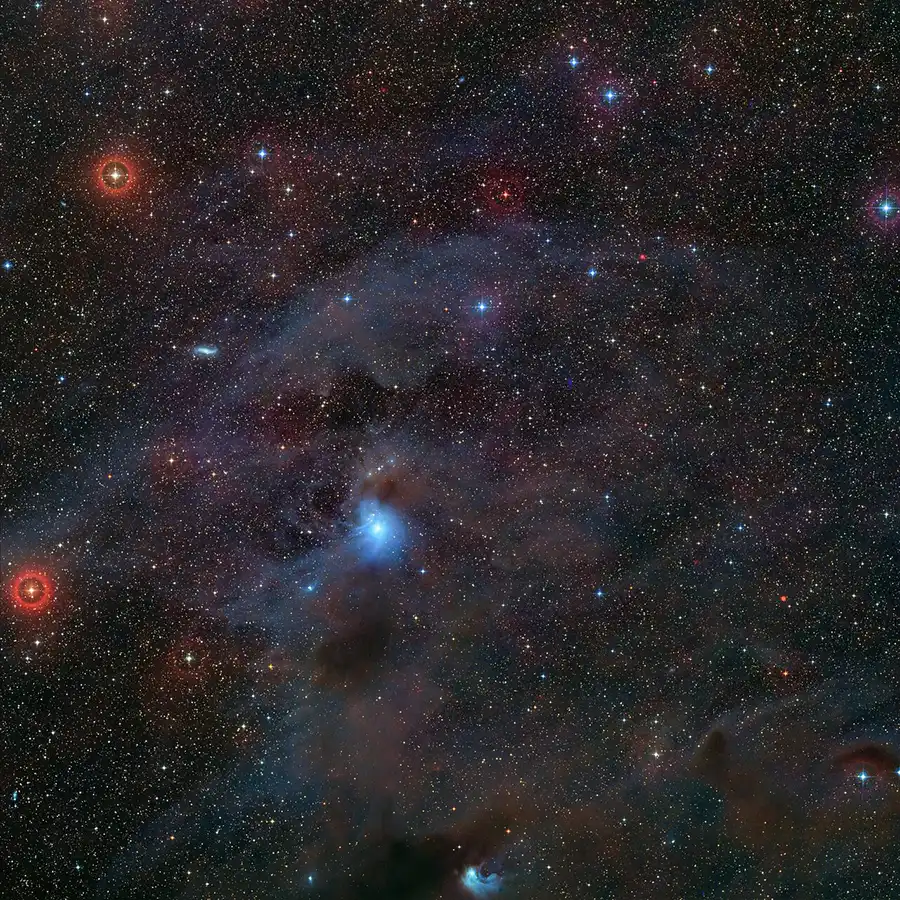 This visible-light image, part of the Digitized Sky Survey 2, shows the position in the sky of the rogue planet Cha 1107-7626. The planet (not visible here) is located exactly at the centre of the frame.
 ESO / Digitized Sky Survey 2
“It is interesting to see that at least some such objects appear to go through turbulent growth periods in their infancy,” says Adam Langeveld (Johns Hopkins University), a frequent collaborator of the team who wasn’t involved in this current study. “It is not always a quiet and stable birth and can be much more dynamic and violent than we previously thought.”
The burst was still increasing by the end of the team’s observations, so its true duration is unknown — it could very well be gobbling up mass at that greater rate today.
“Many [astronomers] think that accretion bursts are key for building up the mass of stars, but to this day we don't fully understand what triggers them,” Scholz says. “Why are some objects experiencing recurrent bursts, and others don't?”
A 2016 spectrum of the rogue world also showed high accretion levels, so these bursts could recur. “The fact that we now have an example of such a burst in a planetary-mass object must mean that those events don't depend on object mass — it should be a really universal process,” Scholz says.
Planet or Star?
Astronomers have coined a name for objects similar to Cha 1107-7626 that blur the line between planets and stars: brown dwarfs. These failed stars aren’t hot enough to fuse hydrogen, though those with more than 13 Jupiters’ worth of mass can usually fuse deuterium, a stable isotope of hydrogen. Cha 1107-7626 isn’t yet heavy enough for deuterium fusion. But the line between planets and stars is fuzzy: Astronomers have even discovered lone brown dwarfs weighing in at only twice Jupiter’s mass.
“The mass range of the most massive objects that form ‘like planets’ overlaps with that of the least massive objects formed ‘like stars,’ so studying objects in this regime is key to disentangling the two formation pathways,” Langeveld says.
Some rogue worlds might be bona fide planets that were ejected from their solar systems, especially if they’re small and rocky, but larger free-floating worlds more likely form in collapsing clouds like stars rather than in a solar system.
“We will definitely follow this object in the coming years and try to find out how common these bursts are,” Scholz says. The team also hopes to study the chemistry in the objects’ disks and atmospheres. “Fortunately we now have the tools to do all that — but it's going to take a bit of time.”
“Thanks to the unprecedented sensitivity of JWST, combined with powerful ground-based facilities such as the VLT used in this study, we are now beginning to uncover these phenomena in far greater detail,” Langeveld says.
“This result provides one more example of how the birth process of brown dwarfs is similar to the birth of stars,” says Kevin Luhman (Penn State), the discoverer of Cha 1107-1726 in 2008 who was not involved with this result. More data will continue to uncover the nature and origin of these lone worlds.
















 English (US) ·
  French (CA) ·