

 1 month ago
80
1 month ago
80
PROTECT YOUR DNA WITH QUANTUM TECHNOLOGY
Orgo-Life the new way to the future Advertising by Adpathway WHEN I HEARD that today’s guest, who’s been a guiding force in educating organic farmers, was finally publishing a book specifically for gardeners, I was thrilled. I’d been following Jean-Martin Fortier since his first handbook on biointensive organic market farming came out more than a decade ago, and even gone to hear him speak at farming conferences—then done my best to translate and distill his advice and apply it to my own garden size and conditions.
Now JM, as he is known, has done all the translating from farm to backyard scale for all of us, within the pages of his latest book, “In Your Garden: The Complete Guide to Home Vegetable Gardening” (affiliate link), and those who grow edibles at home can benefit from every last insight he shares, from soil and bed prep, to crop spacing and succession schedules, and exacting details on how to have the greatest success with each crop.
Quebec-based JM Fortier has been farming for about 25 years, and has popularized his method of highly efficient small-scale market farming with two how-to manuals, “The Market Gardener” and “The Winter Market Gardener,” which have sold more than 300,000 copies. In addition, more than 10,000 farmers have taken his professional grower training. His latest book, “In Your Garden,” speaks to a potentially even wider audience, and we talked about some of the mainstays of the methods he teaches in it.
Plus: Comment in the box near the bottom of the page for a chance to win a copy of the new book.
Read along as you listen to the Sept. 7, 2026 edition of my public-radio show and podcast using the player below. You can subscribe to all future editions on Apple Podcasts (iTunes) or Spotify (and browse my archive of podcasts here).

vegetable-garden wisdoms from jm fortier
Download file | Play in new window | Duration: 00:26:40
Subscribe: Apple Podcasts | Spotify
Margaret Roach: Hi, JM, how are you? I bet you’re one busy guy. It’s harvest season.
Jean-Martin Fortier: Yeah. We were just talking how I made it late and yeah, the weather’s been good. So we’re outside and we’re roaming everywhere. Yeah, there’s work [laughter].
Margaret: There’s work and there’s vegetables.
JM: There’s plenty of vegetables. This is a great season. I don’t know if it’s the same where you are, but up here and we’re just on the tip with Vermont. We’re just on the tip there and it’s been raining every week a little bit, just enough, never too much. We’ve been really blessed this season.
Margaret: Good. The book comes out shortly. And so just to get us started, when I looked back at the book to get ready for this conversation, there’s like a mathematics to a lot of what you do, a method that’s almost mathematical. You’ve really sorted it out so that it works. For instance, I guess it begins with fixed permanent beds that are raised up just a few inches, I guess, of the soil, but they’re not raised as in boxes, and they have a prescribed dimension, always four feet wide with I think 30 inches of growing area and always 18 inches of path between. So tell us a little bit about the math of the layout [laughter]. [Below, a garden of 30-inch beds with 18 inch paths between.]
 JM: Yeah. Well, it’s funny because people will think that I’m a geek, and I’m far from that. I’m actually the contrary. I’m this creative, crazy mind that’s all over the place. And that’s why, because farming is my career and I’ve had to make a living, I’ve created boxes around me and systems to help me streamline, organize, not forget, prepare. And I’ve just been really fortunate because the reason why people know us, and why our farm is known about, is because we were landlocked. All these years we’ve had only 2 acres to farm and we’ve developed methods and skills and tools to work within that 2 acres to grow more vegetables, but not on more land.
So to answer you, we’ve kind of always grown in a box and it’s the same thing for plants. If you have a bed system that is a permanent bed system with a fixed setup, you have a box. And then each box is one planting, one crop. And then you can plan it better, you can optimize it, you can streamline it and you can organize your whole garden in terms of boxes like these. So the garden will be one square or rectangular box, and then inside of that you have all these permanent beds that are rectangular.
So I would say that the math kind of comes from that, but that’s more of design principles. And for me, when I looked at home gardeners, how they operate, a lot of them just go on whims. They don’t have a system to work from within. And actually you’ve picked up on the one piece that I think is the most fundamental one is that permanent bed that is standardized in width and in length. So all the beds are 30-inch, that’s your growing area; the pathways are 18 inch. That’s enough to walk beside each bed, to hump over the beds. And all the tools and techniques that we use and that have been tested and by market growers all over the world, we’ve all adopted this 30-inch bed now. So a lot of the information that people need or want, the spacing, how many seeds they need for everything, it becomes more easy because everything is in this format.
Margaret: Right. And these are all no-till. You don’t go through with a tractor. And as I said, they’re permanent beds. You don’t go through the tractor and plow it all out and then form the beds again.
JM: You eliminate compaction, which is the Number 1 problem when growing vegetables is compaction. That’s the Number 1. If you have compaction, compacted soil, it starts on the wrong foot. So having light, deep, loose soil is really the key. And just having a permanent bed system, like you said, that you don’t plow, disc, hill, shape or rototill—in a home garden, you rent the rototiller in April and then you till it away. You could do that once, but if anytime you’re flipping a bed and you’re changing the crop, you’re rototilling and destroying your soil structure, you’re destroying your soil ecology. So that’s not what we’re doing.
 Margaret: And you rely on your trusted friend, your broadfork [laughter], which is a beautiful tool and it’s peaceful and it has a rhythm and it’s like you put it in the soil and you rock a little bit on it and you go to move ahead and do it again and again and again. It’s just contemplative, but it’s also very effective at loosening without destroying, yes?
JM: Exactly. It’s just the perfect tool to go with the permanent beds because it allows you to create deep, loose soil, which really is what… The system that we use is the biointensive cropping system, where all the crops are really, really closely spaced so that we can create canopies, get more yield per square foot. But all this works if the roots can shoot down. So you need deep, loose soil. Really, that’s the secret and it’s the reverse of having compacted soil.
So the broadfork, you’ve named it, it’s just like I probably have 10,000 hours with me with the broadfork [laughter] over the years and yeah, it’s my trusted companion. I really like how you said that. I never get bored of it and every time I’m using it, I’m connecting with the soil, I’m connecting with my environment, I’m listening to birds. Obviously on our farm, it’s 1.6 acres, so it’s more broadfork than in a garden, but still it’s enjoyable, it’s very symbolic, it’s very good for the soil. You’re not disturbing the earthworms, the ecology, and it’s allowing you to have deep, loose soil.
Margaret: You said “create canopies,” and is that the close spacing? When you say canopies, does that mean that because once the plants have grown, they’re in a sense touching, they are excluding weeds, helping to exclude weeds? Is that what you mean by canopies?
JM: Yeah, exactly. The canopy is really important in the system because when the leaves, three-quarter of the growth of everything we plant, at three-quarter, the leaves need to touch and eventually the plant grows mature and then the bed is kind of like it’s under an umbrella of leaf. And that’s important because as you said, it eliminates a lot of the weeds because the sun is not hitting the ground so it can’t germinate, but also because it’s retaining the moisture. And we don’t understand this much because we’re not thinking that way, but soil moisture in the ground is really what activates the biology in the soil. So by retaining the moisture, you’re creating just perfect conditions for your plants, for your roots, and it’s just you’re protecting the crop because it doesn’t get hit by wind so easily.
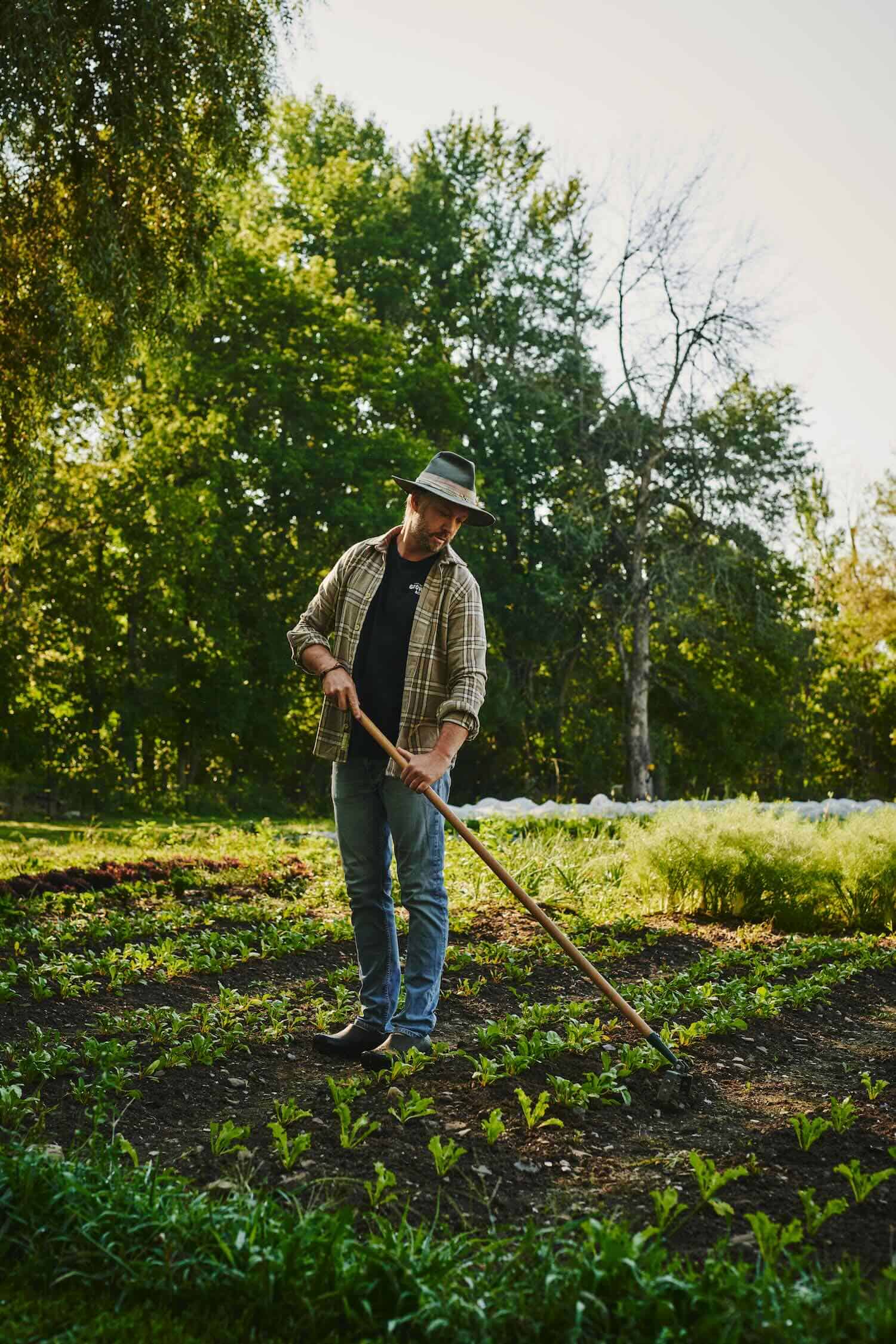
Margaret: Right. And while we’re waiting for that canopy to fill out, so to speak, when you’re in between the seedlings, you use a stirrup hoe. Is that another tool? I believe it was the stirrup hoe that you kind of weed with, but it’s not weeding like going around literally pulling each thing-
JM: Yeah, that’s one big difference between a market gardener and a home gardener is that we have, let’s say 2 acres of gardens, which is a pretty big garden, and we’re never on our knees. We never, never, never hand-pull weeds because we don’t weed, we cultivate.
Margaret: Exactly.
JM: And the big difference is that we’ll use these tools, these stirrup hose, and we have a bunch of different hose that we use, but the idea is that you have a blade on a long shaft and you’re continuously stirring up soil, providing oxygen to it, and then if there’s weeds coming up, you’re destroying them just by the action of moving soil around. And then you do this once, twice, depending on the crop after transplant or a few weeks after the crops have germinated, and then eventually the crop grows its canopy and then you don’t do that anymore. So we’re always doing things preventively and proactively, and the tool makes the difference. [Below, JM using a scuffle hoe.]
 Margaret: Right. So we’ve been saying that you’re expecting a lot out of your soil, but you’re also giving it a lot of tender, loving care. And I wanted to talk a little bit just about what, besides the techniques we’ve just been discussing, what are the other dimensions of the soil-care or support regimen that you adhere to? Since we don’t till, everyone’s probably wondering, well, when do you turn in your whatever amendments they want to use, whether it be fertilizers or compost or whatever it is. And are you topdressing on these beds? Here we are, we’re coming to fall, some areas are coming empty. What are we doing at this time of year or other times of year in terms of amendments or no?
JM: So each bed is going to be a crop. So one of the things that when I did my book that I researched, and to be honest to your listeners, I’ve never really had a garden in my life.
Margaret: [Laughter.] A confession.
JM: Yes. My parents had a garden, but I’ve always had a market garden, which is kind of a different thing, but I’ve been around plants and I’ve been around growing them. So I was researching what people do in gardens, and I found that trying to do crop association was a big thing, which I don’t believe really in and I wouldn’t advise. Me, I think each bed is like one crop and is like a garden. So let’s say you have a 40-by-40 garden, you’ll have 20, 30 beds that they’re all going to be 4 or 5 feet long, and each of them is like a garden. And so depending on what you’re planting and what time of year, you’ll put compost, you’ll put fertilizers, you’ll put different amendments.
But to answer your question, what happens is that then we’ll put cover crops, which is what we’ll do now. Once the season’s over and we have these crops that are harvested, when the bed is free, we’ll plant legumes, we’ll mix legumes with different cereal rye grass, and we’ll grow plants that are not meant to eat, but just to structure the soil and to give it a lot of oomph and to have the soil covered for the winter. And that’s something that I think home gardeners can learn a lot from professional growers because cover crops, they’re amazing. They really are.
Margaret: And I think a lot of gardeners may have had kind of a bad or unfortunate experience with a cover crop when earlier on, people who have been gardening a long time, it was like, “Oh, get some winter rye and put that in.” Well, but then at the other end of things, “Turning it under,” it’s no small feat Whereas some of the things you’re talking about, you have a different tactic and they behave differently. So what’s the aftercare, kind of, of a cover crop? And when you’re saying legumes, what are we talking about?
JM: We’re talking about vetch, peas.
Margaret: Like field peas or something?
JM: Yeah, field peas. And your listeners probably know this, but these legumes have the capacity to fix nitrogen from the air and bring it into the soil. So that’s really nice, but you’re touching a good point. How do you get rid of them, especially rye grass? And so the answer is we tarp it.
Margaret: So you tarp it. Okay. So occultation.
JM: Exactly. Yeah.
Margaret: O.K. Which is different from solarization, people should know. So this does not require summer sunshine [laughter].
JM: No, it’s black opaque tarps. Once we’re ready to prepare soil, once we know that what was there, it could be a cover crop or it could be a bed of lettuce or whatever it was, when we’re ready to replace it, we just cover it. And it’s the absence of light that will help the decomposition of what’s there. You’re actually nutrient-cycling these vegetables, they’re transforming them themselves. Because there’s no light, you’re kind of mulching it and then you’re destroying what’s there, allowing it to eventually after two, three, four, five weeks, depending on the time of the year, to have clean beds again to work from.
Margaret: So if I sowed as things come empty at this end of the season, we’re in September and so forth, if I sowed a legume and oats or something, when would I get to the tarp? When is that timing of the tarping? When’s that going to be?
JM: So now you’d have your beds and some of them are free. So you would come and you would put a mix of hairy vetch and winter rye. I said rye grass, but it’s actually winter rye. It’s not the same. Sorry, I got confused there. Winter rye. So everyone, it’s a cereal. So then you seed that, and you seed only your bed. You don’t seed the pathway; you seed your bed. Then you’ll let it grow because vetch and the rye will grow really well, even if there’s low light and it’s cold in the fall, and it’s going to really kick fast in the spring. So by June, you should have 4 or 5 feet of really dense cover crop.
Margaret: And that’s where I freaked out the one time I tried this.
JM: So now you’re in June. So what do you do? O.K.? Yes. Or you’re in May, and you want to plant in June. So what you’ll do is that you’ll come with a weed whacker or with your mower or with your scissors, anything, you’ll chop it and then you’ll tarp it.mThen you’ll leave that there for three, four weeks, and then when you’ll take it out, it’s going to be gone.
Margaret: O.K. So there’s a beheading, and then there’s a tarping. O.K.
JM: And then when you open that tarp and you realize that it’s black soil, you realize that your soil is alive, because it’s been eating this organic matter.
Margaret: Yeah. All those microorganisms have been having a feast.
JM: Exactly. And they’re having a feast because it’s a night party, no birds are coming in, earthworms are there. It’s like the black tarp creates these conditions where it’s perfect for them to operate.
 Margaret: I remember when we did a “New York Times” story, a garden column, not so long ago, I remember you were enthusiastically encouraging me [laughter] to try a particular turnip you love.
JM: Yes, the ‘Hakurei’ turnips. Did you try them? [Photo above from Johnny’s Selected Seeds.]
Margaret: [Laughter.] Not yet, no. But you must have tried everything in these years of growing, and especially as a market gardener or market farmer, because you’re very connected to your audience, your customers, your clients are in the local market. Do you have a CSA as well?
JM: We have a hundred families.
Margaret: Yeah. So I mean, this is a close relationship and you know what they like and they don’t like it, I would imagine. And you’ve tried many things, I would imagine, over the years, many varieties.
JM: So every year, since I’ve been doing this for all these years, I’ve tried a lot of things. A lot of things I don’t even remember that I tried and that I know it didn’t work, but I don’t remember that. And then sometimes I’m re-trialing the same things. That is a bit problematic, but let’s not talk about that [laughter]. I would rather say that I get excited, especially when I get the seed catalogs. They’re going to come out probably in November, October. They come out early. And then there’s always these new varieties. And then every year, give or take, I try at least five, six, seven new varieties. And then I have my favorites that I know they work and that they’re all in the book. All my favorites are all in the book. These are tested, trialed. I know they work, but I always try new ones because it’s exciting and I need to stay excited. I need to get a little feeling of, “Oh wow, this could be it.” And sometimes I’m disappointed, sometimes I’m not. It’s fun.
Margaret: So is there a tomato you would never not have in your offering? Is there almost like a signature of your farm? Do you know what I mean? A best tomato or is there an herb that you have that you feel like your customers just love that you have it and maybe you introduced them to it? Do you know what I mean? Some sort of.
JM: Some signatures. Well, we talked about ‘Hakurei’ turnip. That’s definitely one that I’ve made people discover so many, so many times. This is a turnip that is white, it’s small, it’s round, and it’s super-fresh. You can crack it open and it’s watery and it doesn’t have that spicy taste. So it’s really amazing.
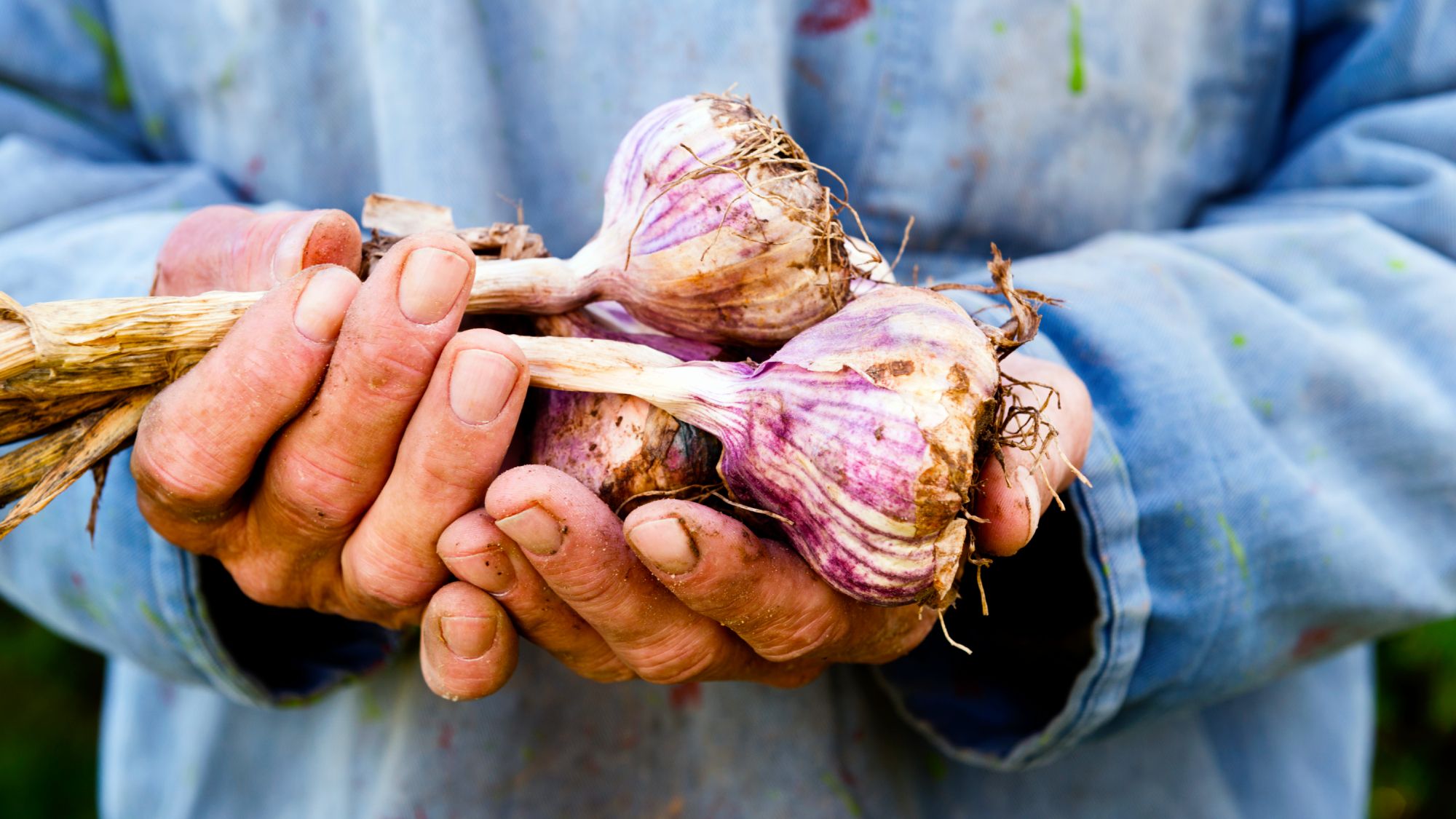
People know us for our garlic. Our garlic is… You can’t compare our garlic with anything else that you can find in the supermarkets, obviously, but that’s something that every year people stock up and people know us for this. And you talked about tomatoes. So tomatoes for me, there’s some varieties that you just can’t do without. ‘Brandywine’ is one.
Then we have all these French cultivars, ‘Marbonne,’ ‘Margold,’ ‘Coeur de Boeuf,’ all these French cultivars that are amazing. They’re amazing. No, they’re fancy names. We buy most of our seeds from Johnny’s Selected Seeds. Sure. I’m a big fan of Johnny’s seeds because it’s quality seeds and they’re not the only one, but they’re my favorite. But we get them at the Johnny stores. I bring some back from France when I go there. But yeah, the French cultivars, they’re hard to beat.
Margaret: Oh that’s fun. I didn’t know about that. That’s something I could be on the lookout for. That’s great. I just wanted to get back to the biointensive and the spacing and the tactical stuff. And both you and I, what we learned when we first met and talked and when we were doing the “New York Times” story, we’re both fans of a pioneer of this from- You know who I’m talking about [laughter].
JM: Oh, yes.
Margaret: … from John Jeavons from Ecology Action out in California, whose 1974 book, I think originally it was just called “How to Grow More Vegetables Than You Ever Thought Possible on Less Land Than You Can Imagine.” And now the 8th edition or 10th edition or whatever has even more words in the title. But he was a hero for us, right?
JM: Yep. And this was one of the first books that I picked up when I was starting, because we were landlocked, we were trying to figure out how to grow more on less land, exactly how the title was for us. We were just kind of pushing the scale to a commercial scale, but still the ideas were the same. And so I picked up a lot of things from that book. Unfortunately, I never met him, but I had the opportunity to meet Eliot Coleman, who was my mentor when I started and still today is somebody that I greatly admire. And most of the best tricks I have in my playbook, they’re all tricks that I learned from Eliot. So in gardening, in farming, you learn from someone. It’s rare that you invent anything. Mostly you pick up tricks here and there and you put that in your game plan and then hopefully it works. And in my case, it did.
Margaret: How long is the market season up there in Quebec where you are?
JM: We probably will stop markets mid-October, and we have our CSA until the last week of November.
Margaret: Wow.
JM: And then we can grow year-round, and we’ve had in the past, and in my book, I talk about this, I’m encouraging home gardeners to have a little small greenhouse that they can grow spinach in. Commercially, it’s fun to have a time off for us, so we tend to not work in December, January, and February, but we can still grow.
Margaret: Yeah. Well, JM Fortier, I’m so glad to speak to you. Thank you very much for the new book distilling all this for us, and people can look forward to it. And I hope I’ll speak to you again soon. Thank you.
JM: O.K., everyone. Have a good one. Thank you.
enter to win a copy of ‘in your garden’

Do you ever use cover crops to build your soil? Which ones?
No answer, or feeling shy? Just say something like “count me in” and I will, but a reply is even better. I’ll pick a random winner after entries close at midnight Tuesday, Sept. 15, 2026. Good luck to all.
(Disclosure: As an Amazon Associate I earn from qualifying purchases.)
prefer the podcast version of the show?

MY WEEKLY public-radio show, rated a “top-5 garden podcast” by “The Guardian” newspaper in the UK, began its 17th year in March 2026. It’s produced at Robin Hood Radio, the smallest NPR station in the nation. Listen locally in the Hudson Valley (NY)-Berkshires (MA)-Litchfield Hills (CT) Mondays at 8:30 AM Eastern, rerun at 8:30 Saturdays. Or play the Sept. 7, 2026 show using the player near the top of this transcript. You can subscribe to all future editions on iTunes/Apple Podcasts or Spotify (and browse my archive of podcasts here).













 English (US) ·
  French (CA) ·