

 1 day ago
5
PROTECT YOUR DNA WITH QUANTUM TECHNOLOGY
Orgo-Life the new way to the future Advertising by AdpathwayPublished by Hamlyn in 1989 as part of their Dinosaur Fact File series and authored by Mary O’Neill, The End of the Dinosaurs is all about, well, the extinction of the (non-avian) dinosaurs. As one might expect. Naturally, what caught my eye while browsing eBay was not the title or subject matter, but the gloriously vibrant depiction on the cover of good ol’ suggestively-headcrested Tsintaosaurus. It might not have the inflated nasal sac that provided additional hilarity back in the day, but it does have a very fetching stripy and spotted colour scheme, implied speculative sexual dimorphism, and a thumb spike for some reason. But who was the artist behind this eye-catching, eye-poking historic depiction of a herd of hadrosaurs? If you’re only familiar with his later work, it might not be who you think…
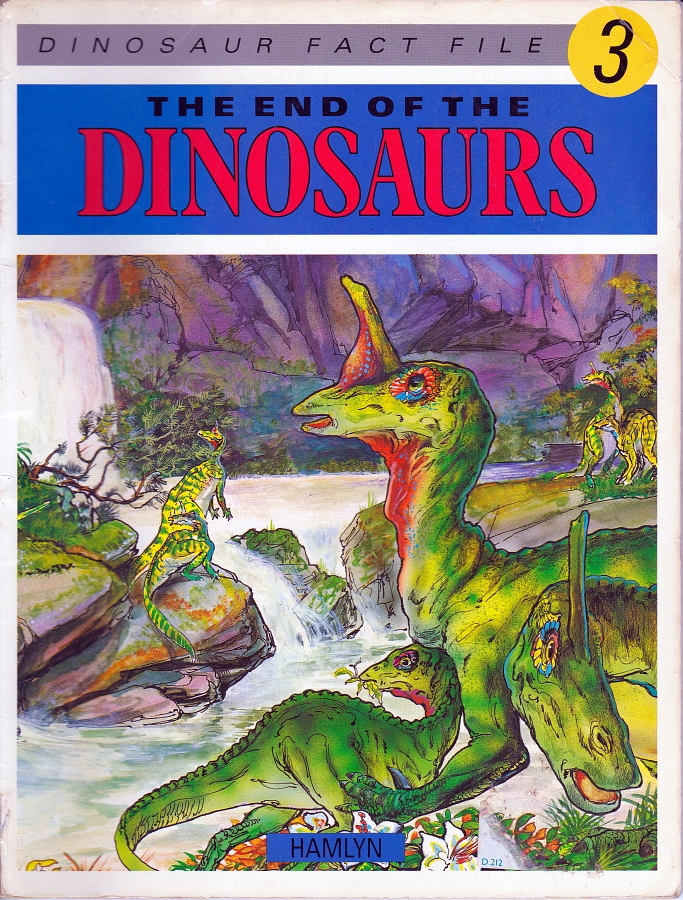
…For it was John Bindon, who would later go on to illustrate books authored by Peter Dodson and, of course, ‘Dodo’ Don Lessem (that’s right, isn’t it?). It’s fair to say that Bindon’s work improved dramatically between this book and Lessem’s well-known Meet the Dinosaurs books in the 2000s (which now fall within our purview, incidentally). That’s not to say his work here is bad by any means – in terms of scientific rigour, it compares quite favourably with a lot of contemporary works – but the stylistic difference is marked. The pieces here have a less refined, altogether more gnarly appearance that’s reminiscent of Stout on occasion, although the theme of this book probably contributes to that impression, as we shall see.

Most notably, a lot of the illustrations in this book feature dinosaurs that are supposed to look unhealthy and half-starved because of, you know, that apocalyptic disaster that killed ’em all off. An exception would be the above piece, in which a tyrannosaur is shown attacking a hadrosaur in a pre-extinction-event world. Apart from the rather sunken-in head (which was just how almost everyone was depicting them at the time), the theropod is a suitably chunky, hefty-looking beast. The hadrosaur is harder to judge as it’s mostly concealed, but it does sport a very lovely cryptic patterning, at least. There’s also plenty of dynamism in the scene, with both animals kicking up clouds of dust as they lunge forward and, in the hadrosaur’s case, crash into the ground.

But never mind all that excitement – bring on the scenes of agonising suffering and death in the wake of ecological collapse! Although the book outlines a number of possible extinction scenarios (back before everyone agreed that it was the asteroid wot did it), the above piece doesn’t relate to any in particular – it’s more of a ‘generic dusty aftermath’ scene. In fact, given the red-orange dusty fog enveloping the landscape, it rather reminds me of the Rite of Spring segment in Fantasia. The emaciated hadrosaur wandering among a wasteland littered with dead trees and dinosaur corpses is horrible enough, but don’t worry, it gets uglier and gnarlier.

Emaciated animals are one thing, but horribly diseased creatures with ragged flesh hanging from their frames are quite another. Here, a Tyrannosaurus,“weakened by hunger…giving in to disease” with “gums that were cracked and bleeding” encounters a Styracosaurus in equally bad shape. As it tries to head over to this potential prey, its knees buckle and it slams into the ground, never to rise again. Grim. Bindon’s depiction of the Tyrannosaurus here, in particular, is like something out of a horror movie; I can imagine a few dinosaur-loving children being rather disquieted by this back in the day. And yes, Tyrannosaurus and Styracosaurus didn’t quite meet in real life, but never mind. Soak in the atmosphere! It rather reminds me of Stout’s depictions of diseased dinosaurs, which were novel and inventive for the time (not just his ’80s works that featured alarmingly shrinkwrapped creatures that looked a bit diseased, but weren’t intended to be).

A modern reader might intuit the wintery scene above as representing the post-asteroid ‘nuclear winter’, but it’s actually used to illustrate a separate ‘dramatic freezing climate change’ scenario, the likelihood of which is then examined by O’Neill. The asteroid scenario comes next, opening with a vivid description of a Hypacrosaurus watching the bolide streak through the sky, complimented by the above illustration. Again, it’s pleasing to see Bindon depict a mixed hadrosaur herd with individuals of varying ages and crest shapes shown. The vibrant colours of the Hypacrosaurus are also very pleasing, with the glowing orange head crest of the individual in the foreground peculiarly mirroring the asteroid opposite.
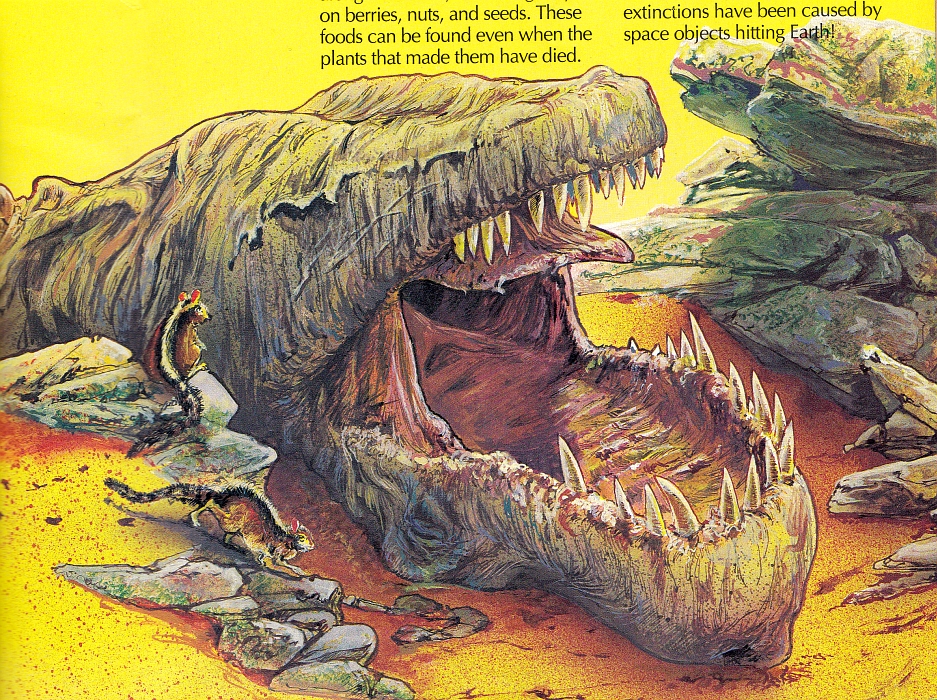
Over on the next page, we’re treated to the especially cool-looking, well-detailed, slightly dessicated head of a tyrannosaur, lying upside-down where it fell and surrounded by the little furry gits that would go on to inherit the Earth (or at least, come to eventually kid themselves that they owned the place). It is, as they used to say back in ’89, totally rad. Stick it on an oversized t-shirt (and don’t start complaining that the palate isn’t quite right, or else).
 After examining the asteroid impact scenario, O’Neill considers how long some dinosaurs might have managed to cling on following the disaster. Naturally, it seems logical that small carnivores and generalists survived longer than their giant neighbours that had to eat the equivalent of 7 horses each day to survive, or whatever. Bindon provides an illustration of a dromaeosaur that totally isn’t Velociraptor hungrily eyeing up a cute little stripy fellow in a bandit mask for lunch. Interesting details include the fact that Bindon opts to give the dromaeosaur a ridge over its eye, rather than a Paulian ‘hornlet’, which indicates that he was observing his references quite closely.
O’Neill also mentions the controversy over dinosaur fossils that appeared in formations from after the K/Pg event. As far as I’m aware these have long since been dismissed as reworked, but the question of whether or not the dinosaurs really did vanish in the blink of an eye or died out gradually leads us to…

Dino-pandemic! Clearly O’Neill had been reading this book by a guy named Bakker, and he said the dinosaurs died of a bunch of diseases. In this scenario, continental drift leads to climactic and sea level changes and new land bridges forming, with dinosaur groups that have been separated for millions of years suddenly encountering each other. They then rapidly spread diseases that are novel, and deadly, to one side or the other. Bindon’s illustration for this scenario contrasts greatly with the others in that the world around the rather haggard-looking, diseased Triceratops remains lush and green. More than that, there are plants in full flower all over the place! The foliage here is quite glorious, but the Triceratops is shown with deeply wrinkled, weathered skin on its face, its eyes indistinct. It’s quite an effective depiction of an animal at the end of its rope.

And finally…it’s back to the rusty red dustbowl. I love the leathery, finely wrinkled look of the theropod’s feet in this scene, in which the viewer notably takes on the perspective of one of the rat-like animals going “about their business with courage” while dinosaur corpses pile up around them. In doing so, the link is effectively made between you, the reader, and the furry little survivors. Horrifying as this scene might be, had this event not happened, it’s unlikely any of us would be here. And then the universe would never have known any erroneous depictions of long-dead reptiles with cock-‘n’-balls headgear. For that, let us be thankful.














 English (US) ·
 French (CA) ·